 Indietro
Chapter 29: Plant Diversity I – How Plants Colonized Land
Guida di studio - Note intelligenti
 Appunti personalizzati basati sui tuoi materiali, ampliati con definizioni chiave, esempi e contesto.
Plant Evolution and the Conquest of Land
Major Events in the History of Life
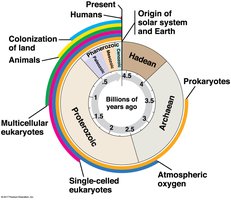
The colonization of land by plants was a pivotal event in Earth's history, enabling the development of terrestrial ecosystems. The timeline of life on Earth highlights the emergence of key groups and innovations.
Origin of Life: Prokaryotes appeared first, followed by atmospheric oxygen, single-celled eukaryotes, multicellular eukaryotes, and eventually land plants and animals.
Colonization of Land: Plants were among the first organisms to colonize terrestrial environments, paving the way for animal life.
Origin and Diversification of Land Plants
Phylogeny of Land Plants
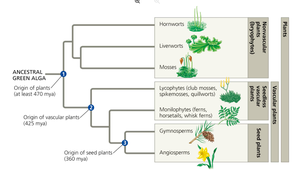
Land plants evolved from green algal ancestors, specifically a group called charophytes. The evolutionary tree shows the relationships among major plant groups and their algal relatives.
Ancestral Green Alga: The common ancestor of all plants and green algae.
Nonvascular Plants (Bryophytes): Includes hornworts, liverworts, and mosses.
Vascular Plants: Lycophytes, monilophytes (ferns and relatives), gymnosperms, and angiosperms.
Key Innovations: Vascular tissue, seeds, and flowers mark major evolutionary steps.
Closest Relatives of Land Plants
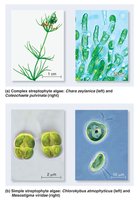
Charophytes are the closest living relatives of land plants, sharing several key features:
Photosynthetic Pigments: Chlorophyll a & b, and β-carotene.
Cellulose-rich Cell Walls
Structure of Flagellated Sperm
Similarities in Cell Division
Key Features and Adaptations of Land Plants
Distinctive Features of Land Plants
Multicellularity: All land plants are multicellular eukaryotes.
Plastids: Cells contain plastids for photosynthesis.
Adaptations for Terrestrial Life: Specialized structures and life cycles to survive on land.
Apical Meristems
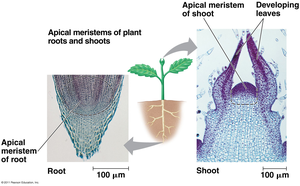
Land plants grow from regions called apical meristems, which are found at the tips of roots and shoots. These regions allow for continuous growth and the formation of specialized tissues and organs.
Apical Meristems: Regions of active cell division at plant tips.
Specialized Tissues: Enable the development of complex plant bodies above and below ground.
Reproductive Adaptations
Land plants have evolved reproductive features to survive in terrestrial environments:
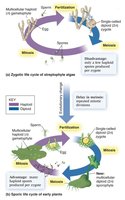
Alternation of Generations: Life cycle alternates between multicellular haploid (gametophyte) and diploid (sporophyte) stages.
Desiccation-Resistant Spores: Spores are produced in sporangia and have tough walls to resist drying out.
Embryo Protection: Embryos are retained and nourished by maternal tissue.
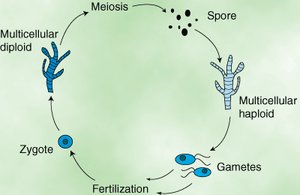
Life Cycles: Zygotic vs. Sporic
Charophytes display a zygotic life cycle, while land plants have a sporic life cycle (alternation of generations):
Zygotic Life Cycle: Only the zygote is diploid; all other stages are haploid.
Sporic Life Cycle: Both multicellular haploid (gametophyte) and diploid (sporophyte) generations exist.
Adaptations to Reduce Water Loss
To survive on land, plants evolved several adaptations to minimize water loss:
Waxy Cuticle: Covers aerial parts, reducing water loss and pathogen attack.
Stomata: Pores that regulate gas exchange and water loss.
Major Groups of Land Plants
Bryophytes: Nonvascular Plants
Bryophytes include mosses, liverworts, and hornworts. They are small, nonvascular plants that thrive in moist environments.
Dominant Gametophyte: The gametophyte is the main, photosynthetic stage.
Sporophyte Dependent: The sporophyte is small and dependent on the gametophyte for nutrition.
Reproduction Requires Water: Sperm must swim to the egg.
Vascular Plants
Vascular plants possess specialized tissues (xylem and phloem) for transporting water, nutrients, and organic molecules. This adaptation allowed them to grow larger and colonize diverse terrestrial habitats.
Xylem: Conducts water and minerals from roots to shoots.
Phloem: Distributes sugars and organic products throughout the plant.
Lignin: Strengthens cell walls, providing structural support.
Roots and Leaves: Roots anchor plants and absorb water/nutrients; leaves increase surface area for photosynthesis.
Seedless Vascular Plants: Lycophytes and Monilophytes
Seedless vascular plants include lycophytes (club mosses) and monilophytes (ferns and relatives). They have a dominant sporophyte generation and reproduce via spores.
Lycophytes: Have microphylls (leaves with a single vein).
Monilophytes: Have megaphylls (leaves with branched veins).
Flagellated Sperm: Require water for fertilization.
Ecological Impact of Early Land Plants
Transformation of Earth's Ecology
Early land plants, especially bryophytes and seedless vascular plants, had a profound impact on Earth's atmosphere and ecosystems:
Decay-Resistant Tissues: Slowed decomposition, leading to organic carbon burial and reduced atmospheric CO2.
Soil Formation: Helped enrich and stabilize soils.
Global Cooling: Large forests during the Carboniferous period reduced CO2 and contributed to global cooling; dead plants became coal deposits.
Weathering: Roots secreted acids that broke down rocks, further reducing CO2 by forming carbonates.
Summary Table: Major Plant Groups and Key Features
Group | Vascular Tissue | Dominant Generation | Seeds | Flowers |
|---|---|---|---|---|
Bryophytes | No | Gametophyte | No | No |
Lycophytes & Monilophytes | Yes | Sporophyte | No | No |
Gymnosperms | Yes | Sporophyte | Yes | No |
Angiosperms | Yes | Sporophyte | Yes | Yes |
Key Terms and Concepts
Alternation of Generations: Life cycle with multicellular haploid and diploid stages.
Gametophyte: Haploid, gamete-producing generation.
Sporophyte: Diploid, spore-producing generation.
Apical Meristem: Region of cell division at plant tips.
Vascular Tissue: Xylem and phloem for transport.
Lignin: Structural polymer in cell walls.
Cuticle: Waxy covering to prevent water loss.
Stomata: Pores for gas exchange.
