 Indietro
Chapter 3: Water and Life – Properties and Biological Importance
Guida di studio - Note intelligenti
 Appunti personalizzati basati sui tuoi materiali, ampliati con definizioni chiave, esempi e contesto.
Water: The Molecule That Supports All of Life
Introduction to Water's Biological Significance
Water is the most abundant molecule in living organisms and covers the majority of Earth's surface. Its unique physical and chemical properties are essential for life. Water is the only common substance that exists naturally in all three states of matter—solid, liquid, and gas—on Earth. The structure and chemical characteristics of water enable these remarkable properties.
Emergent Properties of Water
Polarity and Hydrogen Bonding
The emergent properties of water arise from its molecular polarity and the resulting hydrogen bonding. A water molecule consists of one oxygen atom covalently bonded to two hydrogen atoms. The electrons are shared unequally, making water a polar molecule with partial positive (δ+) charges on the hydrogens and a partial negative (δ−) charge on the oxygen. This polarity allows water molecules to form hydrogen bonds with each other, organizing them into a higher level of structural order.
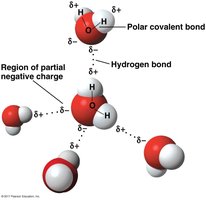
Four Emergent Properties of Water That Support Life
A. Cohesion and Adhesion
Cohesion refers to the attraction between water molecules due to hydrogen bonding. This property enables water to move upward against gravity in plants, a process essential for transporting nutrients. Adhesion is the attraction between water molecules and other substances, such as plant cell walls, which helps counteract gravity's pull.
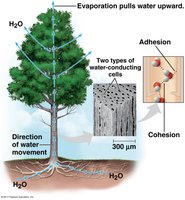
Surface Tension
Surface tension is a measure of how difficult it is to stretch or break the surface of a liquid. Water's high surface tension, resulting from cohesive hydrogen bonds, allows small organisms like water striders to walk on its surface.

B. Moderation of Temperature by Water
Water moderates Earth's climate by absorbing heat from warmer air and releasing it to cooler air. It can absorb or release large amounts of heat with only slight changes in its own temperature, stabilizing environmental and organismal temperatures. For example, large bodies of water like lakes and oceans buffer temperature fluctuations, making coastal climates milder.

Temperature, Heat, and Specific Heat
Kinetic energy: Energy of motion; faster-moving molecules have more kinetic energy.
Thermal energy: Total kinetic energy of all molecules in a body of matter; depends on volume.
Temperature: Average kinetic energy of molecules; independent of volume.
Heat: Transfer of thermal energy from one body to another.
Specific heat: Amount of heat required to change 1 g of a substance by 1°C. Water's specific heat is 1 cal/(g·°C), much higher than most substances, due to hydrogen bonding.
Because of its high specific heat, water stabilizes temperatures in organisms and environments, making life possible.
Evaporative Cooling
Evaporation is the transformation of a liquid to a gas. As water evaporates, the remaining surface cools—a process called evaporative cooling. This effect helps organisms regulate temperature (e.g., sweating in humans) and stabilizes temperatures in aquatic environments.

C. Expansion Upon Freezing
Unlike most substances, water expands as it freezes. Ice is less dense than liquid water and floats. This property is due to the stable hydrogen bonds formed at low temperatures, which keep water molecules further apart in ice than in liquid form. If ice sank, aquatic life would be impossible in cold climates, as bodies of water would freeze solid from the bottom up.

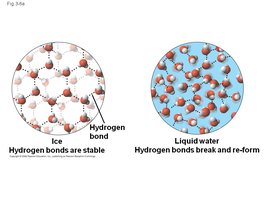
D. Water: The Solvent of Life
Water is known as the "universal solvent" because its polarity allows it to dissolve a wide variety of substances. In a solution, the solvent is the dissolving agent (water in aqueous solutions), and the solute is the substance dissolved (e.g., salt or sugar). Water forms hydration shells around ions and can also dissolve polar molecules, making it essential for biochemical reactions.
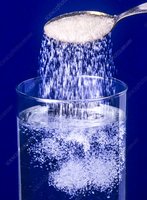
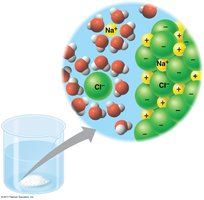
Even large molecules like proteins can dissolve in water if they have ionic or polar regions, allowing for complex biochemical processes in cells.
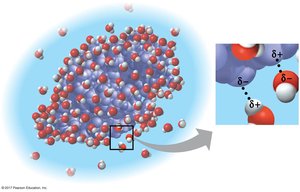
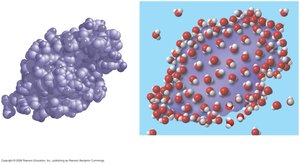
Hydrophilic and Hydrophobic Substances
Hydrophilic: Substances with an affinity for water (e.g., salts, sugars).
Hydrophobic: Substances that repel water, usually nonpolar (e.g., oils).

Solute Concentration in Aqueous Solutions
Most biological reactions occur in aqueous solutions. Understanding solute concentration is essential for studying these reactions. Key concepts include:
Molecular mass: Sum of the masses of all atoms in a molecule (e.g., sucrose = 342 daltons).
Mole (mol): 6.02 × 10²³ molecules (Avogadro’s number).
Molarity (M): Number of moles of solute per liter of solution.
For example, a 1 M solution of sucrose contains 342 g of sucrose dissolved in 1 liter of water. Molarity is the standard unit for expressing concentration in biology and chemistry.
