 Indietro
Chapter 30 Plant Reproduction and Life Cycles Study Guide
Guida di studio - Note intelligenti
 Appunti personalizzati basati sui tuoi materiali, ampliati con definizioni chiave, esempi e contesto.
Q1. Compare the following terms: gymnosperms and angiosperms
Background
Topic: Plant Diversity and Evolution
This question tests your understanding of the two major groups of seed plants and their distinguishing features.
Key Terms:
Gymnosperms: Seed plants with "naked" seeds, typically not enclosed in fruit.
Angiosperms: Seed plants whose seeds are enclosed within a fruit (flowering plants).
Step-by-Step Guidance
Identify the main reproductive structures of gymnosperms and angiosperms.
Consider how seeds are protected in each group.
Think about the presence or absence of flowers and fruits.
List examples of each group (e.g., pine trees for gymnosperms, roses for angiosperms).
Try solving on your own before revealing the answer!
Final Answer:
Gymnosperms produce seeds that are not enclosed by fruit, often found in cones (e.g., pine, fir). Angiosperms produce seeds within fruits, and have flowers as reproductive structures (e.g., apple tree, sunflower).
Q2. Compare the following terms: ovule and ovary
Background
Topic: Flower Structure and Reproduction
This question tests your knowledge of the anatomy of a flower and the location/function of reproductive structures.
Key Terms:
Ovule: The structure within the ovary that develops into a seed after fertilization.
Ovary: The part of the carpel that contains ovules and develops into fruit.
Step-by-Step Guidance
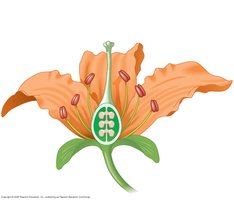
Locate the ovary and ovule in a flower diagram.
Describe the function of each structure in reproduction.
Explain what happens to each after fertilization.
Try solving on your own before revealing the answer!
Final Answer:
The ovule is the structure inside the ovary that becomes the seed after fertilization. The ovary is the larger structure that contains ovules and matures into the fruit.
Q3. Compare the following terms: megaspore and microspore
Background
Topic: Plant Reproductive Cells
This question tests your understanding of the types of spores produced in seed plants and their roles in the life cycle.
Key Terms:
Megaspore: A spore that develops into a female gametophyte.
Microspore: A spore that develops into a male gametophyte.
Step-by-Step Guidance
Recall where megaspores and microspores are produced (megasporangium and microsporangium).
Identify which gametophyte each spore type gives rise to.
Think about the ploidy of these spores.
Try solving on your own before revealing the answer!
Final Answer:
Megaspores develop into female gametophytes, while microspores develop into male gametophytes (pollen grains).
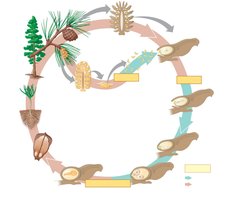
Q4. Label the diagram with sporophyte, gametophyte, meiosis, mitosis, fertilization, megasporangium, megasporocyte, megaspore, egg, microsporangium, microsporocyte, pollen grain, sperm, zygote, archegonium and gametophyte. Which structures are haploid? Which are diploid?
Background
Topic: Plant Life Cycle (Alternation of Generations)
This question tests your ability to identify stages and structures in the plant life cycle, and distinguish between haploid and diploid phases.
Key Terms:
Sporophyte: Diploid, produces spores by meiosis.
Gametophyte: Haploid, produces gametes by mitosis.
Meiosis: Cell division that produces haploid spores.
Mitosis: Cell division for growth or gamete production.
Fertilization: Fusion of gametes to form a diploid zygote.
Step-by-Step Guidance
Examine the life cycle diagram and identify the main stages (sporophyte, gametophyte).
Label where meiosis and mitosis occur in the cycle.
Identify which structures are haploid (n) and which are diploid (2n).
Locate and label the reproductive structures (megasporangium, microsporangium, etc.).
Mark the transition points: meiosis produces spores, fertilization produces zygote.
Try solving on your own before revealing the answer!
Final Answer:
Diploid structures: sporophyte, megasporangium, microsporangium, megasporocyte, microsporocyte, zygote. Haploid structures: gametophyte, megaspore, microspore, egg, sperm, pollen grain, archegonium. Meiosis occurs in sporocytes, mitosis in gametophytes, fertilization forms the zygote.
Q5. Describe the process of embryo sac development starting from megasporangium.
Background
Topic: Female Gametophyte Development in Angiosperms
This question tests your understanding of how the embryo sac (female gametophyte) forms in flowering plants.
Key Terms:
Megasporangium: Tissue where megaspores are produced.
Megasporocyte: Cell that undergoes meiosis to produce megaspores.
Embryo sac: Female gametophyte containing egg cell and other cells.
Step-by-Step Guidance
Start with the megasporangium in the ovule.
Identify the megasporocyte and its role in meiosis.
Describe the formation of four megaspores, and note that only one survives.
Explain how the surviving megaspore undergoes mitosis to form the embryo sac.
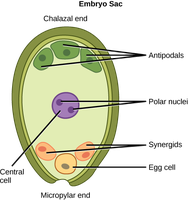
List the cells present in the mature embryo sac (egg, synergids, antipodals, central cell).
Try solving on your own before revealing the answer!
Final Answer:
The megasporocyte in the megasporangium undergoes meiosis to produce four megaspores; one survives and divides by mitosis to form the embryo sac, which contains seven cells: one egg, two synergids, three antipodals, and a central cell with two polar nuclei.
Q6. Describe the process of pollen sac development from microsporangium to pollen grain.
Background
Topic: Male Gametophyte Development in Angiosperms
This question tests your understanding of how pollen grains (male gametophytes) are formed.
Key Terms:
Microsporangium: Structure where microspores are produced.
Microsporocyte: Cell that undergoes meiosis to produce microspores.
Pollen grain: Male gametophyte containing sperm cells.
Step-by-Step Guidance
Begin with the microsporangium in the anther.
Identify the microsporocyte and its role in meiosis.
Describe the formation of four microspores from each microsporocyte.
Explain how each microspore develops into a pollen grain through mitosis.
Note the structure of the mature pollen grain (generative cell and tube cell).
Try solving on your own before revealing the answer!
Final Answer:
Microsporocytes in the microsporangium undergo meiosis to produce microspores, which then divide by mitosis to form pollen grains. Each pollen grain contains a tube cell and a generative cell, which will produce sperm.
Q7. Describe the process of double fertilization. List the names and functions of the 7 cells inside an embryo sac.
Background
Topic: Angiosperm Fertilization
This question tests your understanding of the unique fertilization process in flowering plants and the structure of the embryo sac.
Key Terms:
Double fertilization: Process where one sperm fertilizes the egg and another fuses with the central cell.
Embryo sac: Contains seven cells: egg, synergids, antipodals, central cell.
Step-by-Step Guidance
Recall the structure of the embryo sac and the location of each cell.
Describe how the pollen tube delivers two sperm cells to the embryo sac.
Explain the fate of each sperm cell: one fertilizes the egg, the other fuses with the central cell.
List the seven cells: egg cell, two synergids, three antipodals, central cell (with two polar nuclei).
Try solving on your own before revealing the answer!
Final Answer:
Double fertilization involves one sperm fertilizing the egg (forming the zygote) and the other fusing with the central cell (forming the triploid endosperm). The embryo sac contains: 1 egg cell (becomes embryo), 2 synergids (help guide sperm), 3 antipodals (function unclear), and 1 central cell (forms endosperm).
Q8. Explain two functions of fruits.
Background
Topic: Fruit Structure and Function
This question tests your understanding of the role of fruits in plant reproduction and survival.
Key Terms:
Fruit: Mature ovary that contains seeds.
Seed dispersal: Movement of seeds away from the parent plant.
Step-by-Step Guidance
Identify how fruits protect seeds.
Describe how fruits aid in seed dispersal (e.g., by animals, wind, water).
Think about the nutritional value of fruits for animals and its ecological significance.
Try solving on your own before revealing the answer!
Final Answer:
Fruits protect seeds from damage and desiccation, and facilitate seed dispersal by attracting animals or using other mechanisms (wind, water). This increases the chances of successful germination away from the parent plant.
Why is seed considered an important evolution of plants? List three reasons, give detailed description.
2. List three advantages of seeds over spores
3. Describe the alternation of generations in a flowering plant’s life cycle. Pay attention to the sequence of the following events/development: diploid zygote, fertilization, gametes, gametophyte, meiosis, sporophyte.
4. Describe the process of embryo sac development starting from megasporangium.
5. Describe the process of pollen sac development from microsporangium to pollen grain.
6. Describe the process of double fertilization. List the names and functions of the 7 cells inside an embryo sac.
7. Explain two functions of fruit
