 Indietro
Chapter 4: Nucleic Acids and an RNA World – Study Notes
Guida di studio - Note intelligenti
 Appunti personalizzati basati sui tuoi materiali, ampliati con definizioni chiave, esempi e contesto.
Chapter 4: Nucleic Acids and an RNA World
Introduction to Nucleic Acids and the RNA World
Nucleic acids are fundamental biomolecules that store and transmit genetic information. The RNA world hypothesis proposes that early life forms relied on RNA for both information storage and catalytic activity, preceding the evolution of DNA and proteins.
Chemical evolution led to the production of molecules capable of self-replication.
DNA stores genetic information and is replicated with the help of proteins.
RNA world hypothesis: Suggests a period in evolutionary history when RNA both stored genetic information and catalyzed its own replication.
Once self-replicating molecules evolved, biological evolution began.
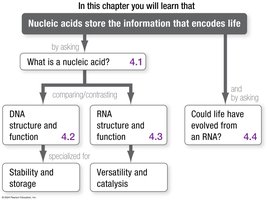
4.1 What is a Nucleic Acid?
Nucleotide Structure
Nucleic acids are polymers made of nucleotide monomers. Each nucleotide consists of three components:
Phosphate group
Five-carbon sugar (ribose in RNA, deoxyribose in DNA)
Nitrogenous base (purines or pyrimidines)
The phosphate group and nitrogenous base are bonded to the sugar molecule.
Types of Nucleotides
Ribonucleotides: Monomers of RNA; contain ribose sugar with an -OH group bonded to the 2' carbon.
Deoxyribonucleotides: Monomers of DNA; contain deoxyribose sugar with an H instead of -OH at the 2' carbon.
Both sugars have a phosphate group bonded to the 5' carbon.
Nitrogenous Bases
Purines: Two rings, nine atoms. Includes Adenine (A) and Guanine (G).
Pyrimidines: One ring, six atoms. Includes Cytosine (C), Uracil (U) (RNA only), and Thymine (T) (DNA only).
Mnemonic: "C U T of Py" for pyrimidines.
4.2 DNA Structure and Function
Polymerization of Nucleic Acids
Nucleic acids polymerize via condensation reactions, forming phosphodiester linkages:
Bond between phosphate group on 5' carbon of one nucleotide and hydroxyl group on 3' carbon of another.
Produces a sugar–phosphate backbone.
Directionality of DNA and RNA Strands
One end has an unlinked 5' phosphate group; the other has an unlinked 3' hydroxyl group.
Primary structure is written as a sequence of bases (e.g., ATCG).
Energy Requirement for Polymerization
Polymerization requires energy, often provided by nucleoside triphosphates (e.g., ATP).
Energy is released when activated nucleotides polymerize, making the reaction spontaneous.
DNA Secondary Structure
Early research revealed clues to DNA's secondary structure:
DNA polymerized through phosphate linkages.
Equal numbers of purines and pyrimidines.
X-ray crystallography predicted a helical structure.
Antiparallel Double Helix
Two DNA strands are held together by hydrogen bonds between complementary bases (A-T, C-G).
Strands are antiparallel and twist to form a double helix.
Sugar–phosphate backbone faces the exterior; nitrogenous bases face the interior.
Major and minor grooves are present in the helix.
DNA Tertiary Structure
DNA forms compact three-dimensional structures (supercoils, wrapping around histones).
Allows long DNA molecules to fit inside cells.
DNA as an Information-Containing Molecule
Stores information for growth and reproduction.
Sequence of bases encodes genetic information.
DNA Replication
Strands separate by breaking hydrogen bonds.
Free nucleotides form hydrogen bonds with complementary bases on the template strand.
Phosphodiester linkages form to create a new complementary strand.
Produces two identical daughter molecules.
Stability of the DNA Double Helix
Held together by phosphodiester linkages, hydrogen bonds, and hydrophobic interactions.
Stable and resistant to degradation.
Stability is key for reliable information storage.
4.3 RNA Structure and Function
Primary Structure of RNA
Four types of nitrogenous bases (A, U, G, C) extend from the sugar–phosphate backbone.
RNA contains ribose and uracil (instead of deoxyribose and thymine).
RNA is less stable than DNA due to the reactive -OH group on ribose.
Secondary Structure of RNA
Results from complementary base pairing (A-U, G-C) within the same strand.
Forms hairpin structures where bases align with complementary bases on another part of the strand.
Strands are antiparallel in these regions.
Tertiary Structure of RNA
Secondary structures fold into complex three-dimensional shapes.
RNA is more diverse in size, shape, and reactivity than DNA.
Comparison of DNA and RNA Structure
Feature | DNA | RNA |
|---|---|---|
Sugar | Deoxyribose | Ribose |
Base | A, T, C, G | A, U, C, G |
Strand | Double-stranded (usually) | Single-stranded (usually) |
Stability | Stable | Less stable |
Function | Information storage | Information transfer, catalysis |
RNA's Versatility
Folds into complex shapes, allowing diverse functions.
Acts as an intermediate (mRNA) between DNA and protein.
Regulates gene expression and catalyzes reactions (ribozymes).
RNA as a Catalytic Molecule
Ribozymes: RNA molecules that catalyze chemical reactions.
Three-dimensional structure is essential for catalytic activity.
Can catalyze formation of phosphodiester bonds, enabling self-replication.
4.4 In Search of the First Life-Form
The RNA World Hypothesis
The theory of chemical evolution suggests life began as a naked self-replicator, a molecule capable of copying itself without a membrane.
The first living molecule needed to provide a template and polymerize monomers into a copy.
RNA is capable of both templating and catalysis.
Most researchers propose the first life-form was made of RNA.
Experimental Evidence for the RNA World
Studies have isolated ribozymes capable of catalyzing RNA replication and nucleotide addition.
Modern ribozymes are essential for protein production, supporting the idea that RNA preceded proteins.
Evolution of protein enzymes likely ended the RNA world.
Characteristics of Life Established in the RNA World
Information processing
Replication of hereditary information
Evolution by random changes in nucleic acids
Human Angle: Research and Applications
Modeling Evolutionary Changes in Ribozymes
Algorithms can model the effect of random evolutionary changes in ribozymes.
Key information for such models includes sequence, structure, and catalytic activity.
Catalytic activities necessary for ribozyme replication include template-directed polymerization and nucleotide addition.
Multiple Choice Example
Which molecule can both catalyze chemical reactions and carry information to copy itself? RNA
Additional info: These notes expand on brief points with academic context, definitions, and examples to ensure completeness and clarity for exam preparation.
