 Indietro
Chapter 4: Nucleic Acids and an RNA World - Study Notes
Guida di studio - Note intelligenti
 Appunti personalizzati basati sui tuoi materiali, ampliati con definizioni chiave, esempi e contesto.
Chapter 4: Nucleic Acids and an RNA World
Introduction to Nucleic Acids and the RNA World
Nucleic acids are fundamental molecules that store and transmit genetic information in all living organisms. The RNA world hypothesis proposes that early life forms used RNA both to store genetic information and to catalyze chemical reactions necessary for replication. Understanding nucleic acids is essential for grasping the molecular basis of heredity and evolution.
Chemical evolution led to the production of molecules capable of self-replication.
DNA (Deoxyribonucleic acid) stores genetic information and is replicated with the help of proteins.
RNA world hypothesis: Suggests a period in evolutionary history when RNA served as both genetic material and catalyst.
Once self-replicating molecules evolved, biological evolution began.
What is a Nucleic Acid?
Nucleotide Structure
Nucleic acids are polymers made up of nucleotide monomers. Each nucleotide consists of three components:
Phosphate group
Five-carbon sugar (either ribose or deoxyribose)
Nitrogenous base (purine or pyrimidine)
The phosphate group and nitrogenous base are bonded to the sugar molecule.
Types of Nucleotides
Ribonucleotides: Monomers of RNA; contain ribose sugar with a hydroxyl group (-OH) bonded to the 2' carbon.
Deoxyribonucleotides: Monomers of DNA; contain deoxyribose sugar, which lacks an oxygen atom at the 2' carbon (has H instead).
Both sugars have a hydroxyl group bonded to the 3' carbon.
Nitrogenous Bases
Purines: Two-ring structure, nine atoms. Includes Adenine (A) and Guanine (G).
Pyrimidines: One-ring structure, six atoms. Includes Cytosine (C), Uracil (U) (only in RNA), and Thymine (T) (only in DNA).
Mnemonic: "C U T of Py" for pyrimidines.
Formation and Structure of Nucleic Acids
Polymerization of Nucleotides
Nucleic acids are formed by condensation reactions, creating phosphodiester linkages between the phosphate group on the 5' carbon of one nucleotide and the hydroxyl group on the 3' carbon of another.
Polymerization requires energy, often provided by nucleoside triphosphates (e.g., ATP).
Energy is released when activated nucleotides polymerize, making the reaction spontaneous.
Directionality of Nucleic Acid Strands
The sugar–phosphate backbone of nucleic acids is directional:
One end has an unlinked 5' phosphate group.
The other end has an unlinked 3' hydroxyl group.
Primary structure is written as a sequence of bases (e.g., 5'-ATCG-3').
DNA Structure and Function
Secondary Structure of DNA
DNA's secondary structure is a double helix formed by two antiparallel strands held together by hydrogen bonds between complementary bases:
Watson–Crick base pairing: A with T, C with G.
Sugar–phosphate backbone faces the exterior; nitrogenous bases face the interior.
Hydrophobic interactions and van der Waals forces stabilize the helix.
Major and minor grooves are present in the double helix.
Tertiary Structure of DNA
DNA can form more compact three-dimensional structures:
Supercoiling occurs when DNA is wound too tightly or loosely.
DNA wraps around histone proteins to form nucleosomes.
DNA as an Information-Containing Molecule
DNA stores information required for growth and reproduction. The sequence of bases encodes genetic instructions.
Replication involves separation of strands, pairing with complementary nucleotides, and formation of new phosphodiester linkages.
Complementary base pairing ensures accurate copying.
Stability of the DNA Double Helix
Double helix is highly stable due to phosphodiester linkages, hydrogen bonds, and hydrophobic interactions.
Stability is crucial for reliable information storage.
No evidence supports DNA as the first life form; RNA is considered more likely.
RNA Structure and Function
Primary and Secondary Structure of RNA
RNA differs from DNA in several ways:
Contains ribose sugar and uracil instead of thymine.
Hydroxyl group on ribose makes RNA more reactive and less stable.
Secondary structure forms via complementary base pairing (A with U, G with C) within the same strand, creating hairpin loops.
Tertiary Structure of RNA
Secondary structures fold into complex tertiary shapes.
RNA is more diverse in size, shape, and reactivity than DNA.
Comparison of DNA and RNA Structure
Feature | DNA | RNA |
|---|---|---|
Sugar | Deoxyribose | Ribose |
Base | A, T, C, G | A, U, C, G |
Strands | Double (usually) | Single (usually) |
Stability | Stable | Less stable |
Function | Information storage | Versatility, catalysis |
Tertiary Structure | Supercoiling, nucleosomes | Complex folding |
RNA's Versatility
RNA can fold into complex three-dimensional shapes.
Acts as an intermediate (mRNA) between DNA and protein.
Regulates gene expression and catalyzes reactions (ribozymes).
RNA as a Catalytic Molecule
Ribozymes: RNA molecules with catalytic activity.
Three-dimensional structure is essential for catalysis.
Can catalyze formation of phosphodiester bonds, enabling self-replication.
Origin of Life and the RNA World
Search for the First Life-Form
The theory of chemical evolution suggests life began as a naked self-replicator, a molecule capable of copying itself without a membrane.
First living molecule needed to provide a template and polymerize monomers into a copy.
RNA is capable of both templating and catalysis.
Most researchers propose the first life-form was made of RNA.
Experimental Evidence for the RNA World
Studies have isolated ribozymes capable of catalyzing RNA replication and nucleotide addition.
Modern ribozymes are essential for protein production, supporting the idea that RNA preceded proteins.
Evolution of protein enzymes likely ended the RNA world.
Characteristics of Life Established in the RNA World
Information processing
Replication of hereditary information
Evolution by random changes in nucleic acids
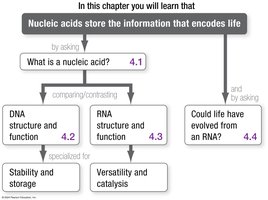
Additional info: The chapter roadmap (image_3) visually summarizes the logical flow of topics: nucleic acids as information storage, DNA and RNA structure/function, and the evolutionary significance of RNA.
