 Indietro
Chapter 4: Nucleic Acids and the RNA World – Study Notes
Guida di studio - Note intelligenti
 Appunti personalizzati basati sui tuoi materiali, ampliati con definizioni chiave, esempi e contesto.
Chapter 4: Nucleic Acids and the RNA World
4.1 What Is a Nucleic Acid?
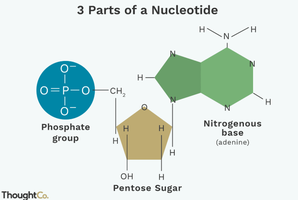
Nucleic acids are essential biological macromolecules that store and transmit genetic information. They are polymers made up of monomers called nucleotides. Each nucleotide consists of three main components: a phosphate group, a five-carbon sugar, and a nitrogenous base.
Phosphate Group: Provides the acidic property and is involved in the formation of the backbone.
Pentose Sugar: The central component; can be ribose (in RNA) or deoxyribose (in DNA).
Nitrogenous Base: The information-carrying part; can be a purine or pyrimidine.
Monomers: Ribonucleotides (RNA) and deoxyribonucleotides (DNA).
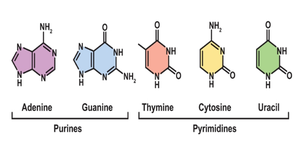
Types of Nitrogenous Bases
Nitrogenous bases are classified into two groups: purines and pyrimidines. Purines have a double-ring structure, while pyrimidines have a single-ring structure.
Purines: Adenine (A), Guanine (G)
Pyrimidines: Cytosine (C), Thymine (T, in DNA), Uracil (U, in RNA)
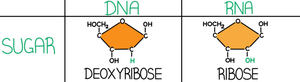
Differences Between DNA and RNA Nucleotides
The sugar component distinguishes DNA from RNA. DNA contains deoxyribose (lacking an oxygen atom at the 2' carbon), while RNA contains ribose.
DNA: Deoxyribonucleotides (A, G, C, T)
RNA: Ribonucleotides (A, G, C, U)
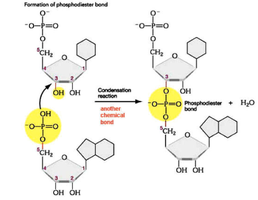
Polymerization of Nucleotides
Nucleotides polymerize via condensation reactions between the hydroxyl group on the sugar of one nucleotide and the phosphate group of another, releasing a water molecule. This forms a phosphodiester linkage, creating the sugar-phosphate backbone of nucleic acids.
Phosphodiester Bond: Connects the 5' phosphate of one nucleotide to the 3' hydroxyl of another.
Directionality: Nucleic acid strands are directional, written from 5' to 3'.
Energy Source: ATP (adenosine triphosphate) or dATP (deoxyadenosine triphosphate) provides energy for polymerization.
4.2 DNA Structure and Function
DNA's structure was elucidated through X-ray crystallography, revealing a helical, repeating structure. The two strands of DNA run antiparallel and twist together to form a double helix. The double helix is stabilized by hydrogen bonds between complementary base pairs (A-T, G-C), hydrophobic interactions, and van der Waals forces.
Antiparallel Strands: One strand runs 5' to 3', the other 3' to 5'.
Complementary Base Pairing: Purines pair with pyrimidines (A-T, G-C).
Major and Minor Grooves: Created by the twisting of the helix.
Structural Levels: Primary (sequence), Secondary (double helix), Tertiary (supercoiling), Quaternary (chromatin organization).
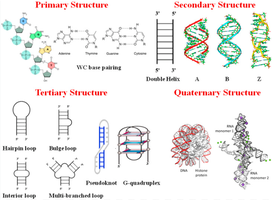
DNA is highly compacted through supercoiling and organization into chromatin, allowing it to fit within the cell nucleus. During replication, the hydrogen bonds between strands are broken, exposing the template and complementary strands for synthesis.
4.3 RNA Structure and Function
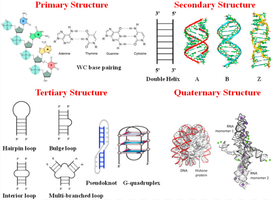
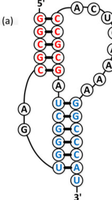
RNA, like DNA, has a primary structure consisting of four nitrogenous bases attached to a ribose sugar-phosphate backbone. However, RNA uses uracil instead of thymine. RNA's secondary structure forms through hydrogen bonding between complementary bases on the same strand, often resulting in hairpin loops.
Primary Structure: Sequence of ribonucleotides (A, G, C, U).
Secondary Structure: Hairpin loops formed by intramolecular base pairing.
Tertiary Structure: Complex folding (e.g., pseudoknots) for diverse functions.
Messenger RNA (mRNA): Carries genetic information from DNA to ribosomes for protein synthesis.
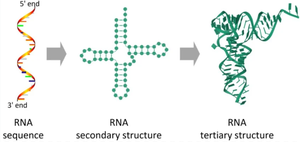
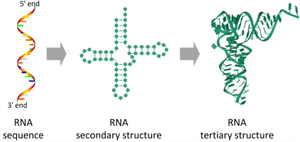
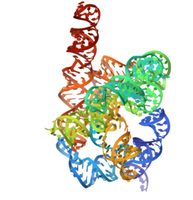
RNA molecules are highly versatile, capable of folding into complex three-dimensional shapes and catalyzing chemical reactions. These catalytic RNAs are called ribozymes, which possess active sites similar to protein enzymes.
Ribozymes: RNA molecules with enzymatic activity (e.g., Tetrahymena ribozyme).
Functions: Catalyze hydrolysis and condensation of phosphodiester linkages.
RNA Replication and the Central Dogma
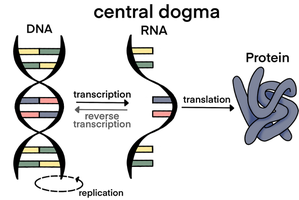
RNA replication is analogous to DNA replication, involving the synthesis of a complementary strand using the original as a template. The Central Dogma describes the flow of genetic information: DNA is transcribed into RNA, which is then translated into protein.
Transcription: DNA → RNA
Translation: RNA → Protein
Replication: DNA → DNA
Additional info: The RNA world hypothesis suggests that early life forms may have relied solely on RNA for both genetic information storage and catalysis, preceding the evolution of DNA and proteins.
