 Indietro
Chapter 4: Nucleic Acids and the RNA World – Study Notes
Guida di studio - Note intelligenti
 Appunti personalizzati basati sui tuoi materiali, ampliati con definizioni chiave, esempi e contesto.
Chapter 4: Nucleic Acids and the RNA World
Introduction to Nucleic Acids and the RNA World
Nucleic acids are fundamental biomolecules that store and transmit genetic information. The RNA world hypothesis suggests that early life forms used RNA for both information storage and catalysis before DNA and proteins evolved. Understanding nucleic acids is essential for grasping the molecular basis of life and evolution.
Chemical evolution led to molecules capable of self-replication.
DNA (Deoxyribonucleic acid) stores genetic information and is replicated using proteins.
RNA world hypothesis: RNA once served as both genetic material and catalyst.
Self-replicating molecules initiated the process of evolution.
4.1 What is a Nucleic Acid?
Structure of Nucleic Acids
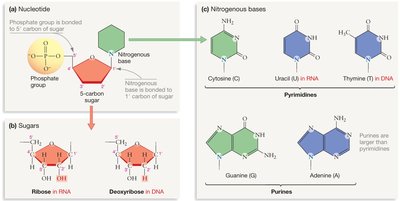
Nucleic acids are polymers made of nucleotide monomers. Each nucleotide consists of three components: a phosphate group, a five-carbon sugar, and a nitrogenous base. The phosphate group and nitrogenous base are bonded to the sugar molecule.
Nucleotide: Basic unit of nucleic acids.
Components: Phosphate group, five-carbon sugar, nitrogenous base.
Phosphate and base are attached to the sugar.

Types of Nucleotides
There are two main types of nucleotides: ribonucleotides (in RNA) and deoxyribonucleotides (in DNA). The difference lies in the sugar component.
Ribonucleotides: Contain ribose sugar; found in RNA.
Deoxyribonucleotides: Contain deoxyribose sugar (lacking an oxygen atom); found in DNA.
Both sugars have a phosphate group bonded to the 5' carbon.
Nitrogenous Bases
Nitrogenous bases are classified into purines and pyrimidines. Purines have two rings, while pyrimidines have one ring.
Purines: Adenine (A), Guanine (G) – two rings.
Pyrimidines: Cytosine (C), Uracil (U, in RNA), Thymine (T, in DNA) – one ring.
Mnemonic: "CUT of Py" for pyrimidines.
Polymerization of Nucleotides
Nucleic acids are formed by condensation reactions, creating phosphodiester linkages between nucleotides. The bond forms between the phosphate group on the 5' carbon of one nucleotide and the hydroxyl group on the 3' carbon of another.
Condensation reaction: Joins nucleotides, releasing water.
Phosphodiester linkage: Connects 5' phosphate to 3' hydroxyl.
Produces RNA or DNA polymers.

Directionality of Nucleic Acid Strands
The sugar–phosphate backbone of nucleic acids is directional, with one end having an unlinked 5' phosphate and the other an unlinked 3' hydroxyl group. The sequence of bases is written from 5' to 3'.
5' end: Unlinked phosphate group.
3' end: Unlinked hydroxyl group.
Primary structure: Sequence of bases (e.g., ATCG).

Energy Requirement for Polymerization
Polymerization of nucleic acids requires energy, which is provided by nucleoside triphosphates (activated nucleotides). Hydrolysis of these triphosphates releases energy, making the reaction spontaneous.
Nucleoside triphosphates: Activated nucleotides (e.g., ATP).
Energy released upon hydrolysis drives polymerization.

4.2 DNA Structure and Function
Secondary Structure of DNA
DNA's secondary structure is a double helix formed by two antiparallel strands. Hydrogen bonds between complementary bases (A-T, C-G) stabilize the structure. X-ray crystallography revealed the helical nature of DNA.
Antiparallel strands: Run in opposite directions.
Complementary base pairing: A-T, C-G.
Double helix: Sugar–phosphate backbone outside, bases inside.


Tertiary Structure of DNA
DNA can form more compact three-dimensional structures, such as supercoils and wrapping around histone proteins. This compaction is necessary to fit long DNA molecules into cells.
Supercoiling: DNA twists to relieve tension.
Histones: DNA wraps around these proteins for further compaction.
DNA as an Information-Containing Molecule
DNA stores genetic information in the sequence of its bases. This information is used for growth, reproduction, and heredity. The sequence of bases acts like letters in a code.
Four bases: A, T, C, G.
Sequence determines genetic information.
DNA Replication
DNA replication involves three steps: strand separation, base pairing, and polymerization. Each strand serves as a template for the formation of a new complementary strand, ensuring accurate copying of genetic information.
Strand separation: Hydrogen bonds are broken.
Base pairing: Free nucleotides pair with template strand.
Polymerization: Formation of new phosphodiester linkages.

Stability of the DNA Double Helix
The double helix is stabilized by phosphodiester linkages, hydrogen bonds, and hydrophobic interactions. This stability makes DNA an effective information-storage molecule, resistant to degradation.
Stable structure due to multiple interactions.
Functional groups participate in chemical reactions.
4.3 RNA Structure and Function
Primary Structure of RNA
RNA's primary structure consists of a sequence of four nitrogenous bases (A, U, G, C) extending from a sugar–phosphate backbone. RNA differs from DNA in several ways.
Contains ribose instead of deoxyribose.
Contains uracil instead of thymine.
Ribose is more reactive, making RNA less stable than DNA.
Secondary Structure of RNA
RNA's secondary structure arises from complementary base pairing within the same strand, forming hairpin loops. The strand folds over, aligning bases to form double-helical regions.
Base pairing: A-U, G-C.
Hairpin structure: Loop and stem regions.
Antiparallel regions form double helix.

Tertiary Structure of RNA
RNA molecules can fold into complex three-dimensional shapes, resulting in diverse sizes, shapes, and reactivity. These tertiary structures are essential for RNA's functional versatility.
Secondary structures fold into tertiary shapes.
RNA is more diverse than DNA in structure and function.

Comparison of DNA and RNA Structure
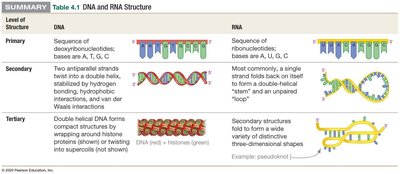
DNA and RNA differ in their primary, secondary, and tertiary structures. The following table summarizes these differences:
Level of Structure | DNA | RNA |
|---|---|---|
Primary | Sequence of deoxyribonucleotides; bases are A, T, G, C | Sequence of ribonucleotides; bases are A, U, G, C |
Secondary | Two antiparallel strands twist into a double helix, stabilized by hydrogen bonding, hydrophobic interactions, and van der Waals interactions | Most commonly, a single strand folds back on itself to form a double-helical stem and an unpaired "loop" |
Tertiary | Double helical DNA forms compact structures by wrapping around histone proteins and/or twisting into supercoils | Secondary structures fold into a wide variety of distinctive three-dimensional shapes |
RNA's Versatility and Catalytic Function
RNA is highly versatile, capable of folding into complex shapes and performing various tasks, including information transmission, regulation, and catalysis. Ribozymes are RNA molecules that catalyze reactions, with three-dimensional structure vital to their activity.
mRNA transmits information between DNA and proteins.
RNA regulates gene expression and catalyzes reactions.
Ribozymes have active sites and can catalyze phosphodiester bond formation.
4.4 The Origin of Life and the RNA World
Search for the First Life-Form
The theory of chemical evolution posits that life began as a naked self-replicator, a molecule capable of providing a template and polymerizing monomers into a copy. RNA is believed to have been the first such molecule.
RNA can both serve as a template and catalyze its own replication.
Most researchers propose the first life-form was made of RNA.
Experimental Evidence for the RNA World
Biologists have studied ribozymes capable of catalyzing RNA replication and nucleotide addition, mimicking natural selection. These studies support the RNA world hypothesis.
Ribozymes can add nucleotides to RNA strands.
Some ribozymes efficiently catalyze reactions, supporting the idea of RNA-based life.
Transition from RNA World to Modern Biology
Most modern ribozymes aid protein production, suggesting RNA preceded proteins. The evolution of protein enzymes marked the end of the RNA world. Three characteristics of life—information processing, replication, and evolution—were established in the RNA world.
RNA's role in protein synthesis is essential.
Evolution of protein enzymes ended the RNA world.
Life's key features: information processing, replication, evolution.
