 Indietro
Chapter 5: An Introduction to Carbohydrates
Guida di studio - Note intelligenti
 Appunti personalizzati basati sui tuoi materiali, ampliati con definizioni chiave, esempi e contesto.
Chapter 5: An Introduction to Carbohydrates
Chapter Roadmap
This chapter explores the structure and function of carbohydrates, focusing on how their molecular arrangement determines their biological roles. The main topics include the structure of monosaccharides, the formation and diversity of polysaccharides, and the major functions of carbohydrates in living organisms.
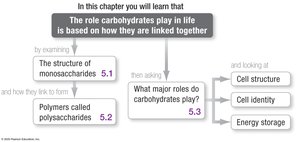
An Introduction to Carbohydrates
Overview of Carbohydrates
Carbohydrates are essential biomolecules that play critical roles in cell structure, cell identity, and energy storage. They are classified based on the number of sugar units present:
Monosaccharides: Single sugar units (e.g., glucose, ribose)
Oligosaccharides: Short chains of monosaccharides (2–10 units)
Polysaccharides: Long chains of monosaccharides (hundreds to thousands of units)
The general formula for carbohydrates is , where n can range from 3 to over a thousand. Carbohydrates contain a carbonyl group and multiple carbon-hydrogen bonds, but not all compounds with this formula are true carbohydrates (e.g., formaldehyde is not a carbohydrate).
5.1 Sugars as Monomers
Monosaccharides: Structure and Diversity
Monosaccharides are the simplest carbohydrates and serve as building blocks for larger molecules. They are important for providing chemical energy and as precursors for nucleotide formation (e.g., ribose in RNA).
Location of the carbonyl group:
Aldose: Carbonyl group at the end of the carbon chain
Ketose: Carbonyl group within the carbon chain
Number of carbon atoms:
Triose (3 carbons)
Pentose (5 carbons)
Hexose (6 carbons)
Spatial arrangement of atoms: Different arrangement of hydroxyl groups leads to different sugars (e.g., glucose vs. galactose).
Linear and ring forms: In aqueous solutions, sugars often form ring structures.
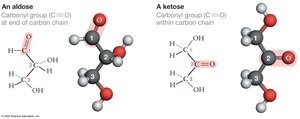
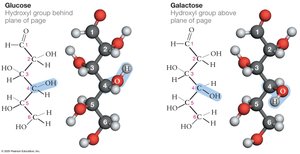
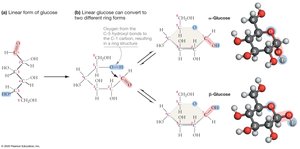
Each monosaccharide has a unique structure and function due to these variations.
5.2 The Structure of Polysaccharides
Formation of Polysaccharides
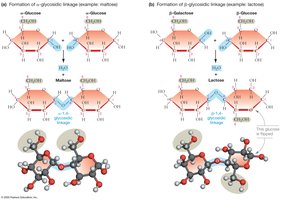
Polysaccharides are polymers formed by linking monosaccharide monomers through condensation reactions, resulting in covalent bonds called glycosidic linkages. These linkages can be broken by hydrolysis reactions.
Disaccharide: Two monosaccharides linked together
Glycosidic linkage: Covalent bond formed between two monosaccharides
Two common types of glycosidic linkages are:
α-1,4-glycosidic linkage
β-1,4-glycosidic linkage
Major Polysaccharides and Their Functions
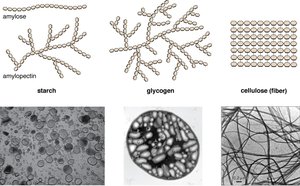
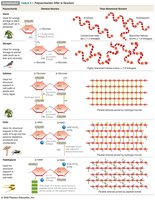
Starch: Storage polysaccharide in plants, composed of α-glucose monomers. Exists as amylose (unbranched) and amylopectin (branched).
Glycogen: Storage polysaccharide in animals, highly branched α-glucose polymer, stored in liver and muscle cells.
Cellulose: Structural polysaccharide in plants, made of β-glucose monomers joined by β-1,4-glycosidic linkages, forming linear fibers.
Chitin: Structural polysaccharide in fungi and arthropods, composed of N-acetylglucosamine monomers, similar structure to cellulose.
Peptidoglycan: Structural polysaccharide in bacterial cell walls, consisting of alternating monosaccharides with peptide cross-links.
5.3 What Do Carbohydrates Do?
Functions of Carbohydrates in Cells
Carbohydrates serve several essential functions in living organisms:
Precursors to other molecules: Used to synthesize nucleotides and amino acids.
Structural materials: Cellulose, chitin, and peptidoglycan provide structural support in plants, fungi, and bacteria, respectively.
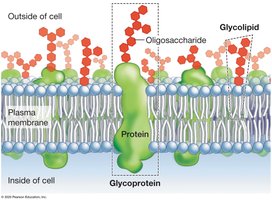
Cell identity: Glycoproteins and glycolipids on cell surfaces are involved in cell–cell recognition and signaling.
Energy storage: Starch and glycogen store chemical energy that can be mobilized when needed.
Carbohydrates as Structural Support
Structural polysaccharides form long strands that are organized into fibers or sheets, providing strength and elasticity to cells and tissues. The β-1,4-glycosidic linkages in cellulose, chitin, and peptidoglycan are resistant to hydrolysis, making these fibers durable and water-excluding.
Role of Carbohydrates in Cell Identity
Carbohydrates attached to proteins (glycoproteins) and lipids (glycolipids) on the cell surface serve as identification badges, mediating cell–cell recognition and communication.
Carbohydrates and Energy Storage
Carbohydrates store energy in their chemical bonds. During photosynthesis, plants convert sunlight into chemical energy stored in carbohydrates. When energy is needed, enzymes hydrolyze starch (in plants) and glycogen (in animals) to release glucose, which is then used to produce ATP.
Starch hydrolysis: Catalyzed by amylase enzymes
Glycogen hydrolysis: Catalyzed by phosphorylase enzymes
The energy released from glucose breakdown is used to synthesize ATP, which powers cellular processes such as polymerization and muscle contraction.
Summary Table: Major Polysaccharides
Polysaccharide | Main Organism | Monomer | Linkage | Function |
|---|---|---|---|---|
Starch | Plants | α-glucose | α-1,4 and α-1,6 | Energy storage |
Glycogen | Animals | α-glucose | α-1,4 and α-1,6 | Energy storage |
Cellulose | Plants | β-glucose | β-1,4 | Structural support |
Chitin | Fungi, Arthropods | N-acetylglucosamine | β-1,4 | Structural support |
Peptidoglycan | Bacteria | Alternating monosaccharides | β-1,4 (with peptide cross-links) | Structural support |
Additional info: The diversity of carbohydrate structures allows for a wide range of biological functions, from energy storage to cell signaling and structural integrity. Understanding the chemistry of carbohydrates is fundamental to studying metabolism, genetics, and cell biology.
