 Indietro
Chapter 5: An Introduction to Carbohydrates
Guida di studio - Note intelligenti
 Appunti personalizzati basati sui tuoi materiali, ampliati con definizioni chiave, esempi e contesto.
Carbohydrates: Structure, Function, and Importance
Introduction to Carbohydrates
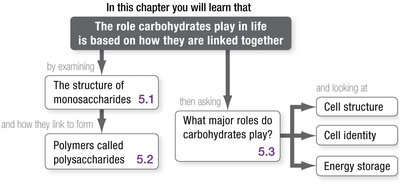
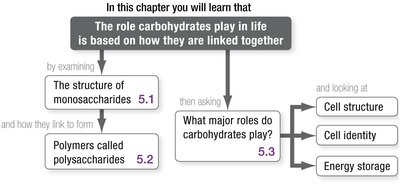
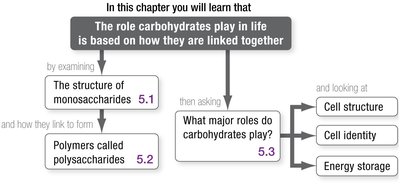
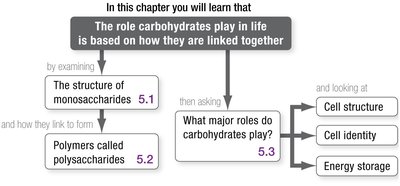
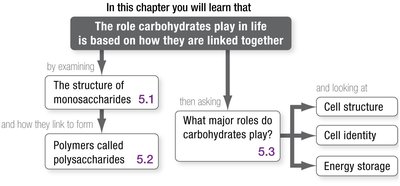
Carbohydrates are essential biomolecules that play critical roles in cell structure, cell identity, and energy storage. They are classified based on the number of sugar units present, ranging from simple monosaccharides to complex polysaccharides.
Monosaccharides: Single sugar units (e.g., glucose, galactose)
Oligosaccharides: Short chains of monosaccharides (few sugars)
Polysaccharides: Long chains of monosaccharides (many sugars)
Monosaccharide Structure and Classification
General Structure of Monosaccharides
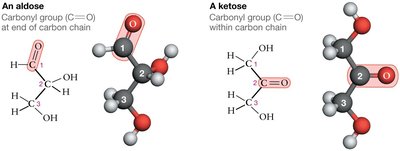
Monosaccharides have the general formula (CH2O)n and contain at least three carbon atoms, one carbonyl group, and two or more hydroxyl groups. Their structure determines their chemical properties and biological roles.
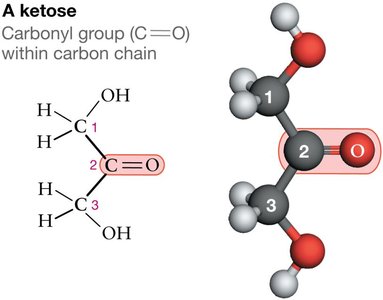
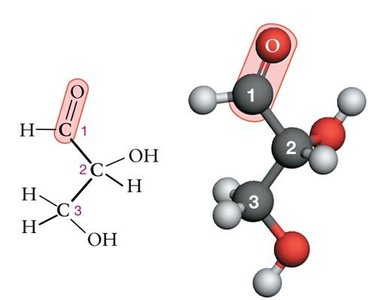
Carbonyl group: Can be at the end (aldose) or within the chain (ketose)
Hydroxyl groups: Attached to the carbon backbone
Number of carbons: Trioses (3C), tetroses (4C), pentoses (5C), hexoses (6C)
Aldoses vs. Ketoses
Monosaccharides are classified based on the position of the carbonyl group:
Aldose: Carbonyl group at the end of the carbon chain
Ketose: Carbonyl group within the carbon chain
Isomerism in Monosaccharides
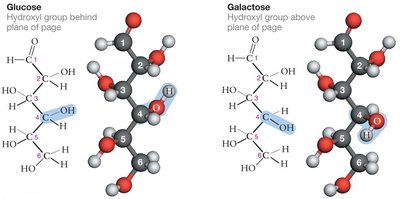
Isomers are molecules with the same molecular formula but different structural arrangements. For example, glucose and galactose are both hexoses (6C) but differ in the orientation of their hydroxyl groups.
Structural isomers: Differ in the arrangement of atoms
Stereoisomers: Differ in spatial arrangement (e.g., glucose vs. galactose)
Linear and Ring Forms of Monosaccharides
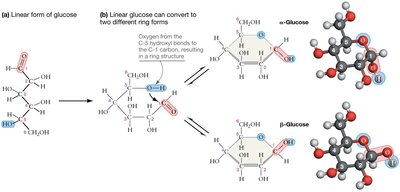
Monosaccharides can exist in both linear and ring forms. In aqueous solutions, the ring form is predominant due to the reaction between the carbonyl and a hydroxyl group within the molecule.
Ring formation: Oxygen from a hydroxyl group bonds to the carbonyl carbon, forming a ring
Alpha (α) and Beta (β) forms: Differ in the position of the hydroxyl group on the anomeric carbon
Formation of Glycosidic Linkages
Polymerization of Monosaccharides
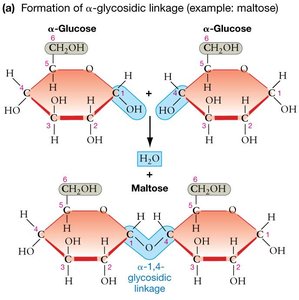
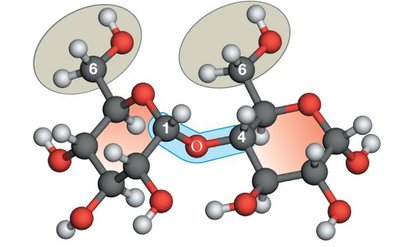
Monosaccharides polymerize through condensation reactions, forming glycosidic linkages (a type of covalent bond). Two monosaccharides joined together form a disaccharide; further additions create oligo- and polysaccharides.
Glycosidic linkage: Covalent bond formed between two monosaccharides by a dehydration reaction
Disaccharide: Two monosaccharides linked (e.g., maltose)
Polysaccharide: Many monosaccharides linked (e.g., starch, cellulose)
Polysaccharides: Structure and Function
Storage Polysaccharides: Starch and Glycogen
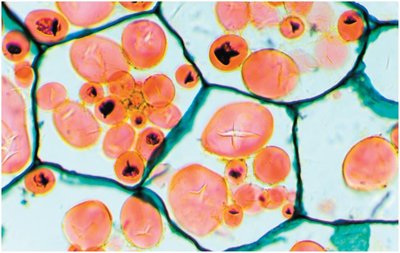
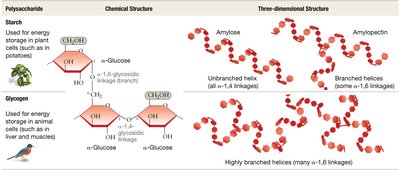
Starch (in plants) and glycogen (in animals) are polysaccharides that store energy. Their structure allows for efficient storage and rapid mobilization of glucose units when needed.
Starch: Composed of amylose (unbranched) and amylopectin (branched)
Glycogen: Highly branched, found in liver and muscle cells
Polysaccharide | Chemical Structure | Three-dimensional Structure |
|---|---|---|
Starch | α-glucose, α-1,4 and α-1,6 linkages | Unbranched helix (amylose), branched helices (amylopectin) |
Glycogen | α-glucose, α-1,4 and many α-1,6 linkages | Highly branched helices |
Structural Polysaccharides: Cellulose, Chitin, and Peptidoglycan
Some polysaccharides provide structural support in cells and organisms. Their unique linkages and cross-linking give them strength and rigidity.
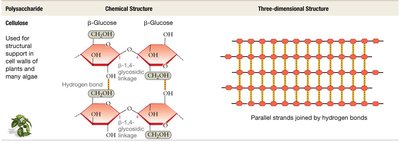
Cellulose: Main component of plant cell walls; β-1,4-glycosidic linkages; parallel strands joined by hydrogen bonds
Chitin: Found in fungal cell walls and exoskeletons of arthropods; contains N-acetylglucosamine (NAG) units
Peptidoglycan: Found in bacterial cell walls; alternating NAG and NAM units cross-linked by peptides
Polysaccharide | Chemical Structure | Three-dimensional Structure |
|---|---|---|
Cellulose | β-glucose, β-1,4 linkages | Parallel strands joined by hydrogen bonds |
Chitin | β-NAG, β-1,4 linkages | Parallel strands joined by hydrogen bonds |
Peptidoglycan | β-NAM and β-NAG, β-1,4 linkages | Parallel strands joined by peptide bonds |
Carbohydrates and Structural Support
Structural polysaccharides form long strands or sheets, providing strength and elasticity to cells and tissues. β-1,4-glycosidic linkages are resistant to hydrolysis, making these molecules durable. Dietary fiber, composed of such polysaccharides, is important for digestive health.
Carbohydrates in Cell Identity and Communication
Glycoproteins and Glycolipids
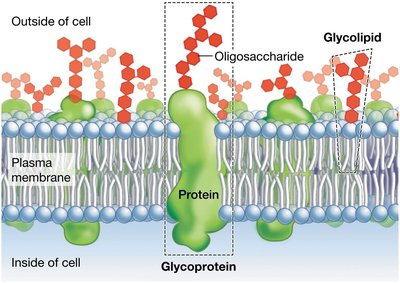
Carbohydrates attached to proteins (glycoproteins) and lipids (glycolipids) on the cell surface play key roles in cell-cell recognition and signaling. These molecules act as identification badges, distinguishing self from non-self and mediating communication between cells.
Glycoproteins: Proteins with attached carbohydrate chains
Glycolipids: Lipids with attached carbohydrate chains
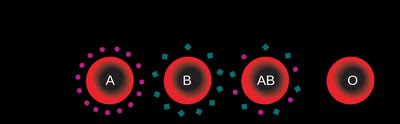
Functions: Cell-cell recognition (e.g., ABO blood groups), cell-cell signaling (e.g., immune response)
Carbohydrates and Energy Storage
Energy Storage and Release
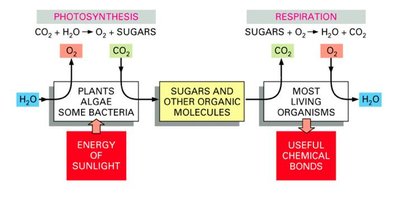
Carbohydrates store chemical energy in their covalent bonds. During photosynthesis, plants convert carbon dioxide and water into glucose, storing solar energy in chemical form. When energy is needed, glucose is broken down via cellular respiration to produce ATP, the cell's energy currency.
Photosynthesis equation:
Cellular respiration equation:
ATP: Adenosine triphosphate, used to drive cellular reactions
Summary Table: Major Polysaccharides
Name | Monomer | Linkage | Function |
|---|---|---|---|
Starch | α-glucose | α-1,4 and α-1,6 | Energy storage in plants |
Glycogen | α-glucose | α-1,4 and α-1,6 | Energy storage in animals |
Cellulose | β-glucose | β-1,4 | Structural support in plants |
Chitin | N-acetylglucosamine | β-1,4 | Structural support in fungi and arthropods |
Peptidoglycan | NAG and NAM | β-1,4 | Structural support in bacterial cell walls |
Key Takeaways
Carbohydrates are vital for energy storage, structural support, and cell identity.
Their function depends on their structure and the types of linkages between monomers.
Polysaccharides such as starch, glycogen, cellulose, chitin, and peptidoglycan have specialized roles in different organisms.
Carbohydrates on cell surfaces are crucial for recognition and communication between cells.
