 Indietro
Chapter 5: An Introduction to Carbohydrates – Structure, Function, and Biological Roles
Guida di studio - Note intelligenti
 Appunti personalizzati basati sui tuoi materiali, ampliati con definizioni chiave, esempi e contesto.
An Introduction to Carbohydrates
Overview of Carbohydrates
Carbohydrates are essential biomolecules that play critical roles in cell structure, cell identity, and energy storage. They are classified based on their size and complexity into monosaccharides, oligosaccharides, and polysaccharides. - Monosaccharides: Simple sugars, such as glucose, that serve as monomers for larger carbohydrates. - Oligosaccharides: Short chains of monosaccharide units. - Polysaccharides: Large polymers composed of many monosaccharide units. 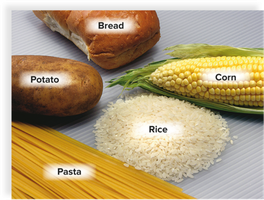
Molecular Structure of Carbohydrates
Carbohydrates generally have the molecular formula , where "n" can range from 3 to over a thousand. They contain a carbonyl group and multiple carbon-hydrogen bonds. Not all compounds with this formula are carbohydrates; for example, formaldehyde is not. - Carbonyl group: Can be at the end (aldose) or in the middle (ketose) of the molecule. - Hydroxyl groups: Multiple –OH groups attached to the carbon skeleton. 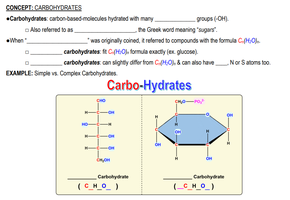
Classification and Structural Variations
Size Classes of Carbohydrates
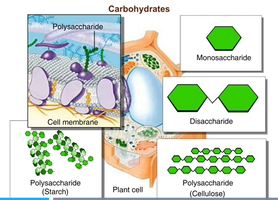
Carbohydrates are classified by the number of sugar units: - Monosaccharide: Single unit (e.g., glucose). - Disaccharide: Two units covalently linked (e.g., sucrose). - Polysaccharide: Many units (e.g., starch, cellulose). 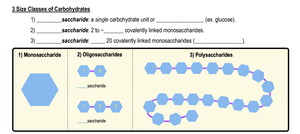
Monosaccharide Structure and Variation
Monosaccharides vary in several ways: - Location of carbonyl group: Aldose (end) or ketose (middle). - Number of carbon atoms: Triose (3), pentose (5), hexose (6). - Spatial arrangement of atoms: Different arrangement of hydroxyl groups. - Linear and ring forms: Sugars can exist in both forms, with ring forms predominant in aqueous solutions.
Biological Importance of Monosaccharide Structure
The structure of monosaccharides determines their function and digestibility. For example, the enzyme specificity for α- or β-glucose affects whether humans can digest starch (α-1,4 linkages) but not cellulose (β-1,4 linkages).
Polysaccharides: Structure and Function
Formation of Glycosidic Linkages
Polysaccharides are formed by condensation reactions between hydroxyl groups of monosaccharides, resulting in glycosidic linkages. - α-1,4 and β-1,4 linkages: The geometry of these linkages affects the structure and function of the polysaccharide. 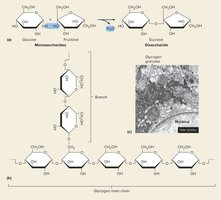
Major Polysaccharides and Their Roles
- Starch: Storage polysaccharide in plants, composed of α-glucose monomers. - Glycogen: Storage polysaccharide in animals, highly branched and stored in liver and muscle cells. - Cellulose: Structural polysaccharide in plants, composed of β-glucose monomers, forms strong fibers. - Chitin: Structural polysaccharide in fungi and exoskeletons of insects and crustaceans. - Peptidoglycan: Structural polysaccharide in bacterial cell walls. 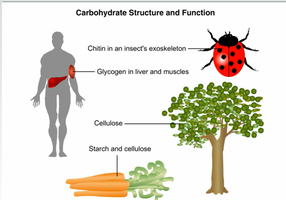
Functions of Carbohydrates in Cells
Energy Storage
Carbohydrates store and provide chemical energy. In photosynthesis, plants convert sunlight into chemical energy stored in carbohydrate bonds. - Starch and glycogen are easily hydrolyzed to release glucose for energy. - Energy in glucose is used to synthesize ATP, which powers cellular processes.
Structural Support
Structural polysaccharides such as cellulose, chitin, and peptidoglycan form fibers or sheets that provide strength and elasticity to cells and organisms. - β-glycosidic linkages are not easily hydrolyzed, making these fibers resistant to digestion and important for dietary fiber.
Cellular Identity
Carbohydrates serve as identification badges for cells. - Glycoproteins: Proteins with attached carbohydrates, important for cell–cell recognition and signaling. - Glycolipids: Lipids with attached carbohydrates, also involved in cell identity. 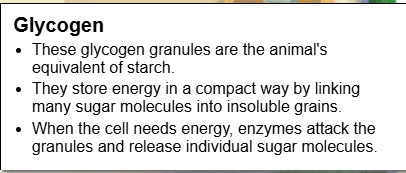
Glycogen: Storage in Animals
Glycogen granules in animal cells are the equivalent of starch in plants. - Store energy compactly by linking many sugar molecules into insoluble grains. - Enzymes release individual sugar molecules when energy is needed.
Summary Table: Types and Functions of Carbohydrates
Type | Structure | Function | Example |
|---|---|---|---|
Monosaccharide | Single sugar unit | Energy source, building block | Glucose |
Disaccharide | Two sugar units | Energy source | Sucrose |
Polysaccharide | Many sugar units | Storage, structure | Starch, cellulose, glycogen |
Conclusion
Carbohydrates are versatile biomolecules with diverse roles in energy storage, structural support, and cellular identity. Their structural variations, from simple monosaccharides to complex polysaccharides, underpin their functional diversity in biological systems. Understanding carbohydrate structure and function is fundamental to biology, biochemistry, and health sciences.
