 Indietro
Chapter 5: The Working Cell – Energy, Enzymes, and Membrane Transport
Guida di studio - Note intelligenti
 Appunti personalizzati basati sui tuoi materiali, ampliati con definizioni chiave, esempi e contesto.
Some Basic Energy Concepts
Conservation of Energy
The law of conservation of energy states that energy cannot be created or destroyed, only transformed from one form to another. Both machines and living organisms convert kinetic energy (energy of motion) to potential energy (stored energy) and vice versa, but the total energy remains constant.
Entropy: Every energy transformation increases the disorder (entropy) of the universe, often releasing heat as a byproduct.
Chemical Energy: Molecules, especially organic ones, store potential energy in the arrangement of their atoms and bonds.
Food Calories: The energy content of food is measured in kilocalories (kcal), which also quantifies the energy expended by organisms.
Energy in Chemical Reactions
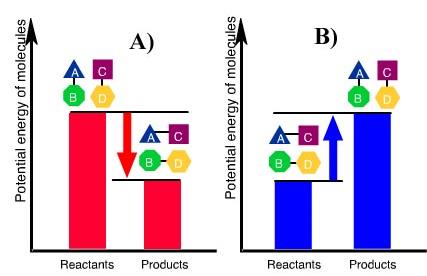
Chemical reactions involve the rearrangement of atoms and bonds, resulting in changes in potential energy. Reactions can either release or absorb energy:
Exergonic reactions: Release energy; products have less potential energy than reactants.
Endergonic reactions: Absorb energy; products have more potential energy than reactants.
Cellular Respiration and ATP
Overview of Cellular Respiration
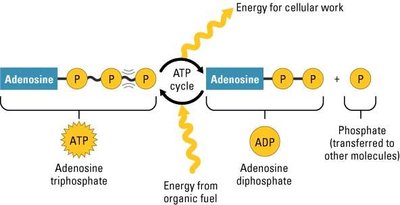
Cellular respiration is the process by which cells extract energy from glucose using oxygen, producing adenosine triphosphate (ATP) as the main energy currency. This process is essential for powering cellular activities such as growth, division, and repair.
Animals obtain glucose by consuming plants; fungi and bacteria absorb glucose from decomposing matter.
Plants, algae, and some bacteria produce glucose via photosynthesis.
Cellular respiration transfers about 40% of glucose's energy to ATP; the rest is lost as heat.
Aerobic respiration: Uses oxygen; highly efficient.
Anaerobic respiration: Occurs without oxygen; less efficient (e.g., fermentation).
Fermentation in muscle cells produces lactic acid, while in yeast it produces alcohol and CO2.
The ATP Cycle
ATP powers cellular work by transferring a phosphate group to other molecules. ATP is regenerated from ADP and phosphate using energy from organic fuels.
Enzymes and Metabolic Reactions
Enzyme Function and Activation Energy
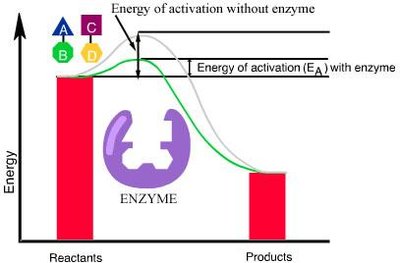
Enzymes are biological catalysts, usually proteins, that speed up metabolic reactions by lowering the activation energy (EA) required for reactions to proceed. This allows reactions to occur at moderate temperatures compatible with life.
Activation Energy: The energy barrier that must be overcome for reactants to be converted into products.
Induced Fit: When a substrate binds to an enzyme's active site, the enzyme changes shape slightly to better fit the substrate, facilitating the reaction.
Enzyme Specificity and Regulation
Each enzyme has a unique active site that binds specifically to its substrate.
Enzyme activity is affected by temperature, pH, and the presence of cofactors (metal ions or organic coenzymes).
Enzyme inhibitors can reduce enzyme function:
Competitive inhibitors: Bind to the active site, blocking substrate access.
Noncompetitive inhibitors: Bind elsewhere, changing the enzyme's shape and reducing activity.
Membrane Function: Traffic Across Membranes
Selective Permeability and Transport Mechanisms
The plasma membrane controls the movement of substances into and out of the cell, maintaining homeostasis through selective permeability:
Hydrophobic substances (e.g., lipids) pass through membranes easily.
Polar molecules and ions require specific transport proteins.
Types of Membrane Transport
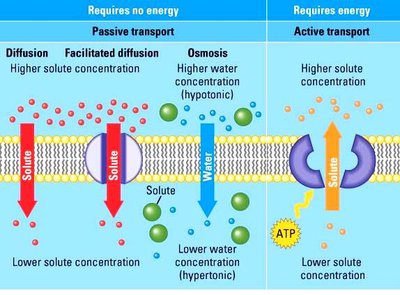
Passive Transport: Movement down a concentration gradient; does not require energy.
Diffusion: Spontaneous movement of molecules from high to low concentration.
Osmosis: Diffusion of water across a membrane from low to high solute concentration.
Facilitated Diffusion: Transport proteins help specific molecules cross the membrane.
Active Transport: Movement against a concentration gradient; requires energy (usually ATP).
Bulk Transport: Large molecules are transported via vesicles in processes such as exocytosis (out of the cell) and endocytosis (into the cell, including phagocytosis, pinocytosis, and receptor-mediated endocytosis).
Osmoregulation and Cell Survival
Animal cells must balance water uptake and loss to avoid bursting or shriveling.
Plant, fungal, and prokaryotic cells have cell walls that prevent bursting in hypotonic environments.
Transport Type | Energy Required? | Direction | Example |
|---|---|---|---|
Diffusion | No | High to Low | O2 and CO2 movement |
Facilitated Diffusion | No | High to Low | Glucose transport |
Osmosis | No | Water: Low to High Solute | Water movement |
Active Transport | Yes (ATP) | Low to High | Na+/K+ pump |
Exocytosis/Endocytosis | Yes (ATP) | Bulk movement | Secretion of proteins, uptake of large particles |
