 Indietro
Chapter 5: The Working Cell – Energy, Enzymes, and Membrane Transport
Guida di studio - Note intelligenti
 Appunti personalizzati basati sui tuoi materiali, ampliati con definizioni chiave, esempi e contesto.
Some Basic Energy Concepts
Forms and Conservation of Energy
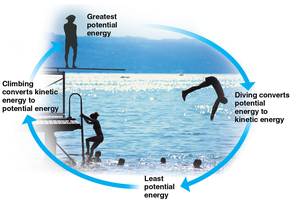
Energy is the capacity to cause change and is essential for all biological processes. It exists in two main forms: kinetic energy (energy of motion) and potential energy (stored energy due to position or structure). Life depends on the conversion of energy from one form to another, following the principle of conservation of energy, which states that energy cannot be created or destroyed, only transformed.
Kinetic energy: Energy associated with moving objects.
Potential energy: Stored energy, such as the energy stored in chemical bonds or due to an object's position.
Conservation of energy: Energy can only change forms, not be created or destroyed.
Heat and Entropy
Heat is a type of kinetic energy resulting from the random motion of atoms and molecules. All energy conversions generate some heat, which increases the entropy (disorder) of a system. According to the second law of thermodynamics, every energy conversion increases the entropy of the universe.
Entropy: A measure of disorder or randomness in a system.
Every energy transformation results in some energy being lost as heat, increasing entropy.
Chemical Energy and Cellular Respiration
Chemical Energy in Food and Fuels
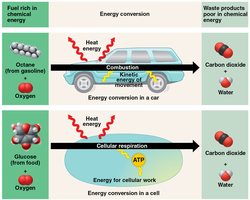
Chemical energy is a form of potential energy stored in the arrangement of atoms within molecules. This energy can be released by chemical reactions, such as the breakdown of food in cells or gasoline in engines. Cellular respiration is the process by which cells extract energy from fuel molecules and store it in a usable form (ATP).
Chemical energy: Energy stored in chemical bonds of molecules like glucose or gasoline.
Cellular respiration: The process of breaking down fuel molecules to release energy for cellular work.
Humans convert about 34% of food energy to useful work; the rest is lost as heat.
Food Calories
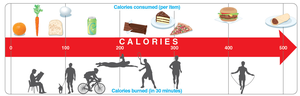
A calorie (cal) is the amount of energy needed to raise the temperature of 1 gram of water by 1°C. Food energy is measured in kilocalories (kcal), where 1 kcal = 1,000 cal. The calories in food fuel the activities of life, from movement to cellular processes.
Calorie (cal): Basic unit of energy.
Kilocalorie (kcal): 1,000 calories; the unit used on food labels.
ATP and Cellular Work
The Role of ATP
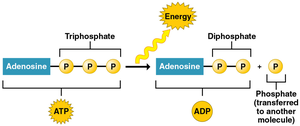
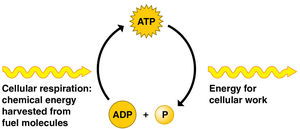
ATP (adenosine triphosphate) is the main energy currency of the cell. It stores energy obtained from food and releases it to power cellular work. ATP consists of adenosine and three phosphate groups; energy is released when the terminal phosphate group is transferred to another molecule.
ATP: Adenosine triphosphate, the cell's energy shuttle.
Energy is released when ATP is converted to ADP (adenosine diphosphate) and a phosphate group.
The ATP Cycle
Cells continuously use and regenerate ATP. Cellular work spends ATP, which is recycled from ADP and phosphate using energy from cellular respiration. A working muscle cell recycles up to 10 million ATP molecules per second.
ATP is constantly regenerated from ADP and phosphate.
This cycle links energy-releasing and energy-consuming processes in the cell.
Enzymes and Metabolism
Enzymes and Activation Energy
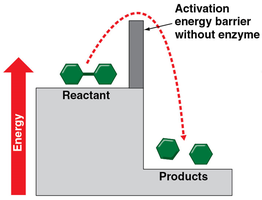
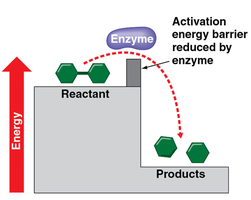
Metabolism is the sum of all chemical reactions in an organism. Most metabolic reactions require enzymes, which are proteins that speed up reactions by lowering the activation energy—the energy needed to start a reaction. Enzymes are not consumed in the reaction and can be used repeatedly.
Enzyme: Protein catalyst that speeds up chemical reactions.
Activation energy: The initial energy input required to start a reaction.
Enzyme Structure and Function
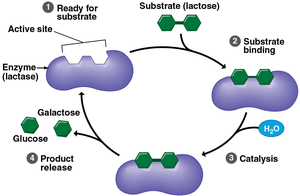
Each enzyme is specific to its substrate (the reactant it acts on). The active site of the enzyme binds the substrate, often changing shape slightly to fit (induced fit). After the reaction, the products are released, and the enzyme is free to catalyze another reaction.
Substrate: The reactant molecule an enzyme acts upon.
Active site: The region of the enzyme where the substrate binds.
Induced fit: The enzyme changes shape to fit the substrate more snugly.
Enzyme Inhibitors
Enzyme inhibitors are molecules that disrupt enzyme function. Some inhibitors resemble the substrate and block the active site, while others bind elsewhere and change the enzyme's shape, reducing its activity. Enzyme inhibition is a key regulatory mechanism in cells and is also the basis for many drugs and poisons.
Competitive inhibitors: Resemble the substrate and compete for the active site.
Noncompetitive inhibitors: Bind elsewhere on the enzyme, altering its shape and function.
Membrane Structure and Function
Plasma Membrane and Membrane Proteins
The plasma membrane is a phospholipid bilayer with embedded proteins. It regulates the flow of materials into and out of the cell and facilitates communication and transport. Membrane proteins perform various functions, including transport, signaling, and cell recognition.
Phospholipid bilayer: Double layer of phospholipids forming the basic structure of the membrane.
Membrane proteins: Embedded proteins with roles in transport, signaling, and structure.
Passive Transport and Diffusion
Passive transport is the movement of substances across a membrane without energy input. Diffusion is the tendency of molecules to spread out evenly, moving from areas of high concentration to low concentration. Facilitated diffusion uses membrane proteins to help substances cross the membrane.
Diffusion: Movement of molecules down their concentration gradient.
Facilitated diffusion: Passive transport aided by membrane proteins.
Osmosis and Water Balance
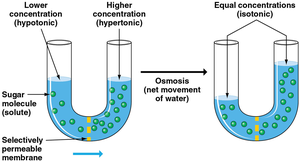
Osmosis is the diffusion of water across a selectively permeable membrane. Water moves from areas of lower solute concentration (hypotonic) to higher solute concentration (hypertonic) until equilibrium (isotonic) is reached. The ability to regulate water balance is called osmoregulation.
Hypertonic solution: Higher solute concentration compared to another solution.
Hypotonic solution: Lower solute concentration compared to another solution.
Isotonic solution: Equal solute concentration.
Water Balance in Animal and Plant Cells
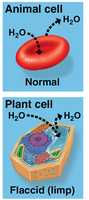
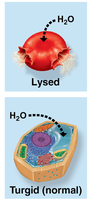
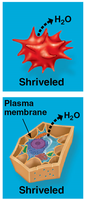
The survival of cells depends on balancing water uptake and loss. Animal cells can burst (lyse) in hypotonic solutions or shrivel in hypertonic solutions. Plant cells are healthiest in hypotonic environments, where water inflow creates turgor pressure against the cell wall.
Osmoregulation: Control of water balance in cells.
Animal cells: Normal in isotonic, lysed in hypotonic, shriveled in hypertonic solutions.
Plant cells: Flaccid in isotonic, turgid (normal) in hypotonic, shriveled in hypertonic solutions.
Solution Type | Animal Cell | Plant Cell |
|---|---|---|
Isotonic | Normal | Flaccid (limp) |
Hypotonic | Lysed (burst) | Turgid (normal) |
Hypertonic | Shriveled | Shriveled |
Active Transport and Bulk Transport
Active Transport
Active transport requires energy (usually from ATP) to move substances across a membrane against their concentration gradient. This process allows cells to maintain internal concentrations of ions and molecules that differ from their surroundings.
Active transport: Movement of substances against their concentration gradient using energy.
Transport proteins in the membrane are responsible for active transport.
Exocytosis and Endocytosis
Exocytosis is the process by which cells export materials in vesicles that fuse with the plasma membrane. Endocytosis is the uptake of materials by forming vesicles from the plasma membrane. Phagocytosis is a type of endocytosis where the cell engulfs large particles.
Exocytosis: Export of materials out of the cell via vesicles.
Endocytosis: Import of materials into the cell via vesicles.
Phagocytosis: "Cellular eating"—engulfing large particles.
Additional info: This chapter provides foundational knowledge for understanding cellular energetics, enzyme function, and membrane transport, which are essential for all subsequent topics in cell biology and physiology.
