 Indietro
Chapter 6: An Introduction to Metabolism – Study Notes
Guida di studio - Note intelligenti
 Appunti personalizzati basati sui tuoi materiali, ampliati con definizioni chiave, esempi e contesto.
An Introduction to Metabolism
Overview: The Energy of Life
Cells are dynamic chemical factories where thousands of reactions occur, extracting energy from nutrients and using it to perform work. Cellular respiration is a key process by which cells extract energy from sugars.
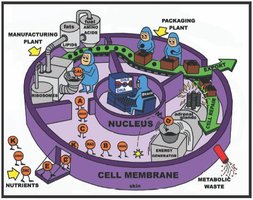
Concept 6.1: An Organism’s Metabolism Transforms Matter and Energy
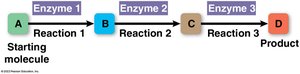
Metabolism refers to the sum of all chemical reactions in an organism. These reactions are organized into metabolic pathways, where each step is catalyzed by a specific enzyme, transforming a starting molecule into a product.
Catabolic pathways: Break down complex molecules, releasing energy (e.g., cellular respiration).
Anabolic pathways: Build complex molecules from simpler ones, consuming energy (e.g., protein synthesis).
Energy and Its Forms
Energy is essential for all metabolic processes. Bioenergetics studies how energy flows through living organisms. Energy can exist as:
Kinetic energy: Energy of motion.
Thermal energy: Kinetic energy from random movement of atoms/molecules; heat is thermal energy transferred between objects.
Light energy: Used by organisms to perform work (e.g., photosynthesis).
Potential energy: Energy due to position or structure.
Chemical energy: Potential energy stored in molecules, released during chemical reactions.
The Laws of Energy Transformation
Thermodynamics is the study of energy transformations. Organisms are open systems, exchanging energy and matter with their surroundings.
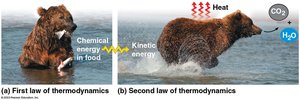
The First Law of Thermodynamics
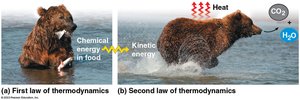
The energy of the universe is constant. Energy can be transferred and transformed, but not created or destroyed. This is known as the principle of conservation of energy.
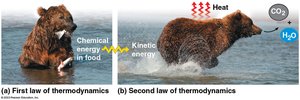
The Second Law of Thermodynamics
Every energy transfer increases the entropy (disorder) of the universe. Spontaneous processes increase entropy and do not require energy input, while nonspontaneous processes decrease entropy and require energy.
Biological Order and Disorder
Cells and organisms create order from less organized materials, but overall, energy transformations increase the universe's entropy. Organisms are islands of low entropy in a universe tending toward disorder.
Concept 6.2: The Free-Energy Change of a Reaction
Free energy (G) is the portion of a system’s energy that can do work under constant temperature and pressure. The change in free energy () determines whether a reaction is spontaneous.
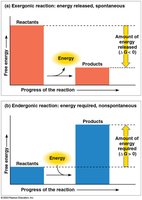
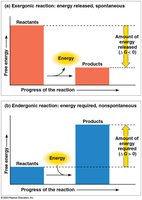
Spontaneous reactions: is negative; these reactions can perform work.
Nonspontaneous reactions: is positive; require energy input.
At equilibrium, forward and reverse reactions occur at the same rate, representing maximum stability. Cells avoid equilibrium by constantly exchanging materials.
Exergonic and Endergonic Reactions
Exergonic reactions: Net release of free energy; spontaneous ().
Endergonic reactions: Absorb free energy; nonspontaneous ().
Concept 6.3: ATP Powers Cellular Work
Cells perform three main types of work: chemical, transport, and mechanical. Energy coupling uses exergonic reactions to drive endergonic ones, primarily mediated by ATP (adenosine triphosphate).
ATP structure: Ribose sugar, adenine base, three phosphate groups.
ATP hydrolysis: Releases energy by breaking phosphate bonds, forming ADP and inorganic phosphate.
Phosphorylation: ATP transfers a phosphate group to another molecule, making it a phosphorylated intermediate.
ATP cycle: ATP is regenerated from ADP by addition of a phosphate group, using energy from catabolic reactions.
Concept 6.4: Enzymes Speed up Metabolic Reactions
Enzymes are protein catalysts that speed up reactions by lowering the activation energy barrier. They do not alter the free energy change () of a reaction.
Activation energy (EA): Energy required to start a reaction.
Substrate: The reactant molecule an enzyme acts upon.
Active site: Region on the enzyme where the substrate binds.
Induced fit: Enzyme changes shape to fit the substrate, facilitating catalysis.
Enzymes can orient substrates, strain bonds, and provide a favorable microenvironment. Reaction rate increases with substrate concentration until the enzyme is saturated.
Effects of Local Conditions on Enzyme Activity
Optimal temperature and pH maximize enzyme activity.
Chemicals can influence enzyme function.
Cofactors
Cofactors: Nonprotein helpers for enzyme function; can be inorganic (e.g., metal ions) or organic (coenzymes).
Most vitamins are coenzymes or their precursors.
Concept 6.5: Regulation of Enzyme Activity
Cells regulate metabolism by controlling enzyme activity and gene expression.
Allosteric regulation: Regulatory molecules bind to enzymes at sites other than the active site, affecting function.
Cooperativity: Binding of one substrate enhances activity of other subunits.
Feedback inhibition: End product of a pathway inhibits an earlier step, preventing overproduction.
Summary Table: Exergonic vs. Endergonic Reactions
Type of Reaction | ΔG | Energy Flow | Spontaneity |
|---|---|---|---|
Exergonic | Negative | Energy released | Spontaneous |
Endergonic | Positive | Energy absorbed | Nonspontaneous |
Key Equations
Free energy change:
Relationship to spontaneity: If , reaction is spontaneous. If , reaction is nonspontaneous.
Example: Cellular respiration is an exergonic process; protein synthesis is endergonic.
Additional info: These notes expand on the textbook content to provide a comprehensive overview of metabolism, energy, and enzyme regulation for General Biology students.
