 Indietro
Chapter 6: Lipids, Membranes, and the First Cells – Structure and Function
Guida di studio - Note intelligenti
 Appunti personalizzati basati sui tuoi materiali, ampliati con definizioni chiave, esempi e contesto.
Lipid Structure and Function
Introduction to Lipids
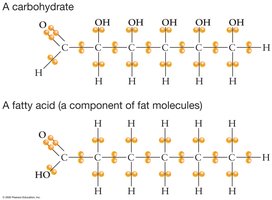
Lipids are a diverse group of carbon-containing compounds that are insoluble in water due to their high proportion of nonpolar bonds. Their hydrophobic nature is a result of the equal sharing of electrons in hydrocarbon chains. Lipids play essential roles in energy storage, cellular signaling, and membrane structure.
Hydrocarbons: Nonpolar molecules containing only carbon and hydrogen; hydrophobic.
Functions of Lipids:
Store chemical energy
Act as pigments and vitamins
Serve as cellular signals
Form waterproof coatings
Hydrocarbon Structure and Saturation
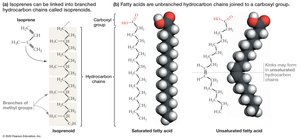
The structure of hydrocarbon chains in lipids determines their physical properties and biological roles. Saturated hydrocarbons have only single bonds, while unsaturated hydrocarbons contain one or more double bonds, introducing kinks in the chain.
Saturated hydrocarbon chains: Only single bonds; maximum hydrogen atoms; typically solid at room temperature.
Unsaturated hydrocarbon chains: One or more double bonds; kinks reduce tight packing; typically liquid at room temperature.
Fluidity of Lipids
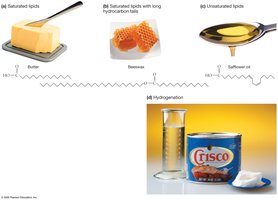
The fluidity of lipids depends on the length and saturation of their hydrocarbon chains. Saturated lipids with long tails are solid at room temperature, while highly unsaturated lipids are liquid. Foods with unsaturated fats are considered healthier due to their effects on membrane fluidity and cardiovascular health.
Major Types of Lipids in Cells
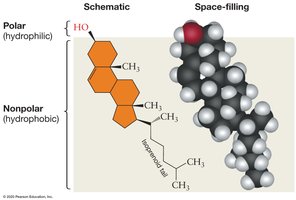
Cells contain three major types of lipids: steroids, fats, and phospholipids. Each type has a distinct structure and function.
Steroids: Characterized by a bulky, four-ring structure; examples include cholesterol, estrogen, and testosterone.
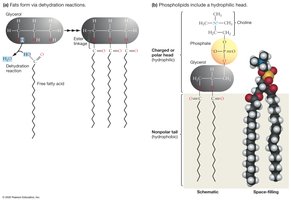
Fats (Triacylglycerols/Triglycerides): Composed of three fatty acids linked to glycerol; primary role is energy storage.
Phospholipids: Consist of glycerol, a phosphate group, and two fatty acid tails; primary component of cell membranes.
Phospholipid Bilayers and Membrane Structure
Amphipathic Nature of Phospholipids
Phospholipids are amphipathic, containing both hydrophilic (polar) heads and hydrophobic (nonpolar) tails. This dual nature drives the formation of biological membranes.
Hydrophilic head: Contains glycerol, phosphate group, and a charged or polar group.
Hydrophobic tail: Composed of nonpolar hydrocarbon chains.
Formation of Micelles and Bilayers
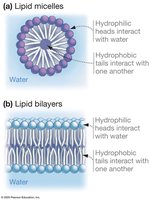
In aqueous environments, amphipathic lipids spontaneously form micelles or bilayers. Micelles are spherical aggregates, while bilayers are paired sheets that form the basis of cellular membranes.
Artificial Membranes and Experimental Systems
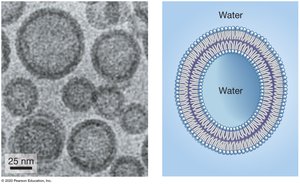
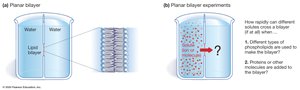
Researchers use artificial membranes, such as liposomes and planar bilayers, to study membrane properties and permeability. Liposomes are vesicles with a phospholipid bilayer, while planar bilayers are constructed across a partition to separate two solutions.
Membrane Permeability and Factors Affecting It
Selective Permeability of Lipid Bilayers
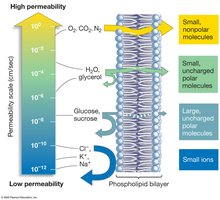
Biological membranes are selectively permeable, allowing some substances to cross more easily than others. Small, nonpolar molecules pass through most readily, while large or charged molecules are restricted.
Influence of Lipid Structure on Permeability
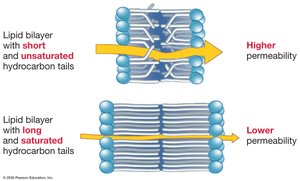
Membrane permeability is affected by the saturation and length of hydrocarbon tails, as well as the presence of cholesterol.
Short, unsaturated tails: Increase membrane permeability.
Long, saturated tails: Decrease membrane permeability.
Cholesterol: Increases packing density, reducing permeability.
Temperature Effects
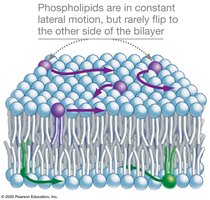
Membrane fluidity and permeability decrease as temperature drops, due to reduced movement of phospholipids and tighter packing of hydrophobic tails.
Diffusion and Osmosis Across Membranes
Diffusion
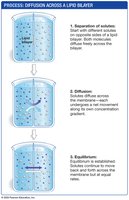
Diffusion is the spontaneous movement of molecules from regions of high concentration to low concentration, driven by a concentration gradient. This process increases entropy and does not require energy (passive transport).
Osmosis
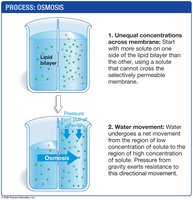
Osmosis is the diffusion of water across a selectively permeable membrane. Water moves from areas of low solute concentration to high solute concentration, diluting the higher concentration and equalizing solute levels on both sides.
Tonicity: Hypertonic, Hypotonic, and Isotonic Solutions
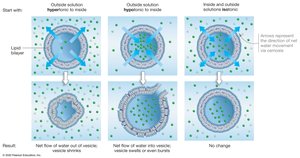
The relative concentration of solutes inside and outside a cell determines water movement:
Hypertonic: Higher solute concentration outside; water leaves cell; cell shrinks.
Hypotonic: Lower solute concentration outside; water enters cell; cell swells.
Isotonic: Equal solute concentrations; no net water movement; cell maintains volume.
Proteins in Membranes: Structure and Function
Role of Membrane Proteins
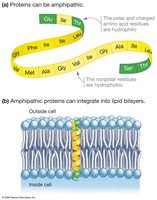
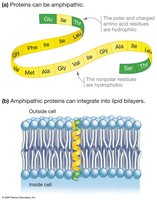
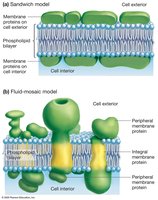
Membrane proteins are as abundant as phospholipids in plasma membranes. Many proteins are amphipathic, allowing them to integrate into the lipid bilayer and form channels or passageways for specific molecules.
Fluid-Mosaic Model
The fluid-mosaic model describes the plasma membrane as a dynamic structure with proteins embedded within or attached to a fluid phospholipid bilayer. Integral proteins span the membrane, while peripheral proteins are attached to one side.
Transport Across Membranes
Channel Proteins and Ion Channels
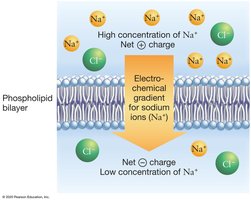
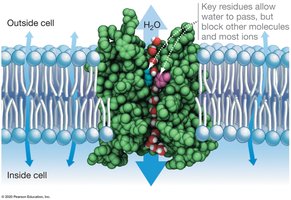
Channel proteins facilitate diffusion by forming pores in the membrane, allowing ions to move down their electrochemical gradients. These channels are highly selective, permitting only specific ions or molecules to pass.
Gated Channels
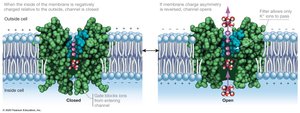
Some channel proteins are gated, opening or closing in response to specific signals or changes in membrane voltage. This regulation ensures controlled movement of ions and small molecules.
Facilitated Diffusion via Carrier Proteins
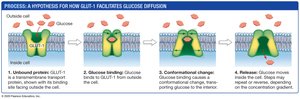
Carrier proteins assist in the passive transport of molecules such as glucose. The GLUT-1 carrier protein binds glucose, undergoes a conformational change, and releases glucose on the other side of the membrane.
Active Transport and Pumps
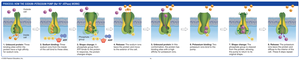
Active transport moves substances against their concentration gradients, requiring energy input, often from ATP. The sodium–potassium pump (Na+/K+-ATPase) is a classic example, transporting Na+ and K+ ions across the membrane to maintain cellular gradients.
Secondary Active Transport (Co-transport)
Secondary active transport uses the energy stored in electrochemical gradients established by primary pumps to move other substances against their gradients, without direct use of ATP.
Summary Table: Passive and Active Membrane Transport
Type of Transport | Description | Proteins Involved | Energy Requirement |
|---|---|---|---|
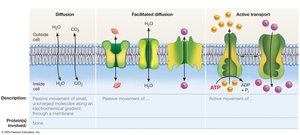
Simple Diffusion | Movement of small, nonpolar molecules down concentration gradient | None | No |
Facilitated Diffusion | Movement of ions or polar molecules via channel or carrier proteins | Channel or carrier proteins | No |
Active Transport | Movement of substances against concentration gradient | Pumps (e.g., Na+/K+-ATPase) | Yes (ATP or gradient energy) |
Conclusion
Biological membranes are complex structures composed of lipids and proteins, providing selective permeability and enabling cells to maintain distinct internal environments. The evolution of membrane proteins has allowed cells to regulate transport, communicate, and carry out essential life processes.
