 Indietro
Chapter 6: Lipids, Membranes, and the First Cells – Study Notes
Guida di studio - Note intelligenti
 Appunti personalizzati basati sui tuoi materiali, ampliati con definizioni chiave, esempi e contesto.
Chapter 6: Lipids, Membranes, and the First Cells
Overview
This chapter explores the structure and function of lipids, the formation and properties of biological membranes, and the mechanisms by which substances move across these membranes. Understanding these concepts is fundamental to cell biology and the origin of life.
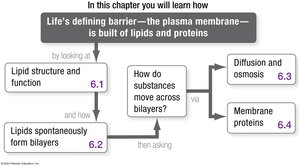
Plasma Membrane: Life’s Defining Barrier
Functions of the Plasma Membrane
The plasma membrane separates living cells from their environment, acting as a selective barrier that regulates the entry and exit of substances.
Selective permeability: Allows essential materials in, keeps harmful substances out.
Facilitates chemical reactions: Provides a controlled environment for biochemical processes.
6.1 Lipid Structure and Function
Definition and Properties of Lipids
Lipids are carbon-containing compounds that are insoluble in water due to their high proportion of nonpolar bonds. Their hydrophobic nature is a result of hydrocarbon chains.
Hydrocarbons: Nonpolar molecules made of carbon and hydrogen.
Fatty acids: Hydrocarbon chains bonded to a carboxyl group; can be saturated or unsaturated.
Isoprenoids: Hydrocarbon chains functioning as pigments, scents, vitamins, and hormone precursors.
Bond Saturation and Hydrocarbon Structure
The saturation of hydrocarbon chains affects lipid structure and physical properties.
Saturated fatty acids: Only single bonds; maximum hydrogen atoms; solid at room temperature.
Unsaturated fatty acids: One or more double bonds; causes kinks; liquid at room temperature.
Polyunsaturated: Multiple double bonds; even more fluid.
Example: Foods with unsaturated fats are considered healthier due to their fluidity.
Types of Lipids in Cells
Cells contain three major types of lipids: steroids, fats, and phospholipids.
Steroids: Bulky, four-ring structure; examples include cholesterol and hormones.
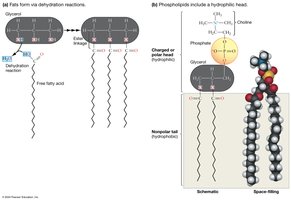
Fats (triglycerides): Three fatty acids linked to glycerol; energy storage.
Phospholipids: Glycerol linked to a phosphate group and two hydrocarbon tails; primary component of cell membranes.
6.2 Phospholipid Bilayers
Amphipathic Nature of Membrane Lipids
Phospholipids are amphipathic, containing both hydrophilic (water-loving) heads and hydrophobic (water-fearing) tails. This property is crucial for membrane formation.
Hydrophilic head: Glycerol, phosphate group, and charged/polar group.
Hydrophobic tail: Nonpolar hydrocarbon chains.
Micelles and Bilayers
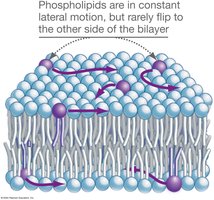
Amphipathic lipids form micelles (spherical aggregates) or bilayers (paired sheets) in water. Bilayers are the basis of biological membranes.
Micelles: Formed by free fatty acids.
Lipid bilayers: Formed spontaneously by phospholipids; no energy input required.
Artificial Membranes
Researchers use artificial membrane systems, such as liposomes and planar bilayers, to study membrane properties and permeability.
Liposomes: Artificial vesicles surrounded by phospholipids.
Planar bilayers: Used to measure permeability and study ion transport.
Selective Permeability
Phospholipid bilayers allow selective passage of substances.
Small/nonpolar molecules: Move quickly across bilayers (e.g., O2).
Large/charged molecules: Move slowly or not at all (e.g., glucose).
Factors Affecting Membrane Permeability
Membrane permeability is influenced by lipid composition, tail length, saturation, cholesterol content, and temperature.
Unsaturated tails: Increase fluidity and permeability.
Saturated/long tails: Decrease permeability.
Cholesterol: Reduces permeability by increasing packing density.
Temperature: Lower temperature decreases fluidity and permeability.
6.3 Diffusion and Osmosis
Diffusion
Diffusion is the spontaneous movement of molecules from regions of high concentration to low concentration, driven by thermal energy and concentration gradients.
Equilibrium: Achieved when molecules are evenly distributed; no net movement.
Passive transport: Diffusion across membranes without energy input.
Osmosis
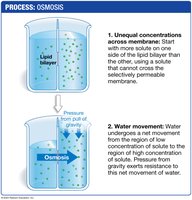
Osmosis is the diffusion of water across a selectively permeable membrane, moving from low solute concentration to high solute concentration.
Hypertonic solution: Higher solute concentration outside; water moves out; cell shrinks.
Hypotonic solution: Lower solute concentration outside; water moves in; cell swells.
Isotonic solution: Equal solute concentration; no net water movement.
Membranes and Chemical Evolution
Protocells and the Origin of Life
Early lipid bilayers likely provided containers for the first replicating molecules, such as RNA. Protocells are simple vesicle-like structures that may have been intermediates in the evolution of cells.
Protocells: Vesicles harboring nucleic acids; possible precursors to living cells.
6.4 Proteins Alter Membrane Structure and Function
Role of Membrane Proteins
Membrane proteins are as abundant as phospholipids in the plasma membrane. Their amphipathic nature allows them to insert into membranes and form passageways for substances.
Integral (transmembrane) proteins: Span the membrane; segments face both interior and exterior.
Peripheral proteins: Bind to membrane lipids without passing through; found on interior or exterior.
Fluid-Mosaic Model
The fluid-mosaic model describes the membrane as a dynamic mosaic of phospholipids and proteins, with proteins spanning the membrane and contributing to its fluidity and function.
Membrane Protein Functions
Channels: Form pores for ions to cross membranes; selective for specific ions.
Carriers: Facilitate diffusion by binding and transporting specific molecules (e.g., glucose).
Pumps: Perform active transport, moving substances against their concentration gradient using energy (often ATP).
Transport Mechanisms
Passive transport: Diffusion and facilitated diffusion; no energy required.
Active transport: Requires energy input; moves substances against gradients.
Secondary active transport (co-transport): Uses electrochemical gradients to power movement of other molecules.
Summary Table: Types of Membrane Transport
Transport Type | Energy Required? | Direction | Example |
|---|---|---|---|
Passive Diffusion | No | High to Low | O2 across membrane |
Facilitated Diffusion | No | High to Low | Glucose via GLUT-1 |
Active Transport | Yes (ATP) | Low to High | Na+/K+ pump |
Secondary Active Transport | Indirect (gradient) | Low to High | Co-transport of glucose |
Key Equations
Diffusion: Net movement down concentration gradient increases entropy.
Osmosis: Water moves from low to high solute concentration across membrane.
ATP hydrolysis (for active transport):
Conclusion
Biological membranes are complex structures composed of lipids and proteins, providing selective permeability and enabling essential cellular processes. Understanding their structure and function is crucial for studying cell biology and the origin of life.
