 Indietro
Chapter 7: Photosynthesis – Structure, Function, and Light Reactions
Guida di studio - Note intelligenti
 Appunti personalizzati basati sui tuoi materiali, ampliati con definizioni chiave, esempi e contesto.
Photosynthesis Overview
General Equation and Redox Changes
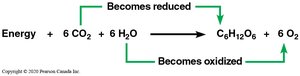
Photosynthesis is the process by which plants, algae, and some bacteria convert light energy into chemical energy, producing glucose and oxygen from carbon dioxide and water. The overall equation is the reverse of cellular respiration:
Equation:
Redox Process: Carbon dioxide is reduced to glucose, and water is oxidized to oxygen.
Carbon Fixation: Inorganic carbon (CO2) is converted into organic molecules.
Leaf Structure and Photosynthesis
Leaf Anatomy and Function
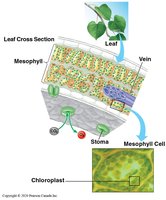
Leaves are specialized organs designed to maximize photosynthesis while minimizing water loss. Key structures include:
Epidermis: The outer layer, often coated with a waxy cuticle to prevent water loss.
Mesophyll Cells: The main site of photosynthesis, located within the leaf's interior.
Veins: Transport water and nutrients throughout the leaf.
Stomata: Pores controlled by guard cells, allowing gas exchange (CO2 in, O2 out) and water vapor loss.
Stomatal Regulation
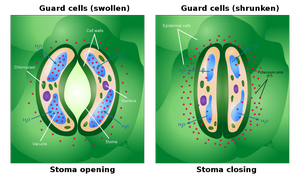
Guard cells regulate the opening and closing of stomata, balancing CO2 intake with water conservation:
Stoma Opening: Guard cells swell, allowing gas exchange.
Stoma Closing: Guard cells shrink, reducing water loss.
Chloroplast Structure
Internal Organization
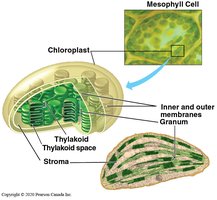
Chloroplasts are the organelles where photosynthesis occurs. Their structure includes:
Inner and Outer Membranes: Enclose the chloroplast.
Stroma: Fluid inside the inner membrane, site of the Calvin cycle.
Thylakoids: Disc-shaped membranes where light reactions occur.
Granum: Stack of thylakoids.
Light as Electromagnetic Radiation
Properties of Light
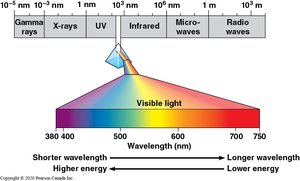
Light is a form of electromagnetic radiation. Only a small portion, called visible light, is detectable by human eyes. Other organisms can perceive ultraviolet or infrared light.
Visible Light: Wavelengths from about 380 nm to 750 nm.
Shorter Wavelengths: Higher energy (e.g., UV, gamma rays).
Longer Wavelengths: Lower energy (e.g., infrared, radio waves).
Color and Light Absorption
Reflection and Transmission
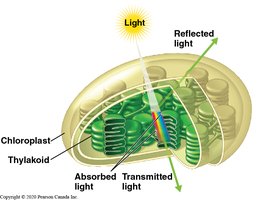
Color is determined by the wavelengths of light that are not absorbed by an object. For example, green leaves reflect and transmit green light, which is why they appear green to us.
Absorbed Light: Used in photosynthesis.
Reflected/Transmitted Light: Reaches our eyes and determines color.
Pigments in Photosynthesis
Types and Functions
Pigments are molecules that absorb light energy. In photosynthesis, they capture photon energy for conversion into chemical energy.
Chlorophyll a: Main pigment, absorbs violet-blue and red light.
Chlorophyll b: Accessory pigment, absorbs blue and orange light, passes energy to chlorophyll a.
Carotenoids: Absorb other wavelengths, provide photoprotection, and are responsible for fall colors.
How Pigments Work
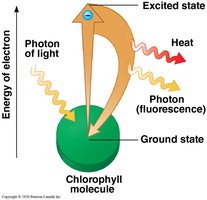
When a pigment absorbs a photon, an electron is excited to a higher energy state. If not used, the energy is released as heat or light (fluorescence).
Energy Transfer: In chloroplasts, energy is passed from pigment to pigment until it reaches chlorophyll a.
Photoprotection: Carotenoids absorb excess light to prevent cellular damage.
Light Reactions of Photosynthesis
Location and Inputs/Outputs
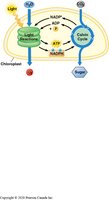
The light reactions are the first stage of photosynthesis, occurring in the thylakoid membrane. They convert light energy into chemical energy (ATP and NADPH).
Inputs: Light, water, NADP+, ADP, and phosphate.
Outputs: Oxygen (O2), NADPH, ATP.
Steps of the Light Reactions
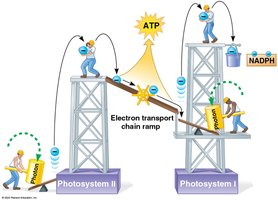
Light reactions involve a series of steps:
Light Absorption: Pigments in photosystem II absorb light, passing energy to the reaction center.
Electron Donation: Excited electron is transferred to a primary electron acceptor; replaced by splitting water (photolysis).
Electron Transport Chain (ETC): High-energy electron moves through ETC, pumping H+ ions into thylakoid space.
Photosystem I: Electron is re-excited by another photon and transferred to NADP+, forming NADPH.
ATP Formation: H+ gradient drives ATP synthase, converting ADP and phosphate into ATP (photophosphorylation).
Summary Table: Photosynthesis Components
Component | Function |
|---|---|
Stomata | Gas exchange (CO2 in, O2 out), water loss regulation |
Mesophyll | Main site of photosynthesis |
Chloroplast | Organelle where photosynthesis occurs |
Thylakoid | Site of light reactions |
Chlorophyll a | Main pigment for light absorption |
Chlorophyll b | Accessory pigment, passes energy to chlorophyll a |
Carotenoids | Photoprotection, absorb excess light |
ATP & NADPH | Products of light reactions, used in Calvin cycle |
Example: During the light reactions, water is split to provide electrons, oxygen is released, and ATP and NADPH are produced for the Calvin cycle.
