 Indietro
Chapter 8: An Introduction to Metabolism – General Biology Study Notes
Guida di studio - Note intelligenti
 Appunti personalizzati basati sui tuoi materiali, ampliati con definizioni chiave, esempi e contesto.
Energy and Metabolism
Metabolism: Transforming Matter and Energy
Metabolism encompasses all chemical reactions occurring within an organism, enabling the transformation of matter and energy. These reactions are organized into metabolic pathways, where a specific molecule is modified in a series of steps, each catalyzed by a unique enzyme.
Catabolic pathways: Break down complex molecules into simpler compounds, releasing energy.
Anabolic pathways: Build complex molecules from simpler ones, consuming energy.
Enzymes: Biological catalysts that speed up specific reactions without being consumed.
Open system: Organisms exchange energy and matter with their surroundings, making them open systems.
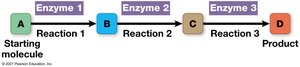
Example: Cellular respiration is a catabolic pathway, while protein synthesis is anabolic.
Forms of Energy
Energy is the capacity to cause change and is essential for biological work.
Kinetic energy: Energy of motion (e.g., movement of molecules).
Potential energy: Energy stored due to position or structure (e.g., chemical bonds).
Chemical energy: A form of potential energy available for release in chemical reactions.
Thermodynamics in Biology
Thermodynamics studies energy transformations in matter.
First Law: Energy can be transferred and transformed, but not created or destroyed.
Second Law: Every energy transfer increases the entropy (disorder) of the universe.
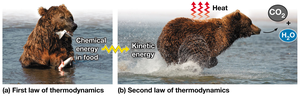
Example: Food energy is converted to kinetic energy and heat, increasing entropy.
The Free-Energy Change of a Reaction
Gibbs Free Energy and Spontaneity
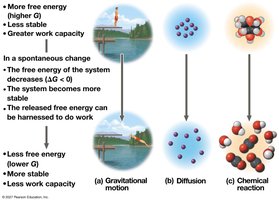
Biologists use Gibbs free energy (G) to predict whether reactions occur spontaneously. Free energy is the portion of a system’s energy available to do work under constant temperature and pressure.
ΔG = ΔH - TΔS (where ΔH = enthalpy, ΔS = entropy, T = temperature in Kelvin)
Spontaneous reactions: ΔG < 0 (system loses free energy, becomes more stable)
Nonspontaneous reactions: ΔG ≥ 0 (require energy input)
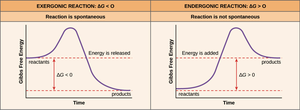
Example: Diffusion and chemical reactions that release energy are spontaneous.
Exergonic vs. Endergonic Reactions
Chemical reactions are classified by their free-energy changes:
Exergonic reactions: Net release of free energy (ΔG < 0), spontaneous.
Endergonic reactions: Absorb free energy (ΔG > 0), nonspontaneous.
ATP Powers Cellular Work
Structure and Function of ATP
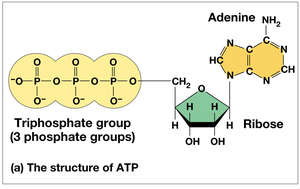
ATP (adenosine triphosphate) is a nucleotide composed of ribose (sugar), adenine (nitrogenous base), and three phosphate groups. It is the primary energy currency of the cell.
ATP belongs to the class of nucleic acids.
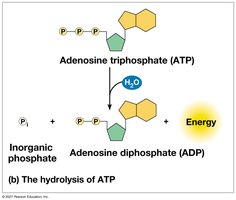
ATP hydrolysis releases energy by breaking the terminal phosphate bond.
ATP Hydrolysis and Energy Coupling
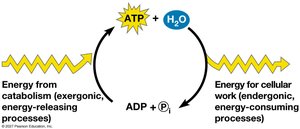
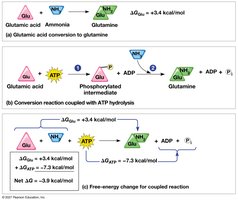
ATP hydrolysis powers cellular work by coupling exergonic reactions (energy-releasing) to endergonic reactions (energy-consuming).
Phosphorylation: Transfer of a phosphate group from ATP to another molecule, driving endergonic reactions.
ATP is regenerated from ADP and inorganic phosphate using energy from catabolic pathways.
Types of Cellular Work Powered by ATP
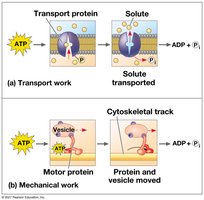
Chemical work: Driving endergonic reactions.
Transport work: Pumping substances across membranes.
Mechanical work: Moving cellular structures (e.g., cilia, muscle contraction).
Enzymes and Metabolic Reactions
Enzyme Function and Activation Energy
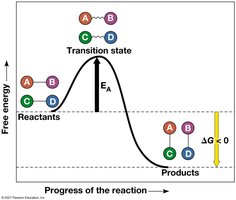
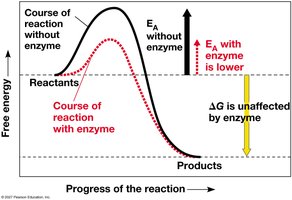
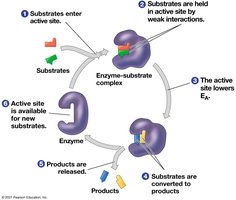
Enzymes are biological catalysts that lower the activation energy (EA) required to initiate reactions, allowing them to occur at moderate temperatures.
Activation energy: The initial energy needed to break reactant bonds.
Enzymes do not affect ΔG; they only speed up the rate of reaction.
Enzyme Specificity and the Induced-Fit Model
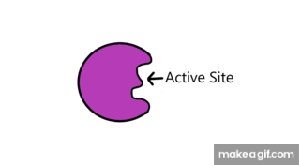
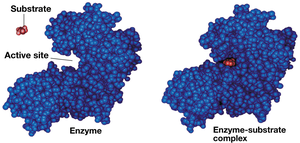
Enzymes are highly specific, binding only to their substrates at the active site. The induced-fit model describes how the active site changes shape to fit the substrate.
Enzyme-substrate complex: Temporary association during catalysis.
Specificity arises from the complementary fit between substrate and active site.
Mechanisms of Enzyme Action
Enzymes lower activation energy by orienting substrates, straining bonds, and providing a favorable microenvironment.
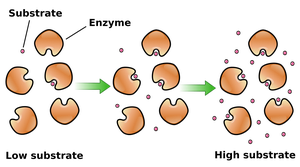
Substrate concentration affects reaction rate; saturation occurs when all active sites are occupied.
Factors Affecting Enzyme Activity
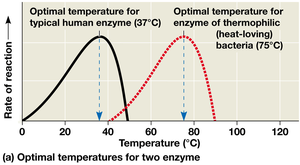
Temperature: Each enzyme has an optimal temperature for activity.
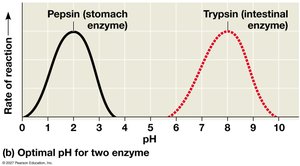
pH: Each enzyme has an optimal pH.
Cofactors: Nonprotein helpers (inorganic or organic) required for enzyme function.
Enzyme inhibitors: Chemicals that reduce enzyme activity (competitive or noncompetitive).
Regulation of Enzyme Activity
Feedback Inhibition and Allosteric Regulation
Cells regulate metabolism by controlling enzyme activity. Feedback inhibition occurs when the end product of a pathway inhibits an earlier enzyme, preventing waste. Allosteric regulation involves regulatory molecules binding to sites other than the active site, affecting enzyme function.
Feedback inhibition conserves resources by halting unnecessary product synthesis.
Allosteric regulation can stimulate or inhibit enzyme activity.
Example: Isoleucine synthesis is regulated by feedback inhibition.
Additional info: These notes cover all key aspects of Chapter 8: Metabolism, including energy transformations, ATP, enzyme function, and regulation, with relevant images reinforcing core concepts.
