 Indietro
Chapter 8: An Introduction to Metabolism – General Biology Study Notes
Guida di studio - Note intelligenti
 Appunti personalizzati basati sui tuoi materiali, ampliati con definizioni chiave, esempi e contesto.
An Introduction to Metabolism
Overview of Metabolism
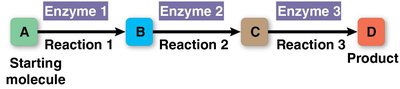
Metabolism encompasses all the chemical reactions occurring within an organism. These reactions are organized into metabolic pathways, where a specific molecule is modified in a series of steps to produce a final product. Each step is catalyzed by a specific enzyme, a macromolecule that accelerates a particular reaction.
Catabolic pathways break down complex molecules into simpler compounds, releasing energy (e.g., cellular respiration).
Anabolic pathways build complex molecules from simpler ones, consuming energy (e.g., protein synthesis from amino acids).
Energy released from catabolic reactions can be stored and used to drive anabolic reactions.
Energy and Its Forms
Definition and Types of Energy
Energy is the capacity to cause change and perform work, such as moving matter against forces like gravity and friction. Living cells transform energy from one form to another to sustain life. Bioenergetics is the study of how energy flows through living organisms.
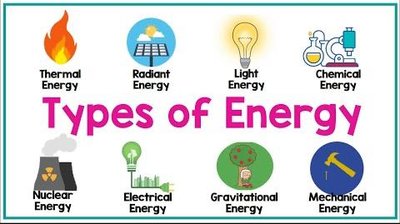
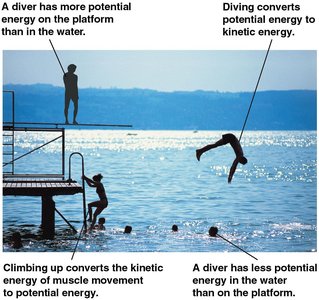
Kinetic energy: Energy associated with motion (e.g., water turning turbines).
Potential energy: Stored energy due to location or structure (e.g., water behind a dam).
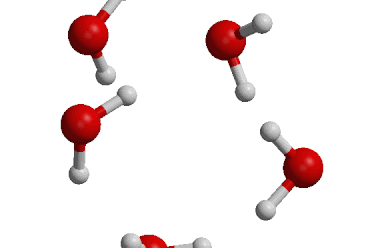
Thermal energy: Kinetic energy from random movement of atoms/molecules; transfer is called heat.
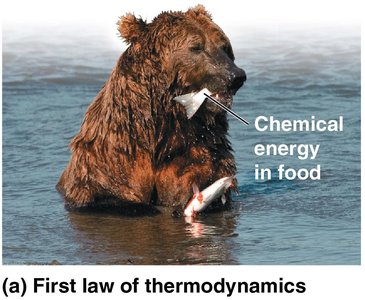
Chemical energy: Potential energy stored in molecules, released during chemical reactions (e.g., glucose breakdown).
Light energy: Can be harnessed for work, such as photosynthesis.
Energy Conversion Examples
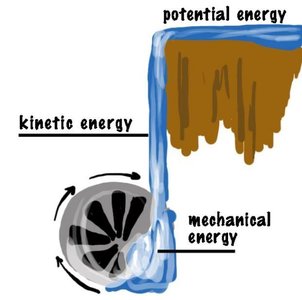
Energy can be converted from one form to another. For example, potential energy in water behind a dam is converted to kinetic energy as water flows, which then turns turbines to produce mechanical energy.
Thermodynamics in Biology
Systems and Surroundings
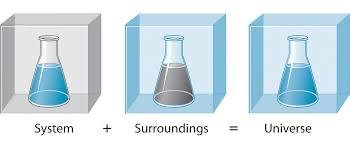
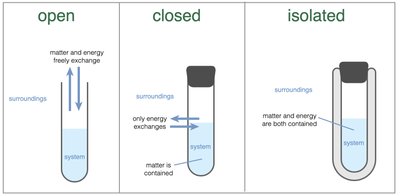
Thermodynamics is the study of energy transformations. The system refers to the matter under study, while the surroundings are everything else. Organisms are open systems, exchanging energy and matter with their environment.
The Laws of Thermodynamics
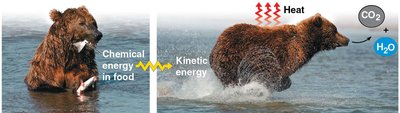
First Law (Conservation of Energy): Energy can be transferred and transformed, but cannot be created or destroyed. The energy of the universe is constant.
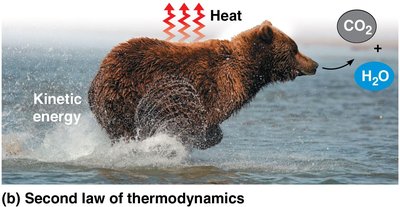
Second Law: Every energy transfer increases the entropy (disorder) of the universe. Some energy is lost as heat and becomes unavailable for work.
Spontaneous and Nonspontaneous Processes
Spontaneous processes increase entropy and occur without energy input. Nonspontaneous processes decrease entropy and require energy input. Living systems create order locally but increase entropy globally.
Free Energy and Chemical Reactions
Gibbs Free Energy (G)
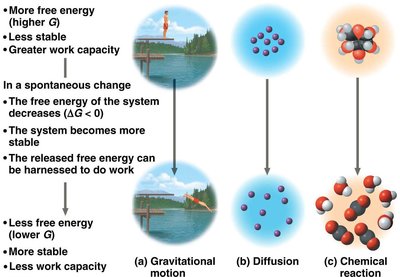
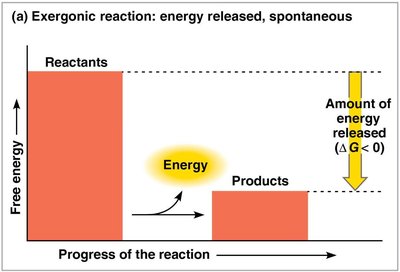
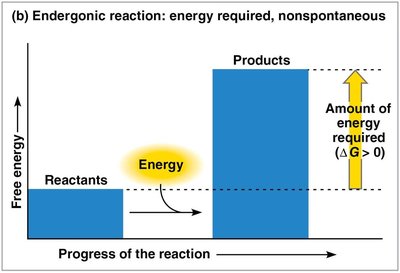
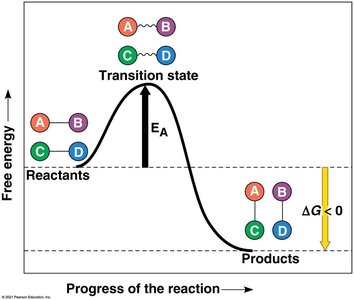
Free energy is the portion of a system’s energy available to do work at constant temperature and pressure. The change in free energy () determines whether a reaction is spontaneous.
must be negative for a process to be spontaneous.
Equilibrium and Stability
A process is spontaneous and can perform work only when moving toward equilibrium. At equilibrium, and there is no net change.
Exergonic and Endergonic Reactions
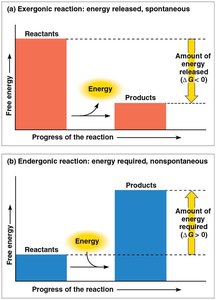
Chemical reactions are classified by their free-energy changes:
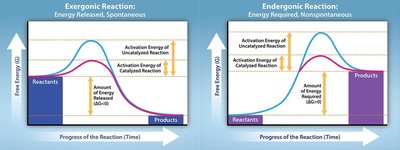
Exergonic reactions: Net release of free energy (), spontaneous.
Endergonic reactions: Absorb free energy (), nonspontaneous.
ATP and Cellular Work
ATP Structure and Function
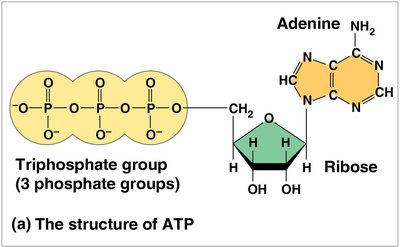
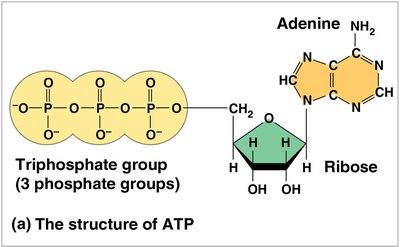
ATP (adenosine triphosphate) consists of ribose, adenine, and three phosphate groups. It is the primary energy currency of the cell, mediating energy coupling for cellular work.
ATP Hydrolysis and Energy Release
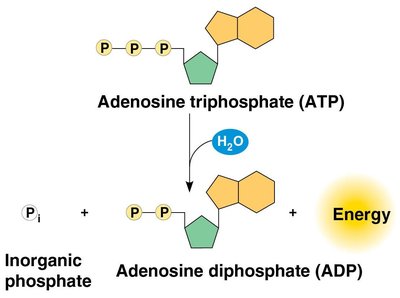
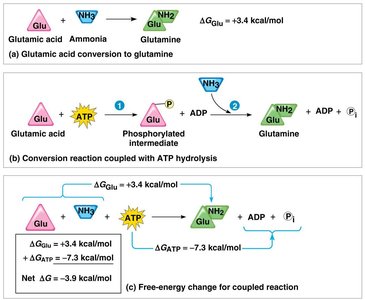
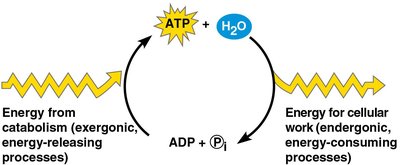
Hydrolysis of ATP releases free energy by breaking the terminal phosphate bond. The energy comes from the change to a lower free energy state, not directly from the bond itself.
Standard conditions: kcal/mol
Cellular conditions: kcal/mol
Phosphorylation and Energy Coupling
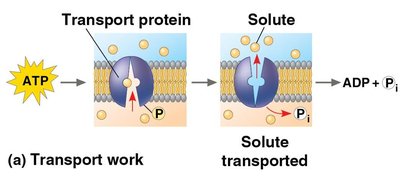
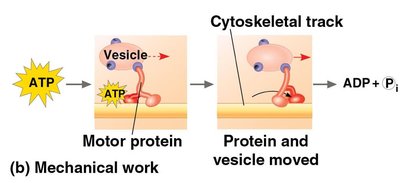
ATP hydrolysis is coupled to endergonic processes by transferring a phosphate group to another molecule, creating a phosphorylated intermediate that is more reactive.
The ATP Cycle
ATP is regenerated by adding a phosphate group to ADP, using energy from catabolic reactions. This cycle couples energy-yielding and energy-consuming processes.
Enzymes and Metabolic Reactions
Enzyme Function and Catalysis
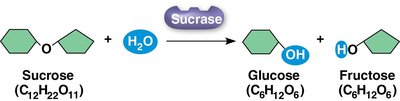
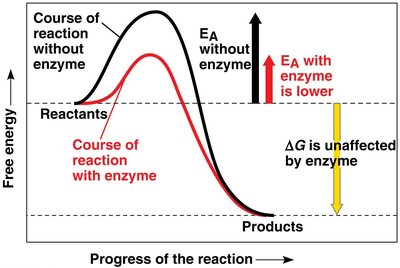
Enzymes are biological catalysts that speed up metabolic reactions by lowering the activation energy (EA) barrier. They do not change but make reactions occur faster.
Substrate Specificity and Induced Fit
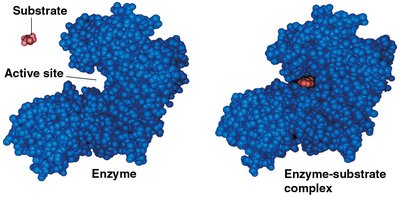
The reactant an enzyme acts on is called its substrate. Binding occurs at the active site, causing the enzyme to change shape for a tighter fit (induced fit). Substrates are held by weak bonds, and the enzyme catalyzes their conversion to products.
Mechanisms of Enzyme Action
Orienting substrates to facilitate reactions
Stretching substrates to make bonds easier to break
Providing a favorable microenvironment
Participating directly in the reaction
Enzyme activity can be increased by raising substrate concentration, but when saturated, only more enzyme can increase the rate.
Factors Affecting Enzyme Activity
Enzyme activity is influenced by temperature, pH, and chemicals. Each enzyme has optimal conditions for maximum activity. Extreme conditions can cause denaturation.
Cofactors and Coenzymes
Cofactors are non-protein helpers for enzymes. Inorganic cofactors include metal ions; organic cofactors are called coenzymes (often derived from vitamins).
Enzyme Inhibition
Certain chemicals inhibit enzyme action, either reversibly or irreversibly. Inhibitors can be:
Competitive: Resemble substrate and bind to active site, blocking substrate.
Noncompetitive: Bind elsewhere, changing enzyme shape and reducing activity.
Regulation of Enzyme Activity
Cells regulate metabolism by controlling enzyme activity and gene expression. Allosteric regulation involves binding of regulatory molecules at sites other than the active site, affecting enzyme function. Cooperativity amplifies enzyme response by stabilizing the active form when substrate binds.
Feedback Inhibition and Enzyme Localization
Feedback inhibition occurs when the end-product of a pathway inhibits an earlier step, preventing overproduction. Enzyme compartmentalization within cells helps organize metabolic pathways.
Type of Inhibitor | Binding Site | Effect |
|---|---|---|
Competitive | Active site | Blocks substrate, can be overcome by increasing substrate |
Noncompetitive | Other site (allosteric) | Changes enzyme shape, reduces activity |
Example: Penicillin is a competitive inhibitor that blocks bacterial cell wall synthesis enzymes. Sarin gas is an irreversible inhibitor of acetylcholinesterase.
Additional info: These notes cover the fundamental concepts of metabolism, energy transformations, thermodynamics, ATP function, enzyme catalysis, and regulation, providing a comprehensive overview for General Biology students.
