 Indietro
Chapter 8: An Introduction to Metabolism – General Biology Study Notes
Guida di studio - Note intelligenti
 Appunti personalizzati basati sui tuoi materiali, ampliati con definizioni chiave, esempi e contesto.
Energy and Metabolism
The Laws of Thermodynamics in Biology
Biological processes are governed by the laws of thermodynamics, which describe how energy is transferred and transformed in living systems.
First Law of Thermodynamics: Energy can be transferred and transformed, but not created or destroyed. This is also known as the principle of conservation of energy.
Second Law of Thermodynamics: Every energy transfer or transformation increases the entropy (disorder) of the universe. Some energy is always lost as heat, making it unavailable for work.
Biological Implication: Living organisms are open systems, absorbing energy and releasing heat and waste products to their surroundings.
Example: Cellular respiration demonstrates both laws: chemical energy in food is converted to kinetic energy and heat, increasing entropy.
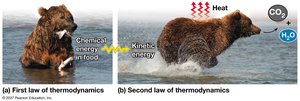
Metabolism: Transforming Matter and Energy
Metabolism is the sum of all chemical reactions in an organism, arising from orderly interactions between molecules.
Metabolic Pathways: Series of steps in which a specific molecule is altered to produce a product, each step catalyzed by a specific enzyme.
Catabolic Pathways: Break down complex molecules into simpler compounds, releasing energy (e.g., cellular respiration).
Anabolic Pathways: Build complex molecules from simpler ones, consuming energy (e.g., protein synthesis).
Bioenergetics: Study of how energy flows through living organisms.
Forms of Energy
Energy is the capacity to cause change and exists in various forms. Living cells must transform energy to perform work.
Kinetic Energy: Energy of motion.
Potential Energy: Stored energy due to position or structure.
Chemical Energy: Potential energy available for release in a chemical reaction (e.g., glucose).
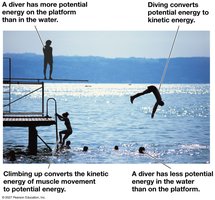
Free Energy and Spontaneous Processes
Gibbs Free Energy (ΔG)
Free energy is the portion of a system’s energy that can do work when temperature and pressure are uniform. The change in free energy (ΔG) determines whether a process is spontaneous.
Spontaneous Process: ΔG is negative; occurs without energy input and decreases system’s free energy.
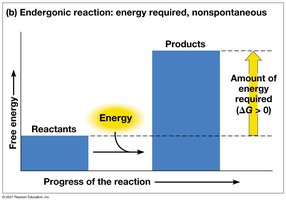
Nonspontaneous Process: ΔG is zero or positive; requires energy input.
Entropy (S): Measure of disorder; spontaneous processes increase entropy.
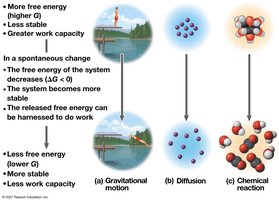
Exergonic and Endergonic Reactions
Chemical reactions are classified by their free-energy changes:
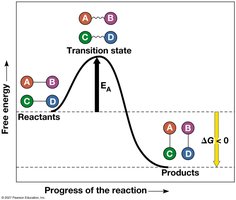
Exergonic Reaction: Releases free energy; ΔG < 0; spontaneous.
Endergonic Reaction: Absorbs free energy; ΔG > 0; nonspontaneous.
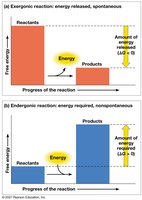
Equilibrium and Metabolism
Metabolic reactions are reversible but never reach equilibrium in living cells, allowing continuous work and energy flow.
Open System: Cells exchange materials with surroundings, preventing equilibrium.
Example: Cellular respiration is a multistep pathway with steady inflow of reactants and outflow of products.
ATP and Cellular Work
ATP: Structure and Function
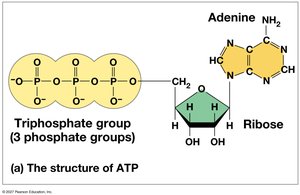
Adenosine triphosphate (ATP) is the cell’s energy currency, mediating most energy coupling in cells.
Structure: Composed of adenine, ribose, and three phosphate groups.
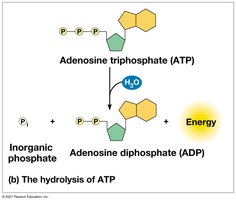
Hydrolysis: ATP hydrolysis releases energy by breaking the terminal phosphate bond, forming ADP and inorganic phosphate.
ATP Powers Cellular Work
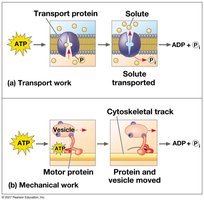
Cells use ATP to perform three main types of work:
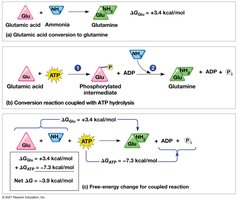
Chemical Work: Driving endergonic reactions.
Transport Work: Pumping substances across membranes.
Mechanical Work: Moving structures like cilia or muscle cells.
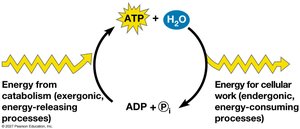
Energy Coupling: Exergonic processes drive endergonic ones, often mediated by ATP.
The ATP Cycle
ATP is regenerated by adding a phosphate group to ADP, using energy from catabolic reactions. This cycle is essential for maintaining cellular energy supply.
Enzymes and Metabolic Reactions
Enzymes: Biological Catalysts
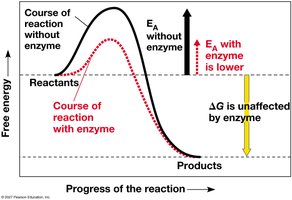
Enzymes are macromolecules (usually proteins) that speed up metabolic reactions by lowering energy barriers.
Catalyst: Speeds up a reaction without being consumed.
Activation Energy (EA): Energy required to start a reaction; enzymes lower EA but do not affect ΔG.
Substrate Specificity and Catalytic Cycle
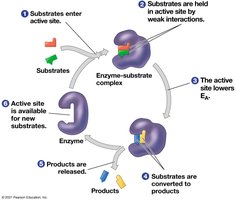
Enzymes are highly specific for their substrates, forming an enzyme-substrate complex. The active site undergoes an induced fit to enhance catalysis.
Substrate: Reactant that an enzyme acts on.
Induced Fit: Enzyme changes shape to better fit the substrate.
Catalytic Cycle: Substrate enters active site, is converted to product, and released.
Mechanisms of Enzyme Action
Enzymes lower activation energy by orienting substrates, stretching bonds, providing a favorable microenvironment, or participating directly in the reaction.
Reaction Rate: Increased by higher substrate concentration; maximum rate achieved when enzyme is saturated.
Environmental Effects on Enzyme Activity
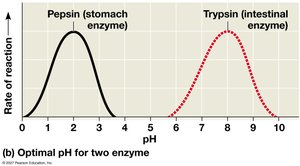
Enzyme activity is affected by environmental factors such as temperature and pH. Each enzyme has optimal conditions for activity.
Optimal pH: Different enzymes function best at different pH levels (e.g., pepsin in stomach, trypsin in intestine).
Enzyme Inhibition
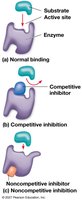
Enzyme activity can be inhibited by molecules that interfere with substrate binding.
Competitive Inhibitors: Bind to the active site, blocking substrate.
Noncompetitive Inhibitors: Bind elsewhere, changing enzyme shape and reducing activity.
Regulation of Metabolism
Regulation of Enzyme Activity
Cells regulate metabolism by controlling enzyme activity and gene expression.
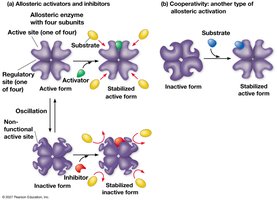
Allosteric Regulation: Enzyme activity is modulated by binding of regulatory molecules at sites other than the active site, stabilizing active or inactive forms.
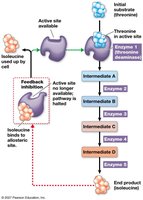
Feedback Inhibition: End product of a pathway inhibits an earlier enzyme, preventing overproduction.
Summary Table: Exergonic vs. Endergonic Reactions
Reaction Type | ΔG | Energy Flow | Spontaneity |
|---|---|---|---|
Exergonic | Negative | Releases energy | Spontaneous |
Endergonic | Positive | Absorbs energy | Nonspontaneous |
Key Equations
Gibbs Free Energy: Where ΔG = change in free energy, ΔH = change in enthalpy, T = temperature in Kelvin, ΔS = change in entropy.
ATP Hydrolysis:
Conclusion
Metabolism is central to life, governed by thermodynamic principles, and regulated by enzymes and energy carriers like ATP. Understanding these concepts is essential for studying biological processes and cellular function.
