 Indietro
Chapter 8: An Introduction to Metabolism – General Biology Study Notes
Guida di studio - Note intelligenti
 Appunti personalizzati basati sui tuoi materiali, ampliati con definizioni chiave, esempi e contesto.
Energy and Metabolism
Thermodynamics in Biological Systems
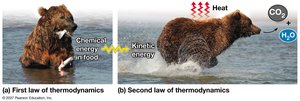
Living organisms utilize energy in accordance with the laws of thermodynamics. These laws govern how energy is transferred, transformed, and conserved within biological systems.
First Law of Thermodynamics: Energy can be transferred and transformed, but not created or destroyed. This is also known as the principle of conservation of energy.
Second Law of Thermodynamics: Every energy transfer or transformation increases the entropy (disorder) of the universe. Some energy is always lost as heat, making it unavailable for work.
Entropy: A measure of molecular disorder or randomness.
Spontaneous Processes: Occur without energy input and increase entropy.
Nonspontaneous Processes: Require energy input and decrease entropy.
Organisms as Open Systems: Organisms absorb energy and matter from their surroundings and release heat and waste products.
Forms of Energy
Energy exists in various forms and is essential for cellular work. Cells transform energy from one form to another to sustain life.
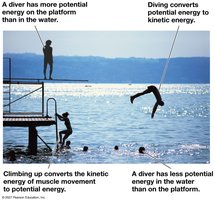
Kinetic Energy: Energy associated with motion (e.g., moving water turns turbines).
Thermal Energy: Kinetic energy due to random movement of atoms or molecules; transferred as heat.
Potential Energy: Energy possessed due to location or structure (e.g., water behind a dam).
Chemical Energy: Potential energy stored in chemical bonds, released during chemical reactions.
Light Energy: Can be harnessed for work, such as photosynthesis.
Metabolism and Metabolic Pathways
Overview of Metabolism
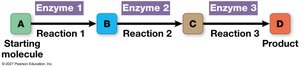
Metabolism is the totality of an organism’s chemical reactions, arising from orderly interactions between molecules. Metabolic pathways consist of a series of steps, each catalyzed by a specific enzyme.
Catabolic Pathways: Release energy by breaking down complex molecules (e.g., cellular respiration).
Anabolic Pathways: Consume energy to build complex molecules from simpler ones (e.g., protein synthesis).
Enzymes: Macromolecules (usually proteins) that speed up specific reactions by lowering activation energy.
Free Energy and Spontaneity
Gibbs Free Energy (G)
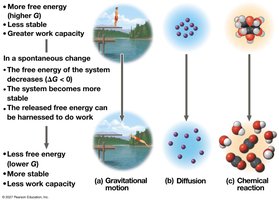
Free energy is the portion of a system’s energy that can do work under uniform temperature and pressure. The change in free energy () determines whether a process is spontaneous.
Equation: Where: = change in free energy = change in enthalpy (total energy) = change in entropy = temperature in Kelvin
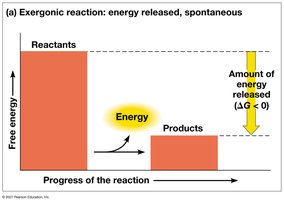
Spontaneous Processes: is negative; these processes decrease the system’s free energy and increase stability.
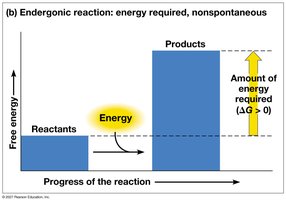
Nonspontaneous Processes: is zero or positive; require energy input.
Equilibrium: Maximum stability; systems do not spontaneously move away from equilibrium.
Exergonic and Endergonic Reactions
Chemical reactions are classified based on their free-energy changes.
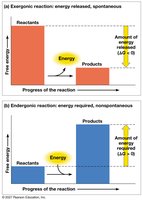
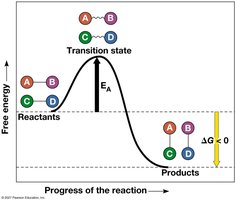
Exergonic Reaction: Proceeds with a net release of free energy (); spontaneous.
Endergonic Reaction: Absorbs free energy (); nonspontaneous.
Equilibrium and Cellular Work
Equilibrium in Biological Systems
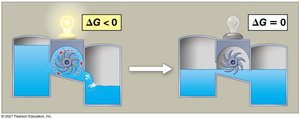
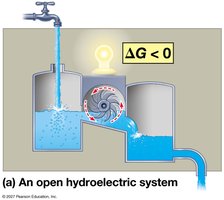
Metabolic reactions in living cells are reversible but never reach equilibrium, allowing cells to continuously do work.
Isolated System: No exchange of energy or matter; reactions reach equilibrium.
Open System: Exchange of energy and matter; prevents equilibrium.
Types of Cellular Work
Cells perform three main kinds of work:
Chemical Work: Pushing endergonic reactions.
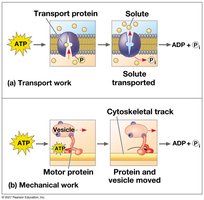
Transport Work: Pumping substances across membranes against spontaneous movement.
Mechanical Work: Beating cilia, contracting muscle cells.
ATP: The Energy Currency of the Cell
Structure and Function of ATP
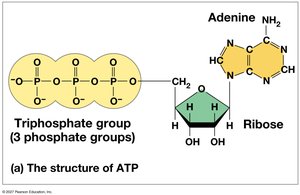
ATP (Adenosine Triphosphate) is composed of ribose (a sugar), adenine (a nitrogenous base), and three phosphate groups. It mediates most energy coupling in cells and is also used to make RNA.
ATP Hydrolysis and Energy Release
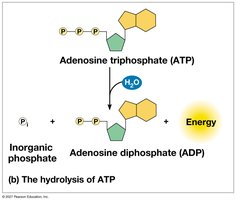
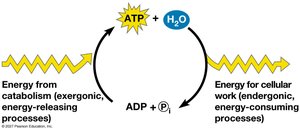
Energy is released from ATP when the terminal phosphate bond is broken by hydrolysis. The energy comes from the chemical change to a state of lower free energy in the products.
ATP and Energy Coupling
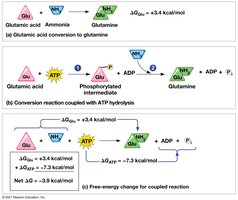
ATP powers endergonic reactions by phosphorylation, transferring a phosphate group to another molecule. The recipient, a phosphorylated intermediate, is more reactive.
The ATP Cycle
ATP is regenerated by adding a phosphate group to ADP. The energy for this comes from exergonic (energy-releasing) catabolic reactions.
Enzymes and Catalysis
Role of Enzymes
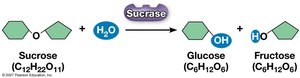
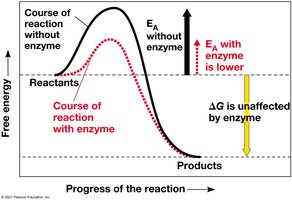
Enzymes are biological catalysts that speed up reactions by lowering activation energy without being consumed. Each enzyme is specific to its substrate.
Activation Energy and Transition State
The initial energy needed to break bonds is called activation energy (). Molecules must absorb energy to reach the transition state, where bonds are unstable and ready to break.
Enzyme Mechanism
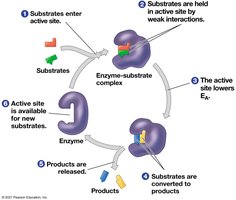
Enzymes lower activation energy by orienting substrates, stretching bonds, providing a favorable microenvironment, or participating in the reaction.
Enzyme-Substrate Complex and Active Site
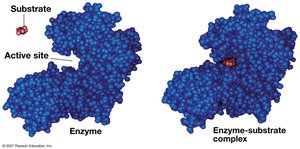
The substrate binds to the enzyme’s active site, forming an enzyme-substrate complex. The induced fit enhances catalysis.
Factors Affecting Enzyme Activity
Environmental Factors
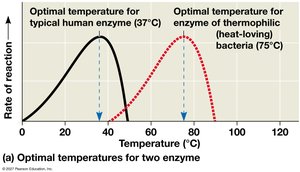
Enzyme activity is influenced by temperature, pH, and substrate concentration. Each enzyme has optimal conditions for activity.
Optimal Temperature: Human enzymes typically function best at 37°C; thermophilic bacteria enzymes at higher temperatures.
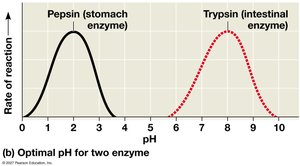
Optimal pH: Pepsin (stomach enzyme) at pH 2; trypsin (intestinal enzyme) at pH 8.
Cofactors and Inhibitors
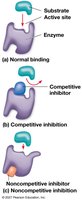
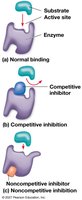
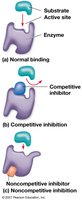
Cofactors are nonprotein helpers for enzymes. Inhibitors can be competitive (bind to active site) or noncompetitive (bind elsewhere, changing enzyme shape).
Inorganic Cofactors: Metal ions like zinc, iron, copper.
Coenzymes: Organic cofactors, often derived from vitamins.
Competitive Inhibitors: Resemble substrate, block active site.
Noncompetitive Inhibitors: Bind elsewhere, reduce enzyme activity.
Regulation of Enzyme Activity
Allosteric Regulation and Cooperativity
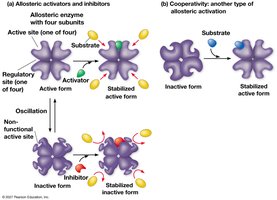
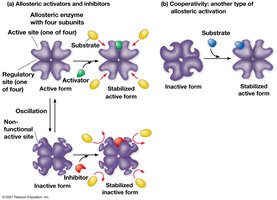
Allosteric regulation involves binding of regulatory molecules at sites other than the active site, affecting enzyme function. Cooperativity amplifies enzyme response by stabilizing the active form.
Feedback Inhibition
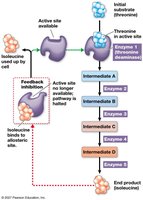
Feedback inhibition occurs when the end product of a metabolic pathway inhibits an enzyme early in the pathway, preventing overproduction and conserving resources.
Summary Table: Exergonic vs. Endergonic Reactions
Type of Reaction | ΔG | Energy Flow | Spontaneity | Example |
|---|---|---|---|---|
Exergonic | Negative (ΔG < 0) | Energy released | Spontaneous | Cellular respiration |
Endergonic | Positive (ΔG > 0) | Energy absorbed | Nonspontaneous | Photosynthesis |
Additional info: These notes expand on the original content by providing definitions, examples, and context for each concept, ensuring completeness and academic quality for exam preparation.
