 Indietro
Chapter 8: An Introduction to Metabolism – General Biology Study Notes
Guida di studio - Note intelligenti
 Appunti personalizzati basati sui tuoi materiali, ampliati con definizioni chiave, esempi e contesto.
Metabolism and Metabolic Pathways
Overview of Metabolism
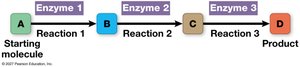
Metabolism encompasses all chemical reactions occurring within an organism, transforming matter and energy to sustain life. These reactions are organized into metabolic pathways, where each step is catalyzed by a specific enzyme.
Metabolic Pathway: A series of chemical reactions that modify a specific molecule, producing a final product.
Enzyme: A protein that accelerates a specific chemical reaction without being consumed.
Types of Metabolic Pathways
Catabolic Pathways: Break down complex molecules into simpler ones, releasing energy (e.g., cellular respiration).
Anabolic Pathways: Build complex molecules from simpler ones, consuming energy (e.g., protein synthesis).
Bioenergetics: Study of how energy flows through living organisms.
Forms of Energy
Energy Types in Biology
Energy is the capacity to cause change and exists in several forms relevant to biological systems.
Kinetic Energy: Energy of motion (e.g., moving water turns turbines).
Thermal Energy: Kinetic energy from random movement of atoms/molecules; transfer is called heat.
Light Energy: Used in processes like photosynthesis.
Potential Energy: Energy due to location or structure (e.g., water behind a dam, arrangement of electrons in molecules).
Chemical Energy: Potential energy stored in chemical bonds, released during reactions (e.g., glucose breakdown).
The Laws of Energy Transformation
Thermodynamics in Biology
Thermodynamics studies energy transformations. Biological systems are open, exchanging energy and matter with their surroundings.
Isolated System: No exchange with surroundings (e.g., liquid in a thermos).
Open System: Exchanges energy and matter (e.g., living organisms).
The First Law of Thermodynamics
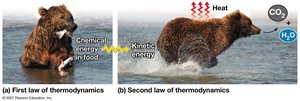
Principle: Energy cannot be created or destroyed, only transformed or transferred.
Conservation of Energy: Total energy in the universe remains constant.
The Second Law of Thermodynamics
Principle: Every energy transfer increases the entropy (disorder) of the universe.
Entropy: Measure of molecular disorder or randomness.
Spontaneous Processes: Increase entropy and occur without energy input.
Nonspontaneous Processes: Decrease entropy and require energy input.
Free Energy and Spontaneity
Gibbs Free Energy (ΔG)
Biologists use free energy changes to predict whether reactions are spontaneous.
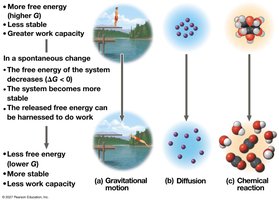
Free Energy (G): Portion of a system's energy available to do work at constant temperature and pressure.
Equation: Where:
= change in free energy
= change in enthalpy (total energy)
= change in entropy
= temperature in Kelvin
Spontaneous Reaction: is negative.
Nonspontaneous Reaction: is zero or positive.
Free Energy, Stability, and Equilibrium
Stability: Systems with lower free energy are more stable.
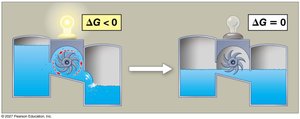
Equilibrium: Maximum stability; forward and reverse reactions occur at the same rate.
Work: Only possible when moving toward equilibrium.
Exergonic and Endergonic Reactions
Classification of Reactions
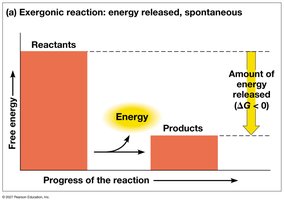
Exergonic Reaction: Releases free energy; ; spontaneous.
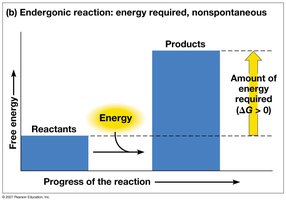
Endergonic Reaction: Absorbs free energy; ; nonspontaneous.
Magnitude of ΔG
Exergonic: Maximum work equals the magnitude of .
Endergonic: Energy input required equals the magnitude of .
Equilibrium and Metabolism
Metabolic Reactions and Equilibrium
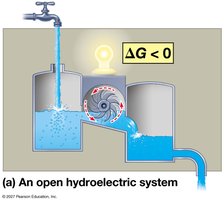
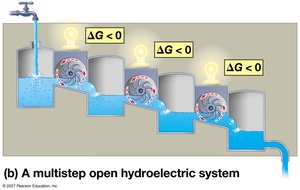
Metabolic reactions are reversible but do not reach equilibrium in living cells, allowing continuous work.
Open Systems: Materials flow in and out, preventing equilibrium.
Catabolic Pathways: Release free energy in a series of reactions, with products serving as reactants for subsequent steps.
ATP and Cellular Work
ATP: Structure and Function
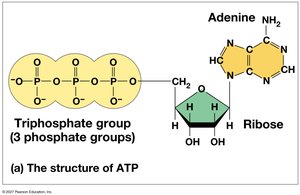
ATP (adenosine triphosphate) is the cell's energy currency, composed of ribose, adenine, and three phosphate groups.
Functions: Energy coupling, RNA synthesis.
ATP Hydrolysis
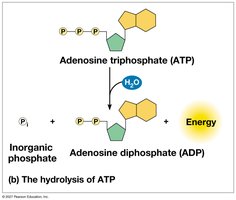
Hydrolysis: Terminal phosphate bond is broken, releasing energy.
Energy Source: Comes from the change to a lower free energy state, not directly from the phosphate bond.
Phosphate Repulsion: Creates high potential energy, like a compressed spring.
ATP Coupling and Cellular Work
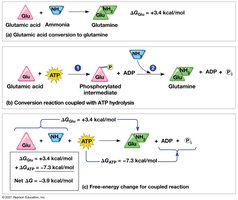
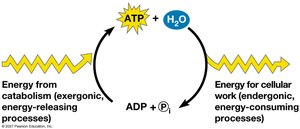
Energy Coupling: Exergonic ATP hydrolysis powers endergonic reactions.
Phosphorylation: Transfer of phosphate group to another molecule, making it more reactive.
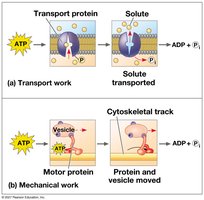
Types of Work: Chemical, transport, and mechanical work.
ATP Cycle
ATP is regenerated from ADP and inorganic phosphate using energy from catabolic reactions.
ATP Cycle: Couples energy-yielding and energy-consuming processes.
Enzymes and Metabolic Reactions
Role of Enzymes
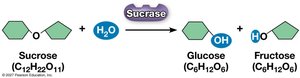
Enzymes are biological catalysts that speed up reactions by lowering activation energy barriers.
Catalyst: Speeds up a reaction without being consumed.
Example: Sucrase catalyzes hydrolysis of sucrose to glucose and fructose.
Activation Energy Barrier
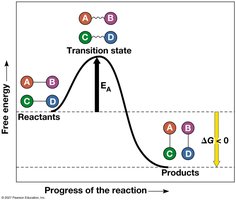
Activation Energy (EA): Initial energy required to start a reaction.
Transition State: Unstable state reached after absorbing activation energy.
Exergonic Reaction: Formation of new bonds releases more energy than was invested.
Enzyme Action
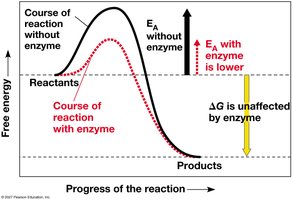
Enzymes Lower Activation Energy: Allow reactions to occur at moderate temperatures.
ΔG Unchanged: Enzymes do not alter the free energy change of a reaction.
Substrate Specificity and Enzyme Function
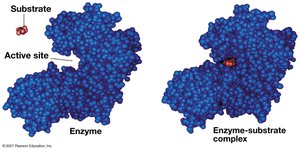
Enzyme-Substrate Complex
Substrate: Reactant acted upon by an enzyme.
Active Site: Region on enzyme where substrate binds.
Induced Fit: Enzyme changes shape to fit substrate, enhancing catalysis.
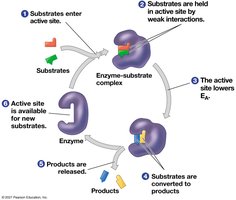
Catalytic Cycle
Weak Bonds: Substrate held by weak interactions (e.g., hydrogen bonds).
Rapid Conversion: Substrate converted to product and released; enzyme is unchanged.
Mechanisms of Catalysis
Substrate orientation, bond stretching, microenvironment changes, and direct participation by amino acids in the active site.
Reaction rate increases with substrate concentration until enzyme is saturated.
Effects of Local Conditions on Enzyme Activity
Temperature and pH
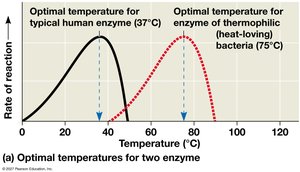
Optimal Temperature: Each enzyme has a temperature at which it works best; human enzymes ~37°C, thermophilic bacteria ~75°C.
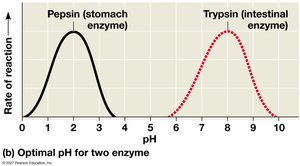
Optimal pH: Each enzyme has a pH at which it is most active; pepsin (stomach) pH 2, trypsin (intestine) pH 8.
Cofactors and Enzyme Inhibition
Cofactors
Inorganic Cofactors: Metal ions (e.g., zinc, iron, copper).
Coenzymes: Organic cofactors, often derived from vitamins.
Enzyme Inhibitors
Irreversible Inhibition: Inhibitor forms covalent bonds with enzyme.
Reversible Inhibition: Inhibitor binds by weak interactions.
Localization of Enzymes within the Cell
Compartmentalization and Structural Order
Cellular compartmentalization organizes metabolic pathways.
Multienzyme Complexes: Enzymes for several steps may be grouped together.
Fixed Locations: Some enzymes are structural components of membranes.
Organelle Localization: In eukaryotes, enzymes reside in specific organelles (e.g., mitochondria for cellular respiration).
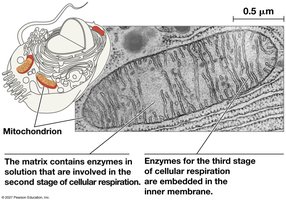
Summary Table: Exergonic vs. Endergonic Reactions
Reaction Type | ΔG | Energy Flow | Spontaneity |
|---|---|---|---|
Exergonic | Negative | Releases energy | Spontaneous |
Endergonic | Positive | Requires energy input | Nonspontaneous |
Summary Table: Effects of Temperature and pH on Enzyme Activity
Enzyme | Optimal Temperature (°C) | Optimal pH |
|---|---|---|
Human Enzyme | ~37 | Varies |
Thermophilic Bacteria | ~75 | Varies |
Pepsin (Stomach) | ~37 | 2 |
Trypsin (Intestine) | ~37 | 8 |
Key Equations
Free Energy Change:
Conclusion
Metabolism is a fundamental concept in biology, involving the transformation of energy and matter through organized pathways. Enzymes play a crucial role in regulating these pathways, ensuring life’s processes occur efficiently and under controlled conditions. Additional info: Academic context was added to clarify the role of enzymes, ATP, and energy transformations in cellular metabolism, and to ensure completeness for exam preparation.
