 Indietro
Chapter 8: An Introduction to Metabolism – General Biology Study Notes
Guida di studio - Note intelligenti
 Appunti personalizzati basati sui tuoi materiali, ampliati con definizioni chiave, esempi e contesto.
Chapter 8: An Introduction to Metabolism
Big Idea: Metabolism and Cellular Energy
Metabolism encompasses all chemical reactions within cells, including those that generate or consume energy. These reactions are organized into metabolic pathways, which are essential for life’s processes.
Concept 8.1: An Organism’s Metabolism Transforms Matter and Energy
Metabolic Pathways
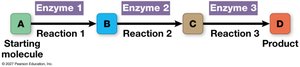
Metabolic pathways are sequences of chemical reactions, each catalyzed by a specific enzyme, that transform molecules within the cell.
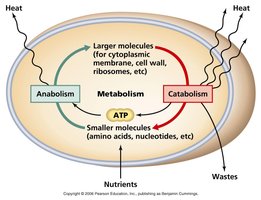
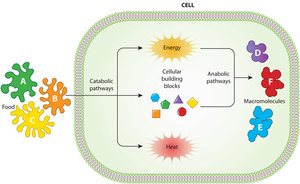
Catabolic pathways break down complex molecules into simpler ones, releasing energy (e.g., cellular respiration).
Anabolic pathways build complex molecules from simpler ones, consuming energy (e.g., protein synthesis).
Enzymes are biological catalysts that speed up reactions without being consumed.
Metabolism is an emergent property arising from the orderly interactions between molecules.
Cells are open systems, exchanging energy and matter with their surroundings.
Forms of Energy
Energy is the capacity to cause change and is used to do work in biological systems.
Kinetic energy: Energy of motion.
Potential energy: Energy stored due to position or structure.
Chemical energy: Potential energy available for release in chemical reactions.
The Laws of Thermodynamics
Thermodynamics governs energy transformations in biological systems.
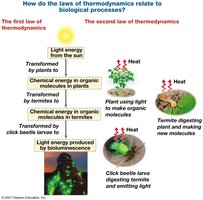
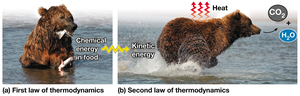
First Law: Energy can be transferred and transformed, but not created or destroyed.
Second Law: Every energy transfer increases the entropy (disorder) of the universe; some energy is lost as heat.
Concept 8.2: Free-Energy Change and Spontaneity of Reactions
Gibbs Free Energy (ΔG)
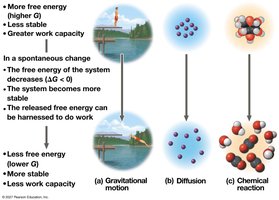
Free energy is the portion of a system’s energy that can perform work at constant temperature and pressure.
Change in free energy () determines whether a reaction is spontaneous.
Formula: Where: = change in enthalpy (total energy) = change in entropy = temperature in Kelvin
Spontaneous reactions have (negative free energy change).
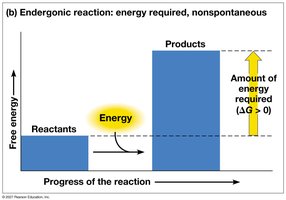
Nonspontaneous reactions have (positive free energy change).
Exergonic vs. Endergonic Reactions
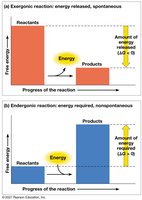
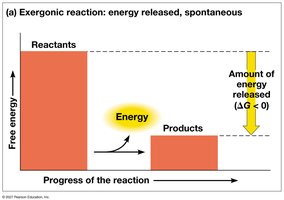
Chemical reactions are classified by their free-energy changes.
Exergonic reactions: Net release of free energy; spontaneous ().
Endergonic reactions: Absorb free energy; nonspontaneous ().
Concept 8.3: ATP Powers Cellular Work by Coupling Reactions
Structure and Function of ATP
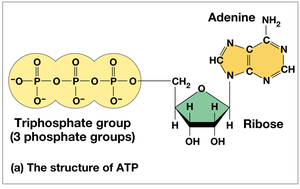
ATP (adenosine triphosphate) is the cell’s energy currency, composed of ribose, adenine, and three phosphate groups.
ATP belongs to the class of nucleotides.
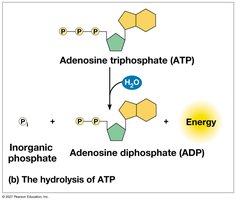
Hydrolysis of ATP releases energy by breaking the terminal phosphate bond.
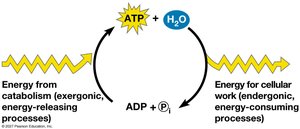
ATP is regenerated from ADP and inorganic phosphate using energy from catabolic reactions.
ATP Coupling and Cellular Work
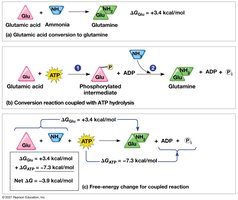
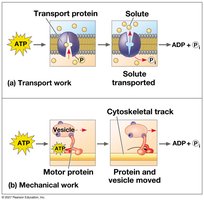
ATP hydrolysis powers cellular work by coupling exergonic and endergonic reactions.
Chemical work: Drives endergonic reactions.
Transport work: Pumps substances across membranes.
Mechanical work: Moves cellular structures (e.g., cilia, muscle contraction).
Phosphorylation transfers a phosphate group from ATP to another molecule, increasing its energy.
Concept 8.4: Enzymes Speed Up Metabolic Reactions by Lowering Energy Barriers
Role and Function of Enzymes
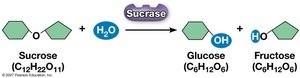
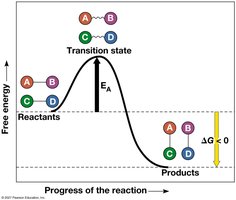
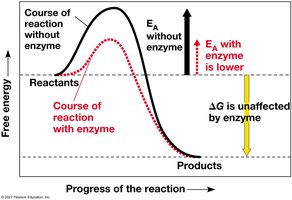
Enzymes are biological catalysts that lower the activation energy required for reactions, increasing reaction rates without altering the free energy change ().
Enzymes are typically proteins.
They facilitate reactions by stabilizing the transition state.
Activation energy is the initial energy needed to start a reaction.
Enzyme Specificity and Induced Fit
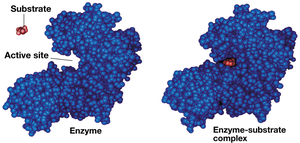
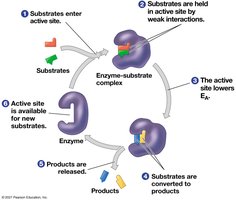
Enzymes are highly specific for their substrates due to the shape and chemical properties of their active sites.
The active site binds the substrate, forming an enzyme-substrate complex.
Induced fit: The enzyme changes shape to better fit the substrate, enhancing catalysis.
Factors Affecting Enzyme Activity
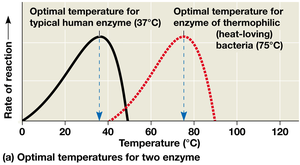
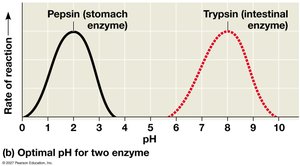
Enzyme activity is influenced by substrate concentration, temperature, pH, cofactors, and inhibitors.
Increasing substrate concentration increases reaction rate until the enzyme is saturated.
Each enzyme has optimal temperature and pH for activity.
Cofactors (inorganic or organic) are required for some enzymes to function.
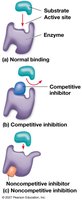
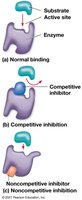
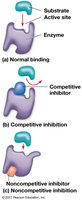
Enzyme inhibitors can be competitive (bind active site) or noncompetitive (bind elsewhere).
Concept 8.5: Regulation of Enzyme Activity Helps Control Metabolism
Allosteric Regulation
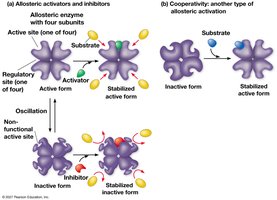
Allosteric regulation involves the binding of regulatory molecules to sites other than the active site, affecting enzyme activity.
Enzymes can oscillate between active and inactive forms.
Activators stabilize the active form; inhibitors stabilize the inactive form.
Cooperativity occurs when substrate binding to one subunit enhances activity in others (e.g., hemoglobin).
Feedback Inhibition
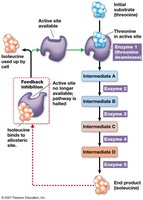
Feedback inhibition is a regulatory mechanism where the end product of a pathway inhibits an earlier step, preventing overproduction and conserving resources.
Type of Regulation | Mechanism | Effect |
|---|---|---|
Allosteric Regulation | Regulatory molecule binds to enzyme (not active site) | Activates or inhibits enzyme |
Feedback Inhibition | End product inhibits pathway | Prevents waste, maintains balance |
Competitive Inhibition | Inhibitor binds active site | Blocks substrate, reversible |
Noncompetitive Inhibition | Inhibitor binds elsewhere | Changes enzyme shape, reduces activity |
Summary: Metabolism is a complex network of chemical reactions regulated by enzymes and energy transformations. Understanding these processes is fundamental to biology, as they underpin cellular function, growth, and homeostasis.
