 Indietro
Chapter 8: An Introduction to Metabolism and Enzyme Function
Guida di studio - Note intelligenti
 Appunti personalizzati basati sui tuoi materiali, ampliati con definizioni chiave, esempi e contesto.
Metabolism and Metabolic Pathways
Overview of Metabolism
Metabolism refers to the totality of an organism’s chemical reactions, which transform matter and energy to sustain life. These reactions are organized into metabolic pathways, each consisting of a series of steps catalyzed by specific enzymes.
Metabolic pathway: A sequence of chemical reactions, each catalyzed by a different enzyme, that either builds (anabolic) or breaks down (catabolic) molecules.
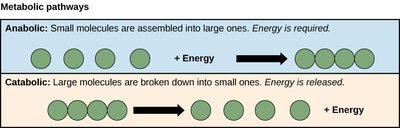
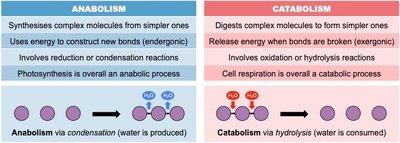
Anabolic pathway: Consumes energy to synthesize complex molecules from simpler ones.
Catabolic pathway: Releases energy by breaking down complex molecules into simpler ones.

Examples and Applications
Anabolic example: Synthesis of proteins from amino acids.
Catabolic example: Cellular respiration, which breaks down glucose to release energy.
Forms of Energy and Bioenergetics
Types of Energy
Energy is the capacity to cause change and exists in various forms. Bioenergetics is the study of how energy flows through living organisms.
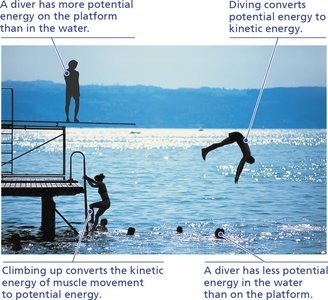
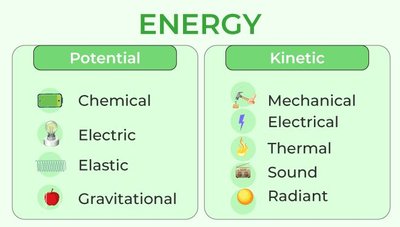
Kinetic energy: Energy of motion.
Potential energy: Stored energy due to position or structure, including chemical energy in molecules.
Chemical energy: Potential energy available for release in a chemical reaction.
The Laws of Thermodynamics
Energy Transformation in Biological Systems
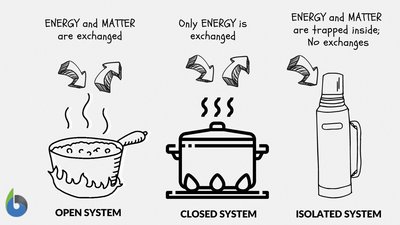
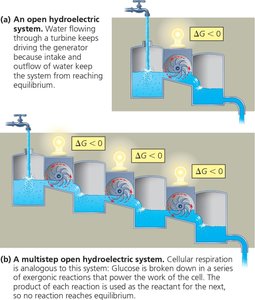
Thermodynamics is the study of energy transformations. Biological systems are typically open systems, exchanging energy and matter with their surroundings.
System: The matter under study.
Surroundings: Everything outside the system.
Open system: Exchanges both energy and matter (e.g., organisms).
Closed system: Exchanges energy but not matter.
Isolated system: No exchange of energy or matter.
First Law of Thermodynamics
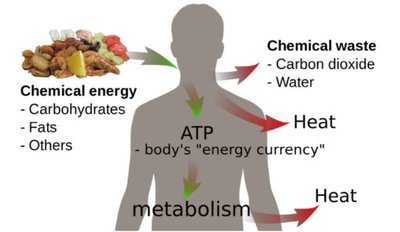
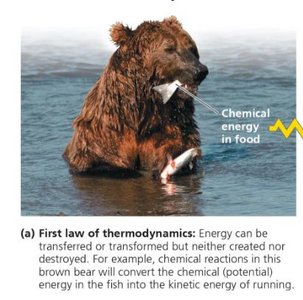
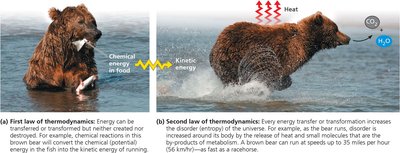
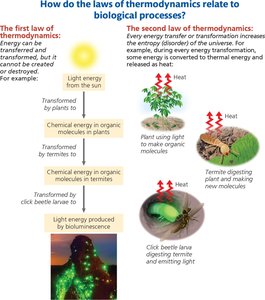
The first law states that energy can be transferred and transformed, but cannot be created or destroyed (principle of conservation of energy).
Example: Chemical energy in food is converted to kinetic energy and heat in animals.
Second Law of Thermodynamics
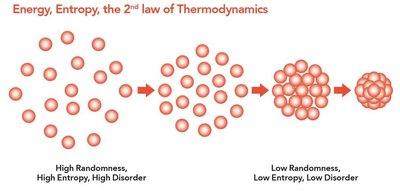
Every energy transfer or transformation increases the entropy (disorder) of the universe. Entropy is a measure of molecular randomness.
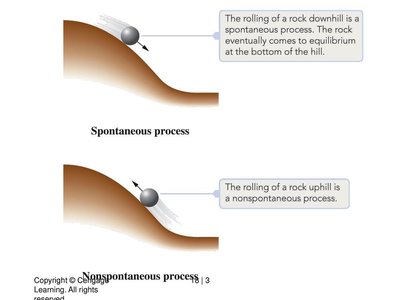
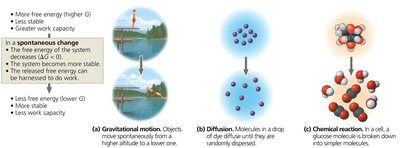
Spontaneous processes: Occur without energy input and increase entropy.
Nonspontaneous processes: Require energy input and decrease entropy.
Free Energy and Spontaneity
Gibbs Free Energy
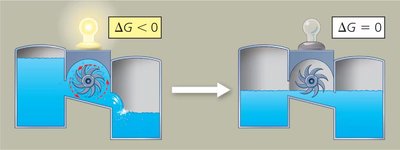
Free energy (G) is the portion of a system’s energy that can perform work at constant temperature and pressure. The change in free energy () determines whether a reaction is spontaneous.
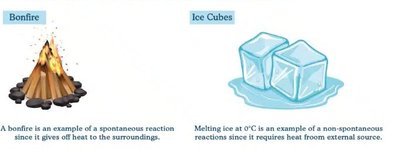
Spontaneous reaction: (negative), energetically favorable, increases entropy.
Nonspontaneous reaction: (positive), requires energy input.
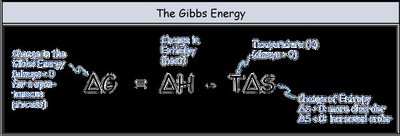
Equation:
= change in enthalpy (total energy)
= temperature in Kelvin
= change in entropy
Stability and Equilibrium
Systems move toward lower free energy and greater stability. At equilibrium, and no work can be done.
Exergonic and Endergonic Reactions
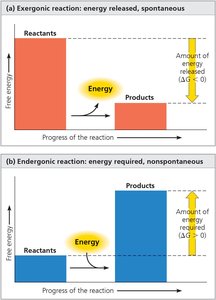
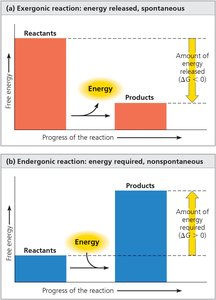
Exergonic reaction: Releases energy, , spontaneous (e.g., cellular respiration).
Endergonic reaction: Requires energy input, , nonspontaneous (e.g., synthesis of ATP).
ATP and Energy Coupling
ATP Structure and Function
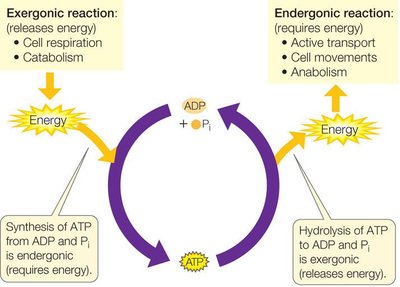
ATP (Adenosine Triphosphate) is the cell’s energy currency, consisting of ribose, adenine, and three phosphate groups. Hydrolysis of ATP releases energy used to drive endergonic reactions.
ATP hydrolysis: ATP + H2O → ADP + Pi ( kcal/mol)
ATP regeneration: ADP + Pi → ATP + H2O ( kcal/mol)
Cellular Work Powered by ATP
Chemical work: Synthesis of macromolecules.
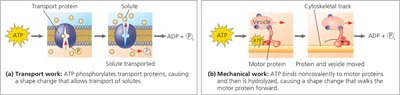
Transport work: Pumping substances across membranes.
Mechanical work: Movement of cilia, muscle contraction.
Enzymes and Catalysis
Role of Enzymes
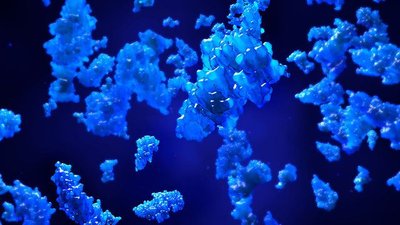
Enzymes are biological catalysts, usually proteins, that speed up metabolic reactions by lowering the activation energy barrier without being consumed.
Activation energy (EA): The energy required to initiate a reaction.
Catalyst: A substance that increases the rate of a reaction without being consumed.
How Enzymes Work
Substrate: The reactant an enzyme acts on.
Active site: The region of the enzyme where substrate binding and catalysis occur.
Induced fit: The enzyme changes shape to bind the substrate more tightly, enhancing catalysis.
Factors Affecting Enzyme Activity
Temperature: Enzyme activity increases with temperature up to an optimal point, then decreases as the enzyme denatures.
pH: Most enzymes have an optimal pH between 6-8.
Enzyme concentration: More enzyme increases reaction rate if substrate is available.
Substrate concentration: Saturation occurs when all enzyme active sites are occupied.
Cofactors and Enzyme Inhibition
Cofactors: Non-protein helpers required for enzyme function; can be inorganic (metal ions) or organic (coenzymes, often vitamins).
Competitive inhibitors: Bind to the active site, blocking substrate binding.
Noncompetitive inhibitors: Bind elsewhere, changing enzyme shape and reducing activity.
Irreversible inhibitors: Toxins and poisons that permanently inactivate enzymes.
Regulation of Enzyme Activity
Allosteric Regulation and Feedback Inhibition
Cells regulate metabolism by controlling enzyme activity. Allosteric regulation involves binding of regulatory molecules at sites other than the active site, affecting enzyme function. Feedback inhibition occurs when the end product of a pathway inhibits an enzyme early in the pathway, preventing overproduction.
Allosteric regulation: Can inhibit or stimulate enzyme activity.
Feedback inhibition: Maintains metabolic balance by halting pathways when enough product is made.
Example: The end product D inhibits Enzyme 1, stopping the pathway when enough D is produced.
Additional info: These notes expand on the original content by providing definitions, examples, and context for each concept, ensuring completeness and academic quality for exam preparation.
