 Indietro
Chapter 8: An Introduction to Metabolism – General Biology Study Notes
Guida di studio - Note intelligenti
 Appunti personalizzati basati sui tuoi materiali, ampliati con definizioni chiave, esempi e contesto.
Metabolism and Metabolic Pathways
Definition and Overview
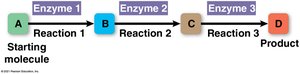
Metabolism is the sum of all chemical reactions occurring within an organism, enabling the transformation of matter and energy. It is an emergent property of life, arising from the orderly interactions between molecules. Metabolic pathways consist of a series of steps, each catalyzed by a specific enzyme, converting a starting molecule into a final product.
Metabolic Pathway: A sequence of enzymatically catalyzed reactions.
Enzyme: A protein that accelerates a specific chemical reaction.
Example: Cellular respiration is a metabolic pathway that breaks down glucose in the presence of oxygen.
Types of Metabolic Pathways
Catabolic and Anabolic Pathways
Metabolic pathways are classified as either catabolic or anabolic. Catabolic pathways release energy by breaking down complex molecules into simpler ones, while anabolic pathways consume energy to build complex molecules from simpler ones.
Catabolic Pathways: "Downhill" reactions; e.g., cellular respiration.
Anabolic Pathways: "Uphill" reactions; e.g., protein synthesis from amino acids.
Bioenergetics: The study of how energy flows through living organisms.
Forms of Energy
Kinetic, Potential, and Chemical Energy
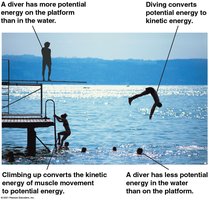
Energy is the capacity to cause change and exists in various forms. Living cells transform energy to perform work, such as moving matter or synthesizing molecules.
Kinetic Energy: Energy of motion (e.g., moving water turns turbines).
Thermal Energy: Kinetic energy from random movement of atoms/molecules; transfer is called heat.
Light Energy: Used in photosynthesis.
Potential Energy: Energy due to location or structure (e.g., water behind a dam).
Chemical Energy: Potential energy stored in molecular bonds (e.g., glucose).
Energy Transformation and Thermodynamics
First and Second Laws of Thermodynamics
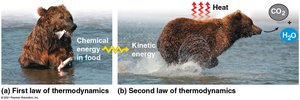
Thermodynamics is the study of energy transformations. Organisms are open systems, exchanging energy and matter with their surroundings. The first law states that energy cannot be created or destroyed, only transformed. The second law states that every energy transfer increases the entropy (disorder) of the universe.
First Law: Principle of conservation of energy.
Second Law: Entropy increases with every energy transfer.
Spontaneous Processes: Increase entropy and occur without energy input.
Nonspontaneous Processes: Decrease entropy and require energy input.
Free Energy and Spontaneity
Gibbs Free Energy (G)
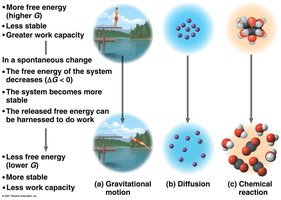
Free energy is the portion of a system's energy available to do work. The change in free energy (ΔG) determines whether a reaction is spontaneous.
Equation:
Spontaneous Reaction: (energetically favorable)
Nonspontaneous Reaction:
Equilibrium: Maximum stability; no work can be done.
Equilibrium and Metabolism
Open vs. Closed Systems
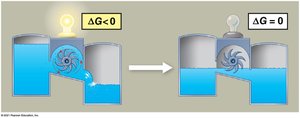
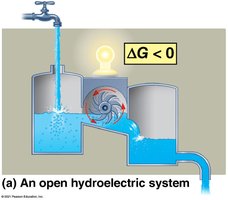
Cells are open systems, allowing material flow and preventing metabolic equilibrium. In a closed system, reactions reach equilibrium and can no longer do work, which is incompatible with life.
Open System: Continuous flow of materials; reactions never reach equilibrium.
Closed System: Reactions reach equilibrium; no work is possible.
Cellular Work and Energy Coupling
Types of Cellular Work
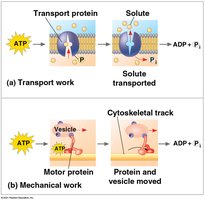
Cells perform three main types of work: chemical, transport, and mechanical. Energy coupling uses exergonic reactions to drive endergonic ones, primarily mediated by ATP.
Chemical Work: Pushing endergonic reactions.
Transport Work: Pumping substances across membranes.
Mechanical Work: Movement, such as muscle contraction.
ATP: Adenosine triphosphate, the cell's energy currency.
ATP Structure and Function
ATP Hydrolysis and Energy Release
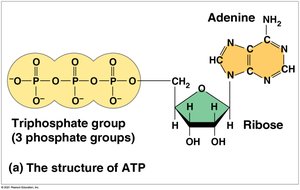
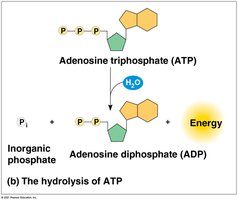
ATP consists of ribose, adenine, and three phosphate groups. Hydrolysis of ATP releases energy by breaking the terminal phosphate bond, powering cellular work.
ATP Hydrolysis:
Phosphorylation: Transfer of phosphate group to another molecule, making it more reactive.
Enzymes and Activation Energy
Enzyme Function and Catalysis
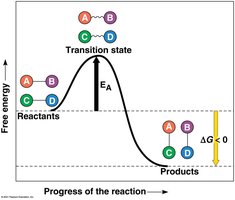
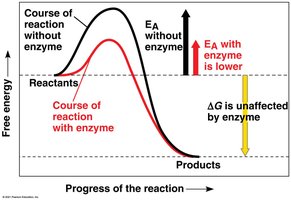
Enzymes are biological catalysts that speed up reactions by lowering the activation energy (EA) barrier. They do not alter ΔG, but make reactions occur faster.
Activation Energy (EA): Initial energy required to start a reaction.
Transition State: Unstable state that reactants must reach for bonds to break.
Catalysis: Selective acceleration of reactions by enzymes.
Enzyme Specificity and Mechanism
Substrate Binding and Induced Fit
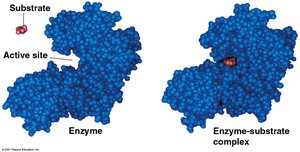
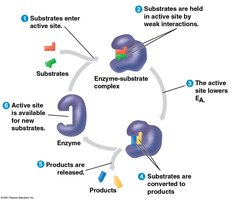
Enzymes bind to specific substrates at their active sites, forming an enzyme-substrate complex. The induced fit enhances catalysis by bringing chemical groups into optimal positions.
Substrate: The reactant an enzyme acts upon.
Active Site: Region on enzyme where substrate binds.
Induced Fit: Enzyme changes shape to better fit substrate.
Factors Affecting Enzyme Activity
Temperature, pH, and Cofactors
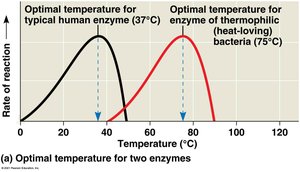
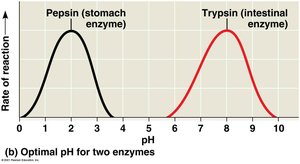
Enzyme activity is influenced by environmental conditions and cofactors. Each enzyme has an optimal temperature and pH for maximum activity. Cofactors, either inorganic or organic (coenzymes), assist enzyme function.
Optimal Temperature: Human enzymes ~37°C; thermophilic bacteria ~75°C.
Optimal pH: Pepsin (stomach) ~2; Trypsin (intestine) ~8.
Cofactors: Nonprotein helpers; coenzymes are organic cofactors.
Enzyme Inhibition and Regulation
Competitive and Noncompetitive Inhibitors
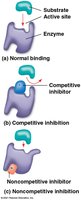
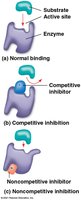
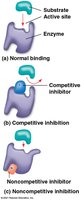
Enzyme inhibitors can reduce enzyme activity. Competitive inhibitors bind to the active site, while noncompetitive inhibitors bind elsewhere, altering enzyme shape and function.
Competitive Inhibition: Inhibitor resembles substrate and blocks active site.
Noncompetitive Inhibition: Inhibitor binds away from active site, changing enzyme shape.
Irreversible Inhibition: Toxins and poisons often act as irreversible inhibitors.
Allosteric Regulation and Feedback Inhibition
Enzyme Regulation Mechanisms
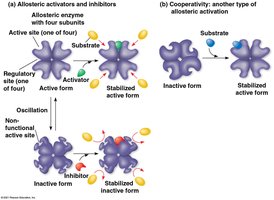
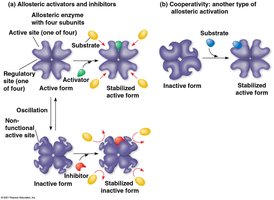
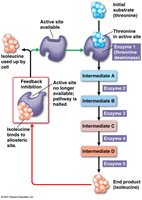
Cells regulate metabolic pathways through allosteric regulation and feedback inhibition. Allosteric regulation involves binding of regulatory molecules at sites other than the active site, affecting enzyme activity. Feedback inhibition occurs when the end product of a pathway inhibits an earlier step, preventing overproduction.
Allosteric Regulation: Regulatory molecule binds to enzyme, stabilizing active or inactive form.
Cooperativity: Substrate binding to one active site enhances activity at other sites.
Feedback Inhibition: End product inhibits pathway, conserving resources.
Localization of Enzymes Within the Cell
Compartmentalization and Multienzyme Complexes
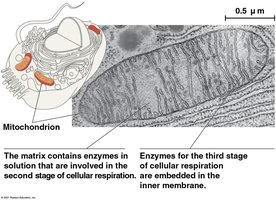
Cellular compartmentalization organizes metabolic pathways, with enzymes localized to specific organelles or forming multienzyme complexes. This spatial arrangement enhances efficiency and regulation.
Compartmentalization: Enzymes reside in specific organelles (e.g., mitochondria).
Multienzyme Complexes: Groups of enzymes catalyzing sequential steps.
Type of Pathway | Energy Flow | Example |
|---|---|---|
Catabolic | Releases energy | Cellular respiration |
Anabolic | Consumes energy | Protein synthesis |
Additional info: These notes provide a comprehensive overview of metabolism, energy transformation, enzyme function, and regulation, suitable for General Biology students preparing for exams.
