 Indietro
Chapter 8: An Introduction to Metabolism – Study Notes
Guida di studio - Note intelligenti
 Appunti personalizzati basati sui tuoi materiali, ampliati con definizioni chiave, esempi e contesto.
Energy and Metabolism
Thermodynamics and Biological Systems
Biological processes are governed by the laws of thermodynamics, which describe how energy is transferred and transformed in living organisms. These laws are fundamental to understanding metabolism and energy flow in cells.
First Law of Thermodynamics: Energy cannot be created or destroyed, only transferred or transformed. This is also known as the principle of conservation of energy.
Second Law of Thermodynamics: Every energy transfer or transformation increases the entropy (disorder) of the universe. Some energy is always lost as heat, making it unavailable to do work.
Entropy: A measure of molecular disorder or randomness. Spontaneous processes increase the entropy of the universe.
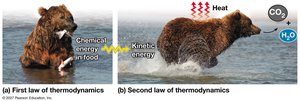
Metabolism: Transforming Matter and Energy
Metabolism is the sum of all chemical reactions in an organism. It is an emergent property of life, arising from the orderly interactions between molecules. Metabolic pathways are sequences of chemical reactions, each catalyzed by a specific enzyme.
Catabolic Pathways: Break down complex molecules into simpler ones, releasing energy (e.g., cellular respiration).
Anabolic Pathways: Build complex molecules from simpler ones, consuming energy (e.g., protein synthesis).
Bioenergetics: The study of how energy flows through living organisms.
Forms of Energy in Biological Systems
Types of Energy
Energy is the capacity to cause change and can exist in various forms. Living cells must transform energy from one form to another to perform work.
Kinetic Energy: Energy of motion.
Potential Energy: Stored energy due to position or structure.
Chemical Energy: A form of potential energy stored in chemical bonds, available for release in a chemical reaction (e.g., glucose).
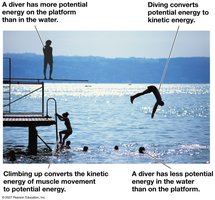
The Laws of Energy Transformation
Open and Closed Systems
In an open system, energy and matter can be exchanged with the surroundings. Organisms are open systems, absorbing energy (e.g., light, food) and releasing heat and waste products.
Free Energy and Spontaneity
Gibbs free energy (G) is the portion of a system’s energy that can do work at constant temperature and pressure. The change in free energy () determines whether a process is spontaneous.
Spontaneous Process: Occurs without energy input; .
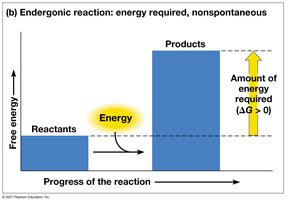
Nonspontaneous Process: Requires energy input; .
Every spontaneous process decreases the system’s free energy.
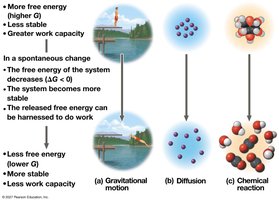
Exergonic and Endergonic Reactions
Classification of Chemical Reactions
Chemical reactions are classified based on their free-energy changes:
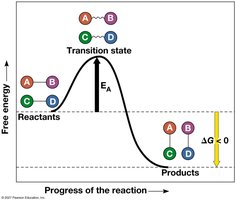
Exergonic Reaction: Proceeds with a net release of free energy (); spontaneous.
Endergonic Reaction: Absorbs free energy from the surroundings (); nonspontaneous.
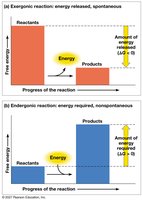
Equilibrium and Metabolism
Metabolic reactions are reversible but never reach equilibrium in living cells. The constant flow of materials in and out of cells prevents equilibrium, allowing cells to continue performing work.
ATP and Cellular Work
ATP: The Energy Currency of the Cell
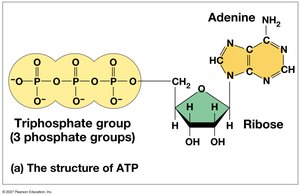
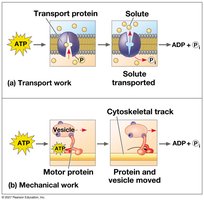
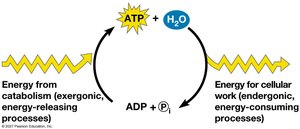
Adenosine triphosphate (ATP) powers cellular work by coupling exergonic reactions to endergonic reactions. ATP consists of adenine, ribose, and three phosphate groups.
Chemical Work: Pushing endergonic reactions.
Transport Work: Pumping substances across membranes.
Mechanical Work: Movement, such as muscle contraction.
ATP Hydrolysis and Energy Coupling
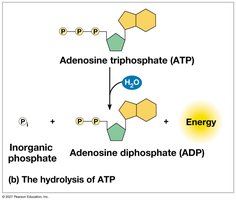
ATP hydrolysis releases energy by breaking a phosphate bond, forming ADP and inorganic phosphate (). This energy is used to drive endergonic reactions in the cell.
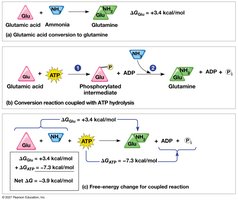
Cells use energy coupling to link exergonic and endergonic reactions, often mediated by ATP.
Enzymes and Metabolic Reactions
Role of Enzymes
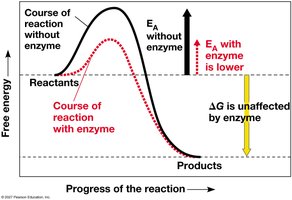
Enzymes are biological catalysts that speed up metabolic reactions by lowering the activation energy barrier. They are typically proteins and are highly specific for their substrates.
Catalyst: A chemical agent that increases the rate of a reaction without being consumed.
Enzymes enable reactions to occur rapidly at cellular temperatures.
Activation Energy
Every chemical reaction requires an initial input of energy, called activation energy (E_A), to break bonds and start the reaction. Enzymes lower this barrier, making reactions proceed faster.
Enzyme-Substrate Specificity
The reactant an enzyme acts on is called its substrate. The enzyme binds to the substrate at its active site, forming an enzyme-substrate complex. The enzyme changes shape slightly to fit the substrate (induced fit), facilitating the reaction.
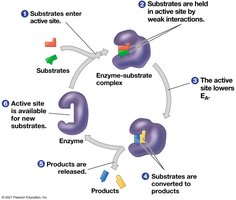
Mechanisms of Enzyme Action
Enzymes may orient substrates, stretch bonds, provide a favorable microenvironment, or participate directly in the reaction.
The rate of enzyme-catalyzed reactions increases with substrate concentration until the enzyme is saturated.
Environmental Effects on Enzyme Activity
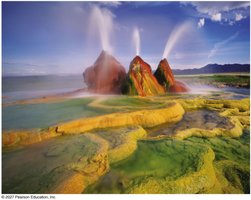
Enzyme activity is affected by temperature, pH, and the presence of inhibitors or activators. Each enzyme has optimal conditions for activity.
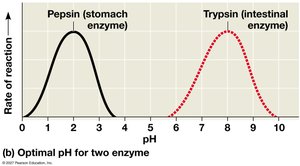
Enzyme Inhibition
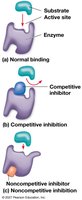
Enzyme activity can be inhibited by molecules that reduce their function:
Competitive Inhibitors: Bind to the active site, blocking the substrate.
Noncompetitive Inhibitors: Bind elsewhere, changing the enzyme’s shape and reducing activity.
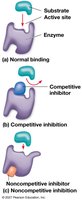
Regulation of Metabolism
Enzyme Regulation
Cells regulate metabolism by controlling enzyme activity and gene expression. This ensures efficient use of resources and prevents chemical chaos.
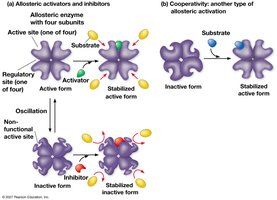
Allosteric Regulation: Enzyme function is regulated by molecules binding to sites other than the active site, stabilizing active or inactive forms.
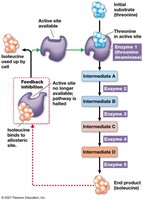
Feedback Inhibition: The end product of a metabolic pathway inhibits an enzyme involved earlier in the pathway, preventing overproduction.
Summary Table: Key Concepts in Metabolism
Concept | Description | Example |
|---|---|---|
Catabolic Pathway | Breaks down molecules, releases energy | Cellular respiration |
Anabolic Pathway | Builds molecules, consumes energy | Protein synthesis |
Exergonic Reaction | Releases free energy, spontaneous | Hydrolysis of ATP |
Endergonic Reaction | Requires energy input, nonspontaneous | Synthesis of glucose |
Enzyme | Speeds up reactions by lowering activation energy | Sucrase catalyzing sucrose hydrolysis |
Allosteric Regulation | Regulation by binding at a site other than the active site | Feedback inhibition |
