Indietro
Chapter 8: An Introduction to Metabolism – Study Notes
Guida di studio - Note intelligenti
 Appunti personalizzati basati sui tuoi materiali, ampliati con definizioni chiave, esempi e contesto.
An Introduction to Metabolism
Metabolism and Metabolic Pathways
Metabolism encompasses all chemical reactions occurring within an organism, transforming matter and energy to sustain life. These reactions are organized into metabolic pathways, where a starting molecule is converted stepwise into a product, each step catalyzed by a specific enzyme.
Metabolic Pathway: A series of chemical reactions, each catalyzed by a different enzyme, converting a starting molecule to a final product.
Catabolic Pathways: Break down complex molecules into simpler ones, releasing energy (e.g., cellular respiration).
Anabolic Pathways: Build complex molecules from simpler ones, consuming energy (e.g., protein synthesis).
Example: The breakdown of glucose in cellular respiration is a catabolic pathway. 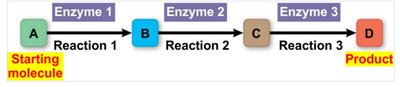
Bioenergetics and Forms of Energy
Bioenergetics studies how energy flows through living organisms. Energy is the capacity to cause change and exists in various forms:
Chemical Energy: Stored in bonds of molecules (e.g., food).
Kinetic Energy: Energy of motion (e.g., muscle movement).
Potential Energy: Stored energy due to position or structure.
Example: A bear converts chemical energy in food to kinetic energy for movement, releasing heat and waste products. 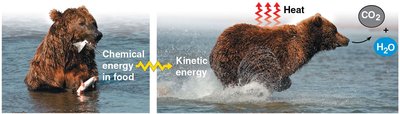
Thermodynamics in Biological Systems
Organisms are open systems, exchanging energy and matter with their surroundings. Two laws of thermodynamics govern biological processes:
First Law: Energy can be transferred and transformed, but not created or destroyed.
Second Law: Every energy transfer increases entropy (disorder); some energy is lost as heat.
Free Energy, Entropy, and Spontaneity
The concept of free energy (G) helps predict whether a process is spontaneous.
Free Energy (G): The portion of a system’s energy available to do work.
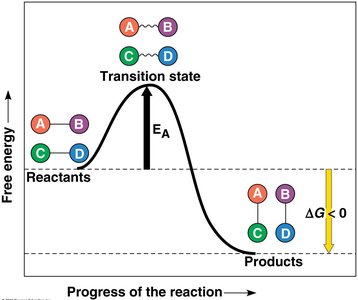
Spontaneous Process: Occurs without energy input; increases entropy; ΔG < 0.
Nonspontaneous Process: Requires energy input; decreases entropy; ΔG ≥ 0.
Equation: 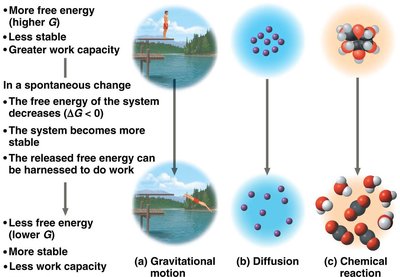
Exergonic vs. Endergonic Reactions
Reactions are classified by their free-energy changes:
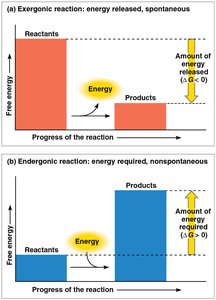
Exergonic Reaction: Releases free energy; spontaneous; ΔG < 0.
Endergonic Reaction: Absorbs free energy; nonspontaneous; ΔG > 0.
Equilibrium and Open Systems
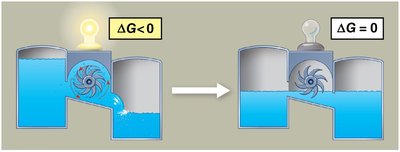
Closed System: Reactions reach equilibrium (ΔG = 0) and stop doing work.
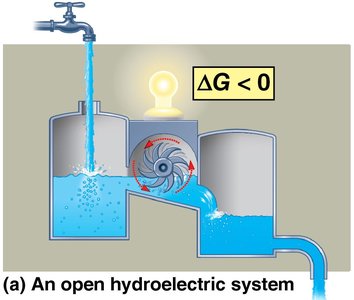
Open System: Living cells are open, never reaching equilibrium, allowing continuous work.
ATP: The Energy Currency of the Cell
ATP (adenosine triphosphate) stores and releases energy for cellular work.
ATP Hydrolysis: Water breaks the terminal phosphate bond, forming ADP and inorganic phosphate (Pi), releasing energy.
Energy Coupling: ATP hydrolysis (exergonic) drives endergonic reactions via phosphorylation.
ATP Cycle: Catabolic pathways regenerate ATP from ADP + Pi.
Equation: 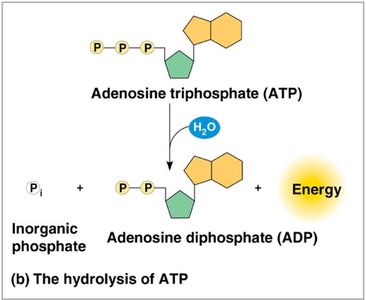
Enzymes and Catalysis
Enzyme Function and Activation Energy
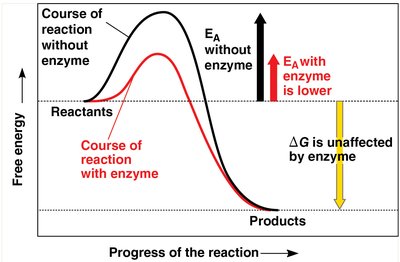
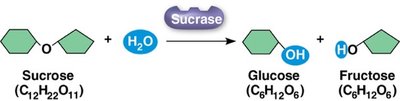
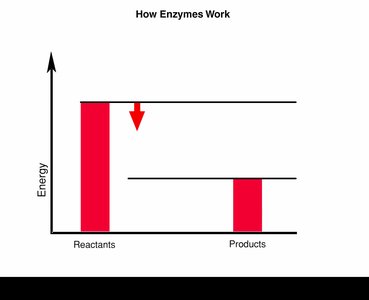
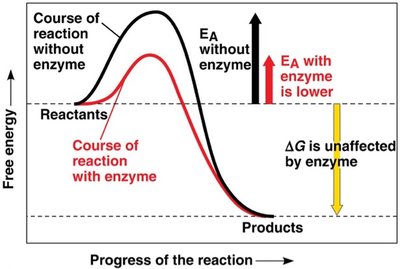
Enzymes are biological catalysts, usually proteins, that speed up reactions by lowering the activation energy (Ea).
Activation Energy (Ea): The energy required to initiate a reaction by breaking bonds in reactants.
Catalysis: Enzymes lower Ea but do not affect ΔG.
Enzyme Specificity and Active Site
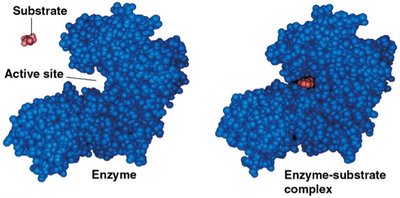
Substrate: The reactant an enzyme acts on.
Active Site: The region of the enzyme that binds the substrate, determining specificity.
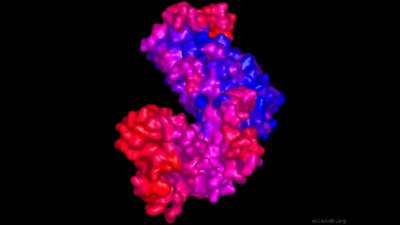
Induced Fit: Binding of substrate causes the enzyme to change shape, enhancing catalysis.
Catalytic Cycle of Enzymes
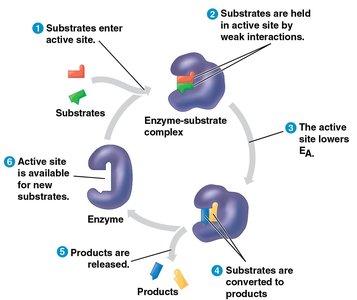
The enzyme’s catalytic cycle involves substrate binding, conversion to products, and release.
Substrates enter the active site.
Substrates are held by weak interactions.
The active site lowers Ea.
Substrates are converted to products.
Products are released; the active site is available for new substrates.
Factors Affecting Enzyme Activity
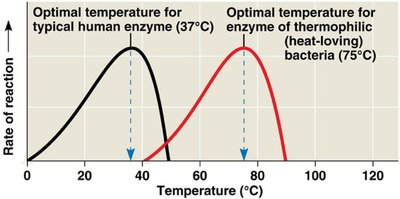
Temperature: Each enzyme has an optimal temperature; above this, enzymes denature.
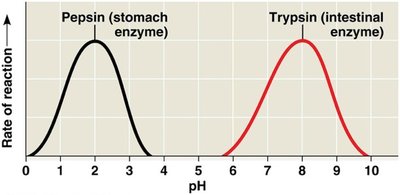
pH: Each enzyme has an optimal pH matching its environment.
Cofactors and Enzyme Regulation
Cofactors: Nonprotein helpers (inorganic ions or organic coenzymes) required for enzyme function.
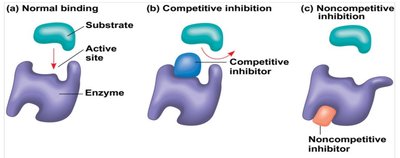
Inhibitors:
Competitive: Resemble substrate, compete for active site.
Noncompetitive: Bind elsewhere, change enzyme shape.
Allosteric Regulation and Feedback Inhibition
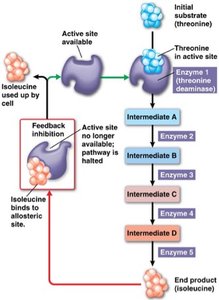
Allosteric Regulation: Regulatory molecules bind away from the active site, changing enzyme activity.
Feedback Inhibition: End product inhibits an early enzyme in the pathway, preventing overproduction.
Summary: Enzymes and Activation Energy
Enzymes lower activation energy (Ea), allowing reactions to proceed rapidly at cell temperatures.
Enzymes do not change the free energy change (ΔG) of a reaction.