 Indietro
Chapter 8: An Introduction to Metabolism – Study Notes
Guida di studio - Note intelligenti
 Appunti personalizzati basati sui tuoi materiali, ampliati con definizioni chiave, esempi e contesto.
Metabolism and Energy Transformation
Overview of Metabolism
Metabolism refers to the sum of all chemical reactions occurring within a living cell. These reactions allow cells to extract energy from their environment and use it to perform work, such as movement, growth, and maintenance. Some organisms can even convert energy into light, a process known as bioluminescence.

Metabolism is an emergent property arising from interactions between molecules within the cell.
Metabolic pathways organize the chemistry of life, beginning with a specific molecule and ending with a product, with each step catalyzed by a specific enzyme.
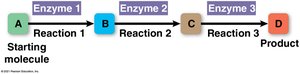
Catabolic and Anabolic Pathways
Metabolic pathways are classified as either catabolic or anabolic:
Catabolic pathways break down complex molecules into simpler compounds, releasing energy (e.g., cellular respiration).
Anabolic pathways build complex molecules from simpler ones, consuming energy (e.g., protein synthesis from amino acids).
Bioenergetics is the study of how organisms manage their energy resources.
Forms of Energy
Energy is the capacity to cause change and exists in several forms:
Kinetic energy: Energy associated with motion.
Heat (thermal energy): Kinetic energy due to random movement of atoms or molecules.
Potential energy: Energy possessed due to location or structure.
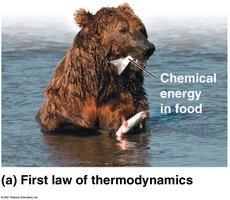
Chemical energy: Potential energy available for release in a chemical reaction.
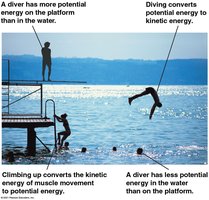
Energy can be converted from one form to another, such as potential energy to kinetic energy.
The Laws of Thermodynamics
First Law of Thermodynamics
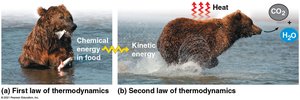
The first law states that energy can be transferred and transformed, but cannot be created or destroyed. This is known as the principle of conservation of energy.
Organisms are open systems, exchanging energy and matter with their surroundings.
Second Law of Thermodynamics
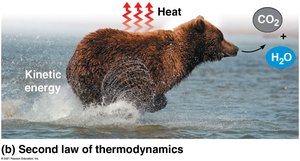
Every energy transfer or transformation increases the entropy (disorder) of the universe. Some energy is always lost as heat, making energy conversions less than 100% efficient.
Spontaneous processes occur without energy input and must increase the entropy of the universe.
Biological Order and Disorder
Cells create ordered structures from less ordered materials, but this increase in order is balanced by the breakdown of organized forms of matter, releasing heat and small molecules. Energy flows into ecosystems as light and exits as heat.
Free Energy and Metabolic Reactions
Free-Energy Change (ΔG)
The free energy change of a reaction determines whether it occurs spontaneously. Free energy is the energy that can do work when temperature and pressure are uniform.
The change in free energy is given by: where is the change in free energy, is the change in enthalpy (total energy), is the change in entropy, and is the temperature in Kelvin.
Only processes with a negative are spontaneous.
Free Energy, Stability, and Equilibrium
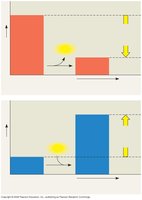
represents the difference between the free energy of the final and initial states:
Spontaneous changes decrease free energy and increase stability.
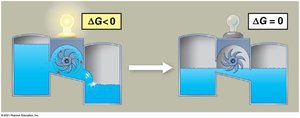
Equilibrium is a state of maximum stability; processes can perform work only when moving toward equilibrium.
Exergonic and Endergonic Reactions
Metabolic reactions can be classified as exergonic or endergonic:
Exergonic reactions release free energy and are spontaneous ().
Endergonic reactions absorb free energy and are non-spontaneous ().
Equilibrium and Metabolism
Reactions in a closed system reach equilibrium and do no work.
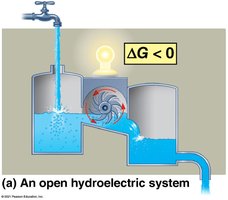
Cells are open systems, constantly exchanging materials and never at equilibrium.
Catabolic pathways release free energy in a series of reactions.
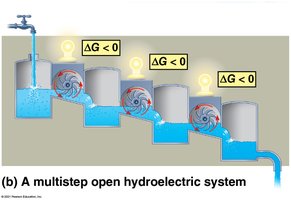
ATP and Cellular Work
ATP Structure and Function
ATP (adenosine triphosphate) is the cell’s energy shuttle, composed of ribose (a sugar), adenine (a nitrogenous base), and three phosphate groups.
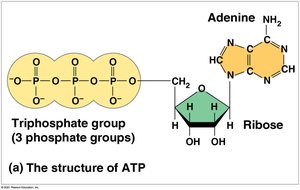
The bonds between the phosphate groups can be broken by hydrolysis, releasing energy.
This energy release comes from the chemical change to a state of lower free energy.
ATP Coupling and Cellular Work
Cells perform three main types of work: chemical, transport, and mechanical. ATP hydrolysis powers these processes by coupling exergonic and endergonic reactions.
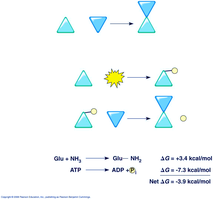
ATP drives endergonic reactions by phosphorylation, transferring a phosphate group to another molecule.
The recipient molecule is now phosphorylated and more reactive.
Regeneration of ATP
ATP is regenerated by adding a phosphate group to adenosine diphosphate (ADP). The energy for this comes from catabolic reactions.
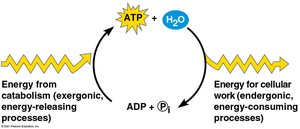
Enzymes and Metabolic Regulation
Enzymes as Catalysts
An enzyme is a catalytic protein that speeds up reactions without being consumed. For example, the enzyme sucrase catalyzes the hydrolysis of sucrose.
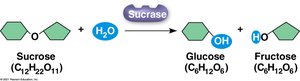
Activation Energy and Enzyme Function
Activation energy () is the initial energy needed to start a reaction. Enzymes lower the activation energy barrier, hastening reactions that would occur eventually.
Substrate Specificity and Active Site
The substrate is the reactant an enzyme acts on.
The enzyme binds to its substrate at the active site, forming an enzyme-substrate complex.
Induced fit brings chemical groups into positions that enhance catalysis.
Catalysis in the Active Site
The active site can lower activation energy by orienting substrates, straining bonds, providing a favorable microenvironment, or covalently bonding to the substrate.
Effects of Local Conditions on Enzyme Activity
Enzyme activity is affected by environmental factors such as temperature and pH, as well as chemicals that influence the enzyme. Each enzyme has an optimal temperature and pH.
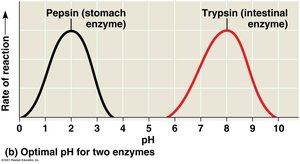
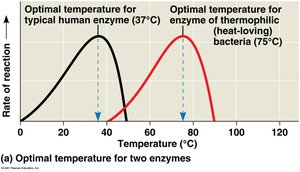
Extreme conditions can denature enzymes, rendering them inactive.
Cofactors and Coenzymes
Cofactors are nonprotein enzyme helpers, which may be inorganic (e.g., metal ions) or organic.
Organic cofactors are called coenzymes (e.g., vitamins).
Enzyme Inhibitors
Competitive inhibitors bind to the active site, competing with the substrate.
Noncompetitive inhibitors bind elsewhere, causing the enzyme to change shape and making the active site less effective.
Examples include toxins, poisons, pesticides, and antibiotics.
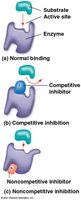
Regulation of Enzyme Activity
Allosteric Regulation
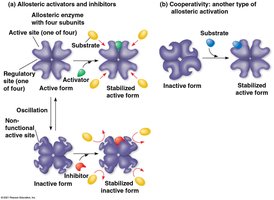
Allosteric regulation involves regulatory molecules binding to a protein at one site and affecting its function at another site. This can inhibit or stimulate enzyme activity.
Most allosterically regulated enzymes are made from polypeptide subunits.
Activators stabilize the active form; inhibitors stabilize the inactive form.
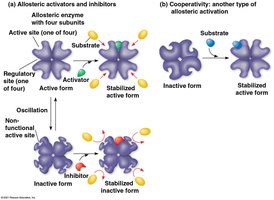
Cooperativity
Cooperativity is a form of allosteric regulation where binding by a substrate to one active site stabilizes favorable conformational changes at all other subunits.
Feedback Inhibition
Feedback inhibition occurs when the end product of a metabolic pathway shuts down the pathway, preventing the cell from wasting resources.
Localization of Enzymes Within the Cell
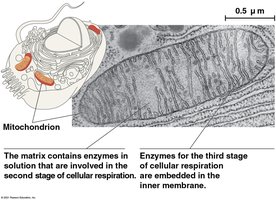
Cellular structures help organize metabolic pathways.
Some enzymes are structural components of membranes; others reside in specific organelles (e.g., mitochondria for cellular respiration).
Summary Table: Key Terms and Concepts
Term | Definition | Example |
|---|---|---|
Catabolic Pathway | Breaks down molecules, releases energy | Cellular respiration |
Anabolic Pathway | Builds molecules, consumes energy | Protein synthesis |
Kinetic Energy | Energy of motion | Muscle movement |
Potential Energy | Energy due to position/structure | Water behind a dam |
Exergonic Reaction | Releases free energy, spontaneous | ATP hydrolysis |
Endergonic Reaction | Absorbs free energy, non-spontaneous | Glutamine synthesis |
Enzyme | Catalytic protein | Sucrase |
Allosteric Regulation | Regulation by binding at a site other than active site | Feedback inhibition |
Additional info: Academic context was added to clarify mechanisms, definitions, and examples for completeness and exam preparation.
