 Indietro
Chapter 8: An Introduction to Metabolism – Study Notes
Guida di studio - Note intelligenti
 Appunti personalizzati basati sui tuoi materiali, ampliati con definizioni chiave, esempi e contesto.
Chapter 8: An Introduction to Metabolism
Big Idea: Cellular Metabolism
Metabolism encompasses all chemical reactions within a cell, including those that consume or generate energy. These reactions are essential for maintaining life and are organized into metabolic pathways.
8.1: An Organism’s Metabolism Transforms Matter and Energy
Metabolic Pathways
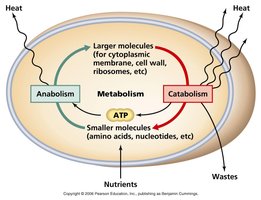
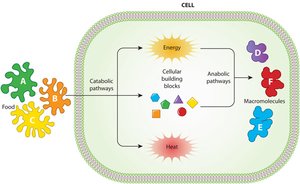
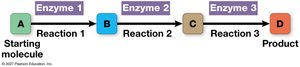
Metabolic pathway: A series of chemical reactions that either build a complex molecule (anabolic pathway) or break down a complex molecule into simpler compounds (catabolic pathway).
Catabolic pathways: Release energy by breaking down complex molecules (e.g., cellular respiration).
Anabolic pathways: Consume energy to build complex molecules (e.g., protein synthesis from amino acids).
Each step is catalyzed by a specific enzyme.
Energy in Biological Systems
Energy: The capacity to cause change or do work.
Kinetic energy: Energy of motion.
Potential energy: Stored energy due to position or structure.
Chemical energy: A form of potential energy stored in chemical bonds.
Thermodynamics in Biology
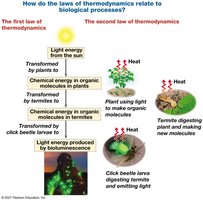
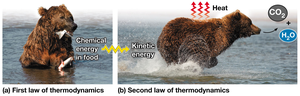
First Law of Thermodynamics: Energy can be transferred and transformed, but not created or destroyed.
Second Law of Thermodynamics: Every energy transfer increases the entropy (disorder) of the universe; some energy is lost as heat.
Organisms are open systems—they exchange energy and matter with their surroundings.
8.2: Free-Energy Change and Spontaneity of Reactions
Gibbs Free Energy (ΔG)
Free energy (G): The portion of a system’s energy that can perform work at constant temperature and pressure.
The change in free energy is given by: where = change in enthalpy, = temperature in Kelvin, = change in entropy.
If is negative, the process is spontaneous; if zero or positive, it is nonspontaneous.
Exergonic vs. Endergonic Reactions
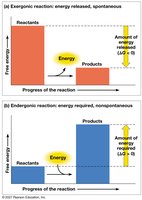
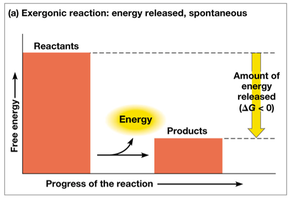
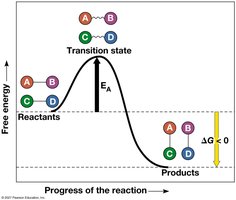
Exergonic reaction: Releases free energy (), spontaneous.
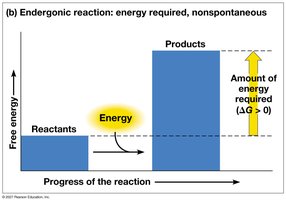
Endergonic reaction: Absorbs free energy (), nonspontaneous.
8.3: ATP Powers Cellular Work by Coupling Exergonic and Endergonic Reactions
Structure and Function of ATP
ATP (adenosine triphosphate): Composed of ribose (sugar), adenine (nitrogenous base), and three phosphate groups.
ATP is a nucleotide and belongs to the class of nucleic acids.
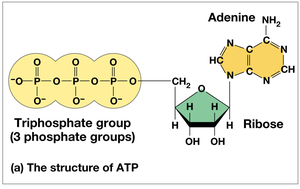
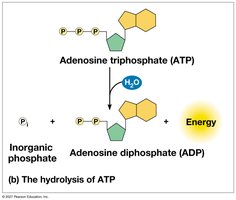
ATP Hydrolysis and Energy Coupling
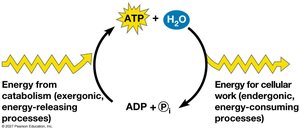
Hydrolysis of ATP releases energy by breaking the terminal phosphate bond:
This energy is used to drive endergonic reactions (energy coupling).
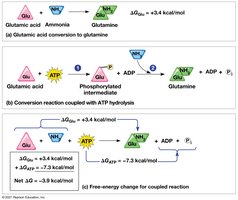
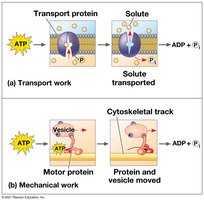
The ATP Cycle
ATP is regenerated from ADP and inorganic phosphate using energy from catabolic reactions.
This cycle couples energy-releasing and energy-consuming processes in the cell.
8.4: Enzymes Speed Up Metabolic Reactions by Lowering Energy Barriers
Role and Function of Enzymes
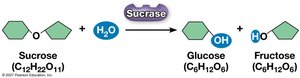
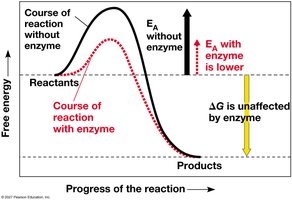
Enzyme: A biological catalyst, usually a protein, that speeds up a specific reaction without being consumed.
Enzymes lower the activation energy required for reactions to proceed.
Enzyme Specificity and Mechanism
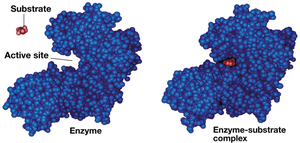
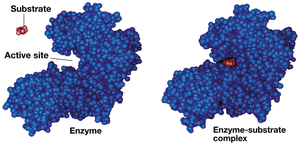
Enzymes are specific to their substrates due to the unique shape of their active site.
The induced-fit model describes how the enzyme changes shape to fit the substrate more closely upon binding.
Factors Affecting Enzyme Activity
Substrate concentration: Increasing substrate increases reaction rate until the enzyme is saturated.
Temperature and pH: Each enzyme has optimal conditions for activity; deviations can reduce efficiency or denature the enzyme.
Cofactors: Nonprotein helpers (inorganic ions or organic coenzymes) required for enzyme function.
Enzyme inhibitors: Chemicals that reduce enzyme activity (competitive or noncompetitive).
8.5: Regulation of Enzyme Activity Helps Control Metabolism
Allosteric Regulation and Feedback Inhibition
Allosteric regulation: Regulatory molecules bind to an enzyme at a site other than the active site, altering its activity.
Feedback inhibition: The end product of a metabolic pathway inhibits an enzyme involved earlier in the pathway, preventing overproduction of the product.
Summary Table: Catabolic vs. Anabolic Pathways
Pathway | Function | Energy | Example |
|---|---|---|---|
Catabolic | Breaks down molecules | Releases energy | Cellular respiration |
Anabolic | Builds molecules | Consumes energy | Protein synthesis |
