 Indietro
Chapter 8: Metabolism – Energy and Enzymes in Biological Systems
Guida di studio - Note intelligenti
 Appunti personalizzati basati sui tuoi materiali, ampliati con definizioni chiave, esempi e contesto.
Metabolism and Metabolic Pathways
Definition and Organization
Metabolism encompasses all chemical reactions occurring within an organism, organized into metabolic pathways. Each pathway starts with a specific molecule and ends with a product, with each step catalyzed by a unique enzyme.
Metabolic pathway: Series of chemical reactions transforming a starting molecule to a product.
Enzyme: Protein catalyst that accelerates reactions without being consumed.
Bioenergetics: Study of energy flow through living organisms.
Catabolic pathways: Break down complex molecules, releasing energy (e.g., cellular respiration).
Anabolic pathways: Build complex molecules, consuming energy (e.g., protein synthesis).

Forms of Energy
Types and Properties
Energy is the capacity to cause change and exists in various forms. Living systems convert energy from one form to another to perform work.
Kinetic energy: Energy of motion.
Thermal energy: Kinetic energy from random movement of atoms/molecules; heat is thermal energy transferred between objects.
Potential energy: Energy due to position or structure.
Chemical energy: Potential energy stored in chemical bonds, released during reactions.

Thermodynamics in Biology
Systems and Laws
Thermodynamics studies energy transformations. Biological systems are open, exchanging energy and matter with their surroundings.
Isolated system: No exchange with surroundings.
Open system: Exchanges energy and matter; organisms are open systems.
First Law of Thermodynamics
Energy can be transferred and transformed, but not created or destroyed (conservation of energy).
Second Law of Thermodynamics
Every energy transfer increases the entropy (disorder) of the universe.
Some energy is lost as heat during transformations.

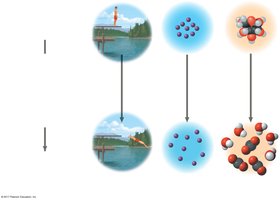
Free Energy and Spontaneity
Gibbs Free Energy
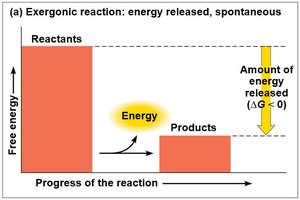
Free energy (G) is the energy available to do work in a system at constant temperature and pressure. The change in free energy (ΔG) determines whether a process is spontaneous.
ΔG = ΔH − TΔS Where ΔH = change in enthalpy (total energy), ΔS = change in entropy, T = temperature in Kelvin.
Spontaneous process: Occurs without energy input; ΔG is negative.
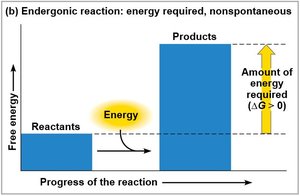
Nonspontaneous process: Requires energy input; ΔG is zero or positive.
Exergonic vs. Endergonic Reactions
Exergonic: Net release of free energy; spontaneous (ΔG < 0).
Endergonic: Absorbs free energy; nonspontaneous (ΔG > 0).
Equilibrium and Cellular Metabolism
Equilibrium in Biological Systems
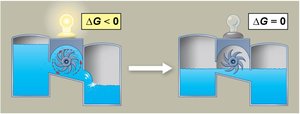
Reactions in a closed system reach equilibrium and can no longer do work. Cells, as open systems, maintain a constant flow of materials and never reach equilibrium, allowing continuous metabolic activity.
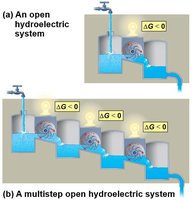
Energy Coupling and ATP
Cellular Work and ATP
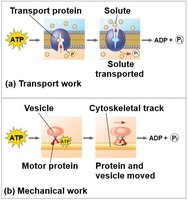
Cells perform three main types of work: chemical, transport, and mechanical. Energy coupling uses exergonic reactions to drive endergonic ones, primarily mediated by ATP.
Chemical work: Driving endergonic reactions.
Transport work: Pumping substances against gradients.
Mechanical work: Movement, such as muscle contraction.
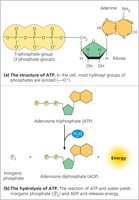
ATP Cycle
ATP is regenerated by phosphorylation of ADP, using energy from catabolic reactions. The ATP cycle links energy-releasing and energy-consuming processes.
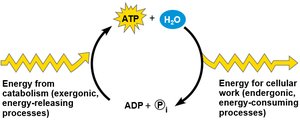
Activation Energy and Enzymes
Energy of Activation
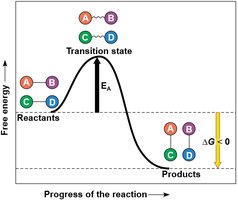
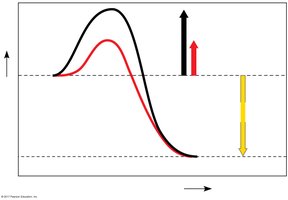
Activation energy (EA) is the initial energy required to start a chemical reaction. Enzymes lower the EA barrier, speeding up reactions without affecting ΔG.
Enzyme Structure and Function
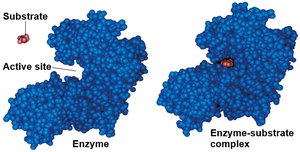
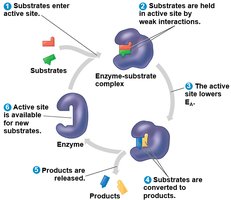
Enzymes are highly specific, acting on substrates at their active sites. The induced fit model describes how substrate binding enhances catalysis.
Substrate: Reactant acted upon by enzyme.
Active site: Region where substrate binds.
Induced fit: Conformational change in enzyme upon substrate binding.
Factors Affecting Enzyme Activity
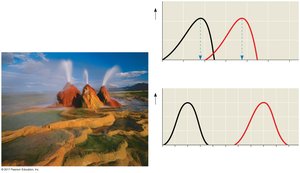
Enzyme activity is influenced by environmental conditions such as temperature, pH, and the presence of cofactors.
Optimal temperature: Each enzyme has a temperature at which it functions best.
Optimal pH: Each enzyme has a pH range for optimal activity.
Cofactors: Non-protein helpers; can be inorganic (metal ions) or organic (coenzymes, e.g., vitamins).
Enzyme Regulation
Mechanisms of Regulation
Cells regulate enzymes to maintain metabolic balance. Regulation occurs via gene expression, enzyme activation, and inhibition.
Proteolytic activation: Removal of polypeptide segments to activate enzyme.
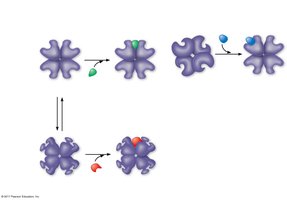
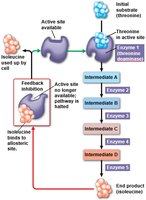
Allosteric regulation: Regulatory molecules bind at sites other than the active site, affecting enzyme activity.
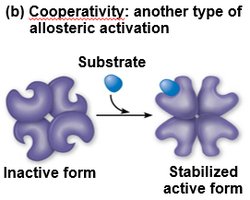
Cooperativity: Substrate binding at one active site enhances activity at others.
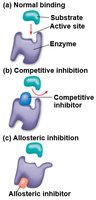
Competitive inhibition: Inhibitor binds to active site, blocking substrate.
Allosteric inhibition: Inhibitor binds elsewhere, changing enzyme shape.
Feedback inhibition: End product of pathway inhibits an earlier step.
Summary Table: Key Concepts in Metabolism
Concept | Definition | Example |
|---|---|---|
Metabolism | Totality of chemical reactions in organism | Cellular respiration, photosynthesis |
Catabolic Pathway | Breakdown of molecules, energy release | Glucose breakdown |
Anabolic Pathway | Synthesis of molecules, energy consumption | Protein synthesis |
ATP | Energy currency of cell | Muscle contraction |
Enzyme | Catalytic protein | Amylase, DNA polymerase |
Activation Energy | Energy needed to start reaction | Enzyme lowers EA |
Allosteric Regulation | Regulation by binding at non-active site | Phosphofructokinase |
Feedback Inhibition | End product inhibits pathway | Threonine to isoleucine pathway |
