 Indietro
Chapter 8: Metabolism – Energy, Enzymes, and Cellular Work
Guida di studio - Note intelligenti
 Appunti personalizzati basati sui tuoi materiali, ampliati con definizioni chiave, esempi e contesto.
Metabolism and Metabolic Pathways
Overview of Metabolism
Metabolism encompasses all chemical reactions occurring within a living organism, enabling the extraction and application of energy to perform work. It is an emergent property arising from molecular interactions.
Metabolic Pathways: A series of chemical reactions where a specific molecule is altered stepwise, each step catalyzed by a unique enzyme.
Catabolic Pathways: Release energy by breaking down complex molecules into simpler compounds.
Anabolic Pathways: Consume energy to build complex molecules from simpler ones.
Example: The stepwise conversion of molecule A to D via intermediates B and C uses less energy than a direct conversion. 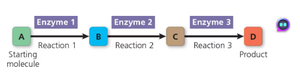
Forms of Energy
Types of Energy in Biological Systems
Energy is the capacity to cause change and exists in several forms relevant to biology.
Kinetic Energy: Energy of motion, including thermal energy (random movement of atoms/molecules).
Potential Energy: Stored energy due to location or structure, such as chemical bonds.
Chemical Energy: Potential energy available for release in chemical reactions.
Example: Food molecules store chemical energy, which is used for movement and cellular processes.
Laws of Thermodynamics
Energy Transformation Principles
Thermodynamics studies energy transformations in matter.
System: The matter under study.
Surroundings: Everything outside the system.
Closed System: No exchange of energy/matter with surroundings (e.g., thermos).
Open System: Energy/matter can be exchanged.
First Law: Energy can be transferred or transformed, but not created or destroyed (Principle of Conservation of Energy). Second Law: Every energy transfer increases disorder (entropy) in the system.
Free Energy and Spontaneity
Free Energy Change (ΔG)
Free energy (G) is the portion of a system’s energy available to perform work at constant temperature and pressure.
ΔG (Change in Free Energy): Determines whether a process is spontaneous.
Formula: Where:
= change in free energy
= change in total energy (enthalpy)
= change in entropy
= absolute temperature (Kelvin)
Spontaneous Process: Occurs without energy input (ΔG < 0).
Nonspontaneous Process: Requires energy input (ΔG > 0).
Exergonic and Endergonic Reactions
Energy Changes in Metabolic Reactions
Exergonic Reaction: Releases energy, spontaneous, ΔG negative.
Endergonic Reaction: Requires energy input, nonspontaneous, ΔG positive.
Equilibrium and Metabolism
Metabolic Equilibrium
In a closed system, reactions reach equilibrium (ΔG = 0) and no work can be done.
Cells are open systems, constantly using products and maintaining negative ΔG, preventing equilibrium.
ATP: The Energy Currency of the Cell
Structure and Function of ATP
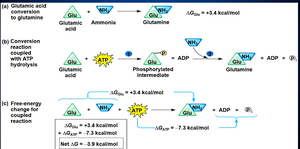
ATP (adenosine triphosphate) stores energy in its phosphate bonds, especially the last phosphate group.
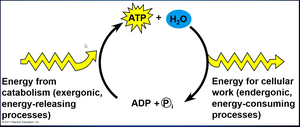
Hydrolysis of ATP releases energy (ΔG = -7.3 kcal/mol), which is used for cellular work.
ATP Powers Cellular Work
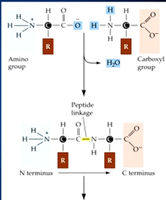
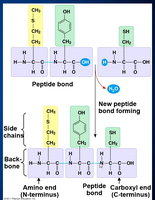
Chemical Work: Drives endergonic reactions, such as peptide bond formation.
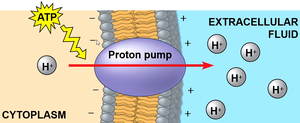
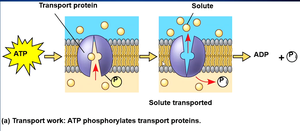
Transport Work: Powers active transport of ions across membranes.
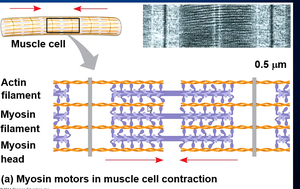
Mechanical Work: Enables muscle contraction and movement.
Energy Coupling
Exergonic reactions (spontaneous, ΔG negative) are paired with endergonic reactions (nonspontaneous, ΔG positive) to drive cellular processes.
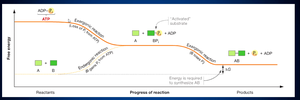
Regeneration of ATP
ATP is regenerated from ADP and inorganic phosphate via cellular respiration, maintaining cellular efficiency.
Activation Energy and Enzymes
Energy Barriers and Enzyme Function
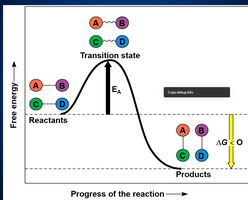
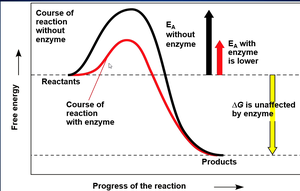
Exergonic reactions are spontaneous but require an initial energy input (activation energy, EA).
Enzymes lower the activation energy, speeding up reactions without affecting ΔG.
How Enzymes Work
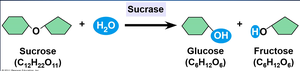
Enzymes are biological catalysts, usually proteins, that facilitate reactions by:
Orienting substrates correctly
Straining substrate bonds
Providing a favorable microenvironment
Covalently bonding to substrates
Enzyme Specificity and Regulation
Environmental Effects on Enzymes
Enzyme activity depends on optimal pH and temperature.
Extreme conditions can denature enzymes, affecting their function.
Cofactors and Enzyme Inhibition
Cofactors: Non-protein helpers required for enzyme activity (e.g., vitamins).
Competitive Inhibitors: Compete with substrate for active site, reversible.
Noncompetitive Inhibitors: Bind elsewhere, change enzyme shape, irreversible.
Allosteric Regulation and Feedback Inhibition
Allosteric Activators/Inhibitors: Bind to sites other than the active site, affecting multiple enzymes.
Cooperativity: Substrate binding activates other enzyme subunits.
Feedback Inhibition: End product inhibits the first enzyme in a pathway, preventing overproduction.
Localization of Enzymes
Enzymes are localized to specific cellular compartments to increase efficiency (e.g., mitochondria, nucleus).
Summary Table: Exergonic vs. Endergonic Reactions
Reaction Type | ΔG | Spontaneity | Energy Flow |
|---|---|---|---|
Exergonic | Negative | Spontaneous | Energy released |
Endergonic | Positive | Nonspontaneous | Energy required |
Key Equations
Free Energy Change:
ATP Hydrolysis:
Conclusion
Metabolism is a dynamic, regulated process involving energy transformations, enzyme catalysis, and cellular work. Understanding these principles is fundamental to biology and essential for further study in cellular and molecular biology.
