 Indietro
Chromosomal Basis of Inheritance and Genetic Disorders
Guida di studio - Note intelligenti
 Appunti personalizzati basati sui tuoi materiali, ampliati con definizioni chiave, esempi e contesto.
Chromosomal Basis of Inheritance
Mendelian Inheritance and Chromosome Theory
Mendel's "hereditary units" were theoretical in the 1860s, but later research revealed that genes are segments of DNA located on chromosomes. The chromosome theory of inheritance, developed by Sutton, Boveri, and others, states that chromosomes are the physical carriers of genes.
Genes: Segments of DNA that encode traits.
Chromosomes: Structures in cells that contain genetic material.
Homologous Chromosomes: Chromosome pairs, one from each parent, carrying the same genes.
Experimental Evidence: Thomas Hunt Morgan and Drosophila
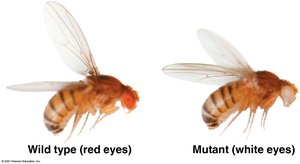
Thomas Hunt Morgan used Drosophila melanogaster (fruit flies) to provide evidence that genes are located on chromosomes. Fruit flies are ideal for genetic studies due to their short generation time, high offspring number, and only four pairs of chromosomes. Morgan distinguished between wild type (normal) and mutant phenotypes, with the first mutant being a fly with white eyes instead of red.
Wild type: The most common phenotype in a population.
Mutant phenotype: A phenotype differing from the wild type due to mutation.
Correlating Gene Behavior with Chromosome Behavior
Morgan's experiments showed that the white-eyed trait in fruit flies was linked to the X chromosome. Females (XX) and males (XY) inherit different combinations, explaining the observed inheritance patterns. This supported the chromosome theory of inheritance.
X-linked traits: Traits determined by genes on the X chromosome.
Sex chromosomes: X and Y chromosomes determine sex in mammals.
Sex-Linked Genes and Patterns of Inheritance
The Chromosomal Basis of Sex
Humans and other mammals have two types of sex chromosomes: X (larger) and Y (smaller). The presence of two X chromosomes typically results in female development, while one X and one Y result in male development. The X-Y system is not universal among all organisms. 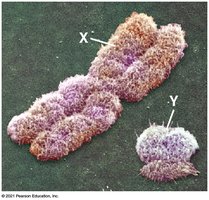
SRY gene: Located on the Y chromosome, responsible for male development.
Sex-linked gene: Any gene located on a sex chromosome.
Inheritance of X-Linked Genes
X-linked genes follow unique inheritance patterns. For a recessive X-linked trait to be expressed, females need two copies of the allele, while males need only one. This makes X-linked recessive disorders more common in males.
Hemizygous: Males have only one X chromosome, so a single recessive allele will express the trait.
Examples of X-linked disorders: Color blindness, Duchenne muscular dystrophy, hemophilia.
X Inactivation in Female Mammals
In female mammals, one X chromosome in each cell is randomly inactivated during embryonic development, forming a Barr body. This results in mosaicism for X-linked traits.
XIST gene: Responsible for X chromosome inactivation.
Barr body: Inactive X chromosome in female cells.
Linked Genes and Genetic Recombination
Linked Genes
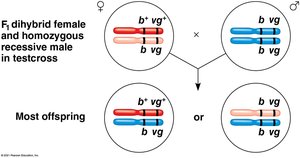
Genes located near each other on the same chromosome tend to be inherited together and are called linked genes. Morgan's experiments with fruit flies showed that linked genes do not assort independently.
Linked genes: Genes located close together on the same chromosome.
Parental phenotypes: Offspring with traits matching the parents.
Genetic Recombination and Crossing Over
Genetic recombination produces offspring with new combinations of traits. For unlinked genes, independent assortment results in a 50% recombination frequency. For linked genes, crossing over during meiosis can separate them, producing recombinant types.
Recombinant chromosomes: Chromosomes with new allele combinations due to crossing over.
Crossing over: Exchange of genetic material between homologous chromosomes.
Mapping Gene Distance Using Recombination Data
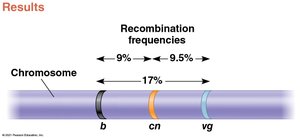
Alfred Sturtevant constructed genetic maps based on recombination frequencies. The farther apart two genes are, the higher the probability of crossing over. Map units (centimorgans) represent 1% recombination frequency.
Linkage map: Ordered list of genetic loci based on recombination frequencies.
Map unit: 1% recombination frequency.
Alterations of Chromosome Number and Structure
Abnormal Chromosome Number
Nondisjunction during meiosis can result in gametes with abnormal chromosome numbers, leading to aneuploidy.
Aneuploidy: Abnormal number of chromosomes.
Monosomic: One copy of a chromosome.
Trisomic: Three copies of a chromosome.
Polyploidy: More than two complete sets of chromosomes (common in plants).
Alterations of Chromosome Structure
Chromosome breakage can cause four types of structural changes:
Deletion: Removal of a chromosomal fragment.
Duplication: Repetition of a segment.
Inversion: Reversal of a segment's orientation.
Translocation: Movement of a segment to another chromosome.
Human Disorders Due to Chromosomal Alterations
Some chromosomal alterations cause genetic disorders, such as Down syndrome (trisomy 21), Klinefelter syndrome (XXY), Turner syndrome (X0), and cri du chat syndrome (deletion in chromosome 5).
Down syndrome: Three copies of chromosome 21.
Klinefelter syndrome: XXY males.
Turner syndrome: X0 females.
Cri du chat syndrome: Deletion in chromosome 5.
Exceptions to Standard Mendelian Inheritance
Genomic Imprinting
Genomic imprinting occurs when the phenotype depends on which parent passed along the allele. It involves the silencing of certain genes, often through methylation. Most imprinted genes are critical for embryonic development.
Genomic imprinting: Parent-of-origin effects on gene expression.
Methylation: Addition of —CH3 groups to DNA, affecting gene expression.
Inheritance of Organelle Genes
Extranuclear genes are found in mitochondria and chloroplasts and are inherited maternally. Defects in mitochondrial genes can cause diseases affecting the muscular and nervous systems.
Extranuclear genes: Genes located outside the nucleus, in organelles.
Mitochondrial inheritance: Maternal inheritance of mitochondrial DNA.
Examples: Mitochondrial myopathy, Leber’s hereditary optic neuropathy.
Summary Table: Types of Chromosomal Alterations
Type | Description | Example Disorder |
|---|---|---|
Aneuploidy | Abnormal number of chromosomes | Down syndrome (trisomy 21) |
Polyploidy | More than two sets of chromosomes | Common in plants |
Deletion | Loss of a chromosome segment | Cri du chat syndrome |
Duplication | Repeat of a chromosome segment | Some cancers |
Inversion | Reversal of segment orientation | May cause infertility |
Translocation | Segment moved to another chromosome | Chronic myelogenous leukemia |
Key Equations
Recombination frequency:
Map units:
Conclusion
The chromosomal basis of inheritance explains how genes are transmitted from parents to offspring, how linked genes and recombination contribute to genetic diversity, and how chromosomal alterations can lead to genetic disorders. Understanding these principles is fundamental to genetics and biology.
