 Indietro
Chromosomal Basis of Inheritance and Genetic Disorders Part 2
Guida di studio - Note intelligenti
 Appunti personalizzati basati sui tuoi materiali, ampliati con definizioni chiave, esempi e contesto.
Linked Genes and Genetic Recombination
Linked Genes
Genes located close together on the same chromosome are called linked genes. These genes tend to be inherited together because their physical proximity reduces the likelihood of being separated during meiosis.
Chromosomes contain hundreds or thousands of genes (except the Y chromosome).
Linked genes do not assort independently, unlike genes on different chromosomes.
Genetic Recombination and Independent Assortment
Genetic recombination refers to the production of offspring with combinations of traits differing from either parent. This can occur through independent assortment or crossing over during meiosis.
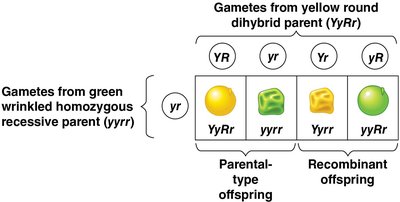
Parental types: Offspring whose phenotype matches one of the parental (P) generation phenotypes.
Recombinant types (recombinants): Offspring with new combinations of traits not found in either parent.
A 50% recombination frequency is observed for genes on different (nonhomologous) chromosomes due to independent assortment.
Mendel’s Dihybrid Cross and Testcross
Mendel’s dihybrid cross experiments demonstrated the principle of independent assortment, producing both parental and recombinant phenotypes among offspring.
Parental generation (P): Yellow-round seeds (YYRR) × Green-wrinkled seeds (yyrr)
F1 generation: All yellow-round seeds (YyRr)
Testcross: F1 (YyRr) × homozygous recessive (yyrr) produces four phenotypes: two parental types and two recombinant types.
Physical Basis of Recombination
The random orientation of homologous chromosomes during metaphase I of meiosis leads to the independent assortment of alleles, generating genetic diversity in gametes.
The F1 plant (YyRr) can produce four types of gametes: YR, Yr, yR, yr.
Variation and Natural Selection
Recombinant chromosomes and random fertilization increase genetic variation, providing the raw material for natural selection to act upon.
Alterations of Chromosome Number and Structure
Abnormal Chromosome Number: Nondisjunction and Aneuploidy
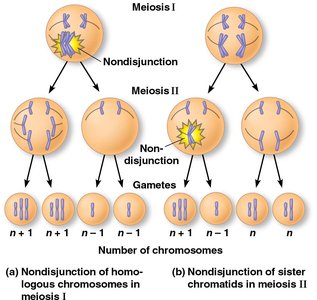
Nondisjunction occurs when homologous chromosomes or sister chromatids fail to separate properly during meiosis, resulting in gametes with abnormal chromosome numbers.
Aneuploidy: Fertilization involving gametes with abnormal chromosome numbers leads to offspring with missing or extra chromosomes.
Monosomic zygote: Has only one copy of a chromosome (2n − 1).
Trisomic zygote: Has three copies of a chromosome (2n + 1).
Polyploidy
Polyploidy is a condition in which an organism has more than two complete sets of chromosomes. It is common in plants but rare in animals.
Triploidy (3n): Three sets of chromosomes.
Tetraploidy (4n): Four sets of chromosomes.
Polyploids are generally more normal in appearance than aneuploids.
Alterations of Chromosome Structure
Chromosome breakage can lead to four main types of structural changes:
Type | Description |
|---|---|
Deletion | Removes a chromosomal segment |
Duplication | Repeats a segment |
Inversion | Reverses orientation of a segment within a chromosome |
Translocation | Moves a segment from one chromosome to another |
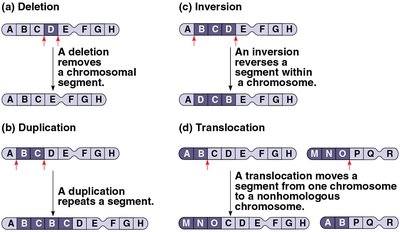
Deletions and duplications often occur during unequal crossing over in meiosis.
Large deletions are usually lethal if essential genes are lost.
Human Disorders Due to Chromosomal Alterations
Aneuploidy Disorders
Alterations in chromosome number and structure can cause serious genetic disorders. Some aneuploidies are compatible with life and result in characteristic syndromes.
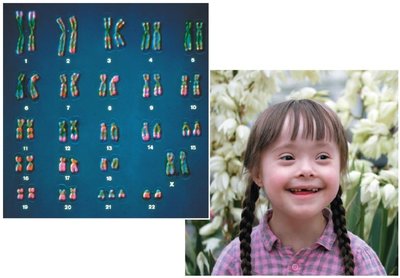
Down syndrome (Trisomy 21): Caused by three copies of chromosome 21. The risk increases with maternal age.
Klinefelter syndrome (XXY): Males with an extra X chromosome; may have learning disabilities and sterility.
Turner syndrome (X0): Females with only one X chromosome; the only viable human monosomy, resulting in sterility.
XXX females: Usually healthy, but may have learning disabilities.
Disorders from Chromosomal Structural Changes
Cri du chat syndrome: Caused by a deletion in chromosome 5; leads to intellectual disability and a distinctive cry.
Chronic myelogenous leukemia (CML): Caused by a reciprocal translocation between chromosomes 9 and 22, forming the Philadelphia chromosome. This activates a gene that leads to uncontrolled cell division.
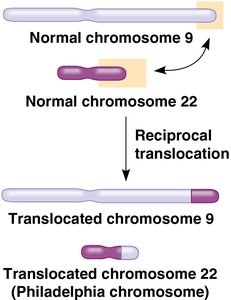
Summary Table: Chromosomal Alterations
Alteration Type | Description | Example Disorder |
|---|---|---|
Aneuploidy | Abnormal number of chromosomes | Down syndrome (Trisomy 21) |
Polyploidy | More than two complete sets of chromosomes | Common in plants |
Deletion | Loss of a chromosomal segment | Cri du chat syndrome |
Duplication | Repeat of a chromosomal segment | Some developmental disorders |
Inversion | Reversal of a segment within a chromosome | Usually no disorder, but can affect fertility |
Translocation | Segment moves to a nonhomologous chromosome | Chronic myelogenous leukemia |
Key Terms and Concepts
Linked genes: Genes located close together on the same chromosome.
Recombinant offspring: Offspring with new combinations of traits.
Nondisjunction: Failure of chromosomes to separate properly during meiosis.
Aneuploidy: Abnormal number of chromosomes in a cell.
Polyploidy: More than two complete sets of chromosomes.
Deletion, duplication, inversion, translocation: Types of chromosomal structural changes.
Practice Questions
Offspring with nonparental phenotypes are called recombinants.
Variation for natural selection is based on recombination, crossing over, and random fertilization.
Which type of alteration reverses a segment within a chromosome? Inversion.
Which type of alteration moves a segment to a nonhomologous chromosome? Translocation.
The abnormal condition due to failure of chromosomes to separate normally during meiosis is called nondisjunction.
Down syndrome is Trisomy 21.
Klinefelter syndrome is XXY male.
Genetic disorders can occur due to alterations of chromosome number and structure.
