 Indietro
Lecture 18 (Unit 2)--Chromosomal Basis of Inheritance: Sex-Linked Traits, Gene Linkage, and Chromosomal Alterations
Guida di studio - Note intelligenti
 Appunti personalizzati basati sui tuoi materiali, ampliati con definizioni chiave, esempi e contesto.
Chromosomal Basis of Inheritance
Convergence of Cytology and Genetics
The development of the chromosome theory of inheritance was a result of advances in microscopy and cytology, which allowed scientists to observe mitosis and meiosis. Parallels between Mendel’s hereditary factors and chromosome behavior led to the realization that genes are located on chromosomes.
Cytology: Study of cell structure and function, including chromosomes.
Chromosome Theory of Inheritance: Genes are carried on chromosomes, which undergo segregation and independent assortment during meiosis.
Mendel’s Laws: Law of Segregation and Law of Independent Assortment are explained by chromosome behavior during meiosis.
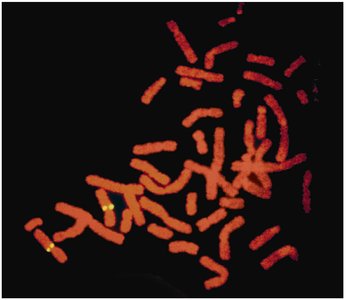
Additional info: The image shows fluorescent labeling of chromosomes, highlighting specific gene locations, reinforcing the concept that genes are physically located on chromosomes.
Chromosomal Basis of Mendel’s Laws
Mendel’s experiments with pea plants demonstrated the principles of segregation and independent assortment, which are explained by the behavior of chromosomes during meiosis.
Law of Segregation: Each individual has two alleles for each gene, which segregate during gamete formation.
Law of Independent Assortment: Alleles of different genes assort independently if they are on different chromosomes.
Phenotypic Ratio: Dihybrid crosses yield a 9:3:3:1 ratio in the F2 generation.
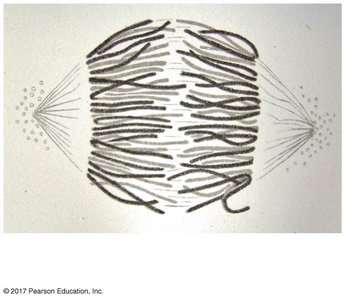
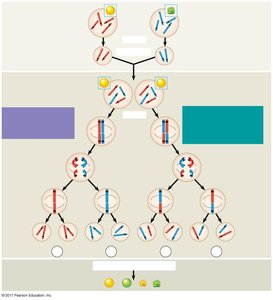
Additional info: The images illustrate chromosome alignment during meiosis and the process of independent assortment, supporting Mendel’s laws.
Sex-Linked Traits and Inheritance
Model Organism: Drosophila melanogaster
Fruit flies are ideal for genetic studies due to their short generation time, high offspring number, and visible chromosomes. Morgan’s discovery of the white-eyed mutant in Drosophila was pivotal in establishing the chromosomal basis of inheritance.
Wild Type: Most common phenotype in nature.
Mutant: Phenotype resulting from a genetic mutation.
Gene Symbols: Mutant phenotype (e.g., w for white eyes), wild-type allele denoted with a plus (e.g., w+).
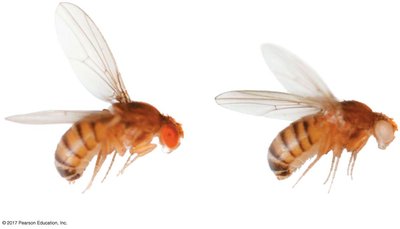
Additional info: The image shows wild type and mutant fruit flies, illustrating the visible differences used in genetic studies.
Sex-Linked Inheritance in Drosophila
Morgan’s cross between white-eyed males and red-eyed females demonstrated that the white gene is located on the X chromosome, leading to unique inheritance patterns.
Sex-Linked Genes: Genes located on sex chromosomes (X or Y).
Inheritance Pattern: Males (XY) express recessive X-linked traits with one mutant allele; females (XX) require two mutant alleles.
Hemizygous: Males have only one X chromosome, so they are hemizygous for X-linked genes.
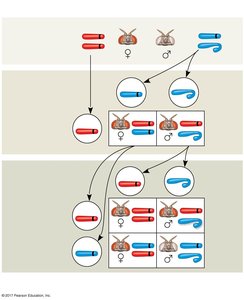
Additional info: The diagram illustrates the inheritance of X-linked traits, showing how males and females inherit different combinations of alleles.
Sex Determination in Humans and Other Organisms
Sex determination is based on the combination of sex chromosomes. Humans use the XY system, while other organisms may use different systems such as X-0 or ZW.
XY System: Males (XY), females (XX).
X-0 System: Females (XX), males (X).
ZW System: Females (ZW), males (ZZ).
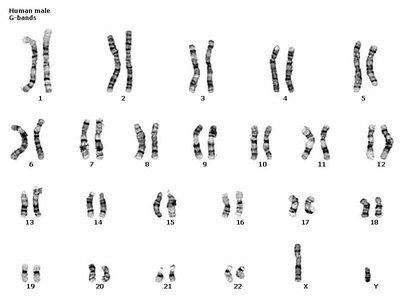
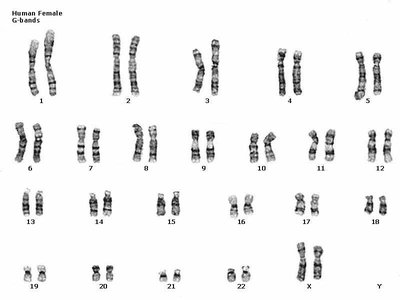
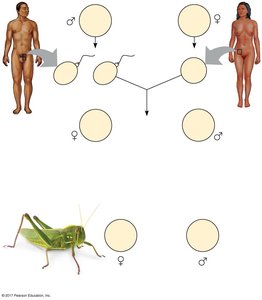
Additional info: The karyotype images show the chromosome composition of human males and females, and the diagram illustrates different sex determination systems.
Inheritance of X-Linked Genes in Humans
X-linked recessive disorders are more common in males because they only need one copy of the mutant allele. Females must be homozygous for the mutant allele to express the trait.
Examples: Color blindness, Duchenne muscular dystrophy, hemophilia.
Carrier Female: Heterozygous for the mutant allele; can pass the trait to offspring.
Punnett Squares: Used to predict probabilities of affected offspring.
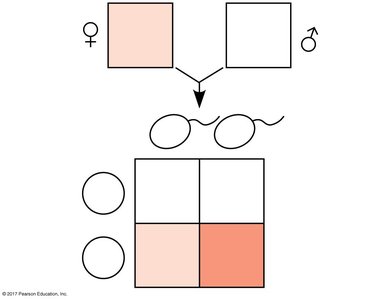
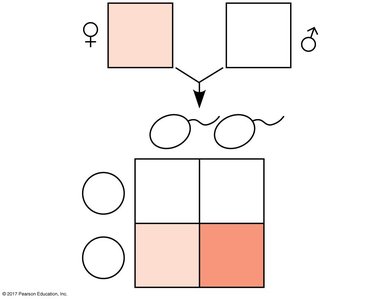
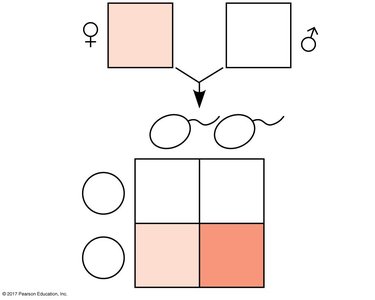
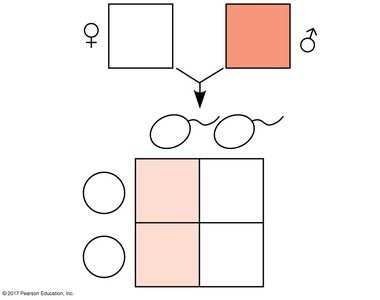
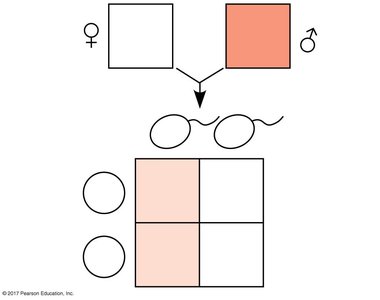
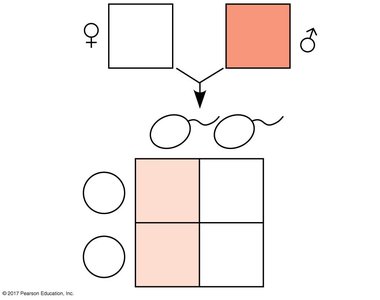
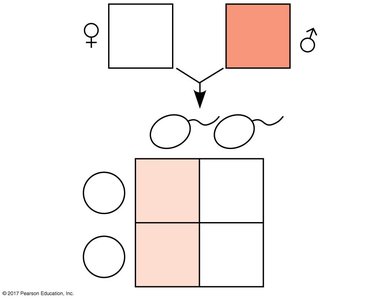
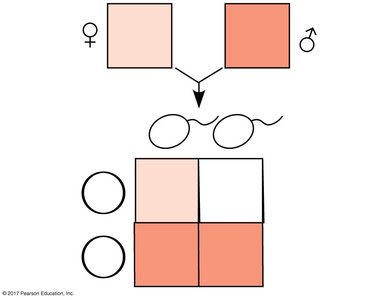
Additional info: The series of Punnett squares visually demonstrate the inheritance patterns and probabilities for X-linked traits in humans.
X Inactivation in Female Mammals
To balance gene dosage, one X chromosome in each cell of female mammals is randomly inactivated, forming a Barr body. This results in genetic mosaicism, as seen in tortoiseshell cats.
Barr Body: Inactivated X chromosome in female cells.
Mosaicism: Heterozygous females express different alleles in different cells.
Example: Tortoiseshell cats display mosaic fur coloration due to X inactivation.
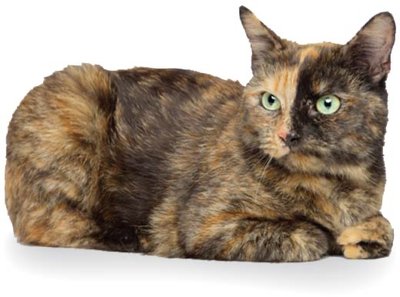
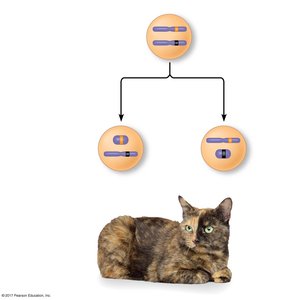
Additional info: The images illustrate mosaicism in female mammals, with tortoiseshell cats as a classic example.
Gene Linkage and Genetic Mapping
Linked Genes and Deviations from Mendel’s Law
Genes located near each other on the same chromosome are called linked genes and tend to be inherited together, deviating from Mendel’s law of independent assortment.
Linked Genes: Genes physically close on the same chromosome.
Inheritance: Linked genes are inherited together unless separated by crossing over.
Example: Morgan’s experiments with Drosophila body color and wing shape.
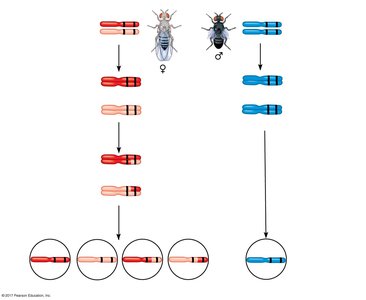
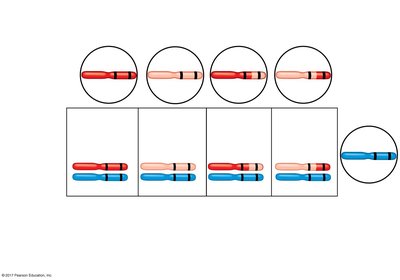
Additional info: The diagrams show how crossing over produces recombinant chromosomes and offspring, explaining deviations from independent assortment.
Recombination Frequency and Linkage Mapping
The frequency of recombination between linked genes depends on their distance apart. Recombination frequency is used to construct linkage maps, with 1% recombination equaling 1 map unit.
Recombination Frequency (RF):
Map Units: 1 map unit = 1% recombination frequency.
Linkage Map: Diagram showing relative positions of genes on a chromosome.
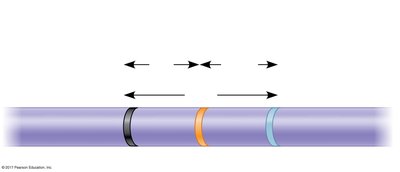
Additional info: The linkage map visually represents gene distances based on recombination frequencies.
Alterations of Chromosome Number and Structure
Aneuploidy and Polyploidy
Abnormalities in chromosome number can lead to genetic disorders. Aneuploidy refers to an abnormal number of a particular chromosome, while polyploidy involves multiple complete sets of chromosomes.
Aneuploidy: Monosomy (2n-1), Trisomy (2n+1), e.g., Down syndrome (trisomy 21).
Polyploidy: More than two complete sets of chromosomes; common in plants.
Nondisjunction and Chromosomal Alterations
Nondisjunction occurs when chromosomes fail to separate properly during meiosis, resulting in gametes with abnormal chromosome numbers. Structural alterations include deletions, duplications, inversions, and translocations.
Nondisjunction: Failure of homologous chromosomes or sister chromatids to separate.
Chromosomal Alterations:
Deletion: Loss of a chromosome segment.
Duplication: Repetition of a segment.
Inversion: Reversal of a segment within a chromosome.
Translocation: Movement of a segment to a nonhomologous chromosome.
Additional info: Chromosomal alterations can have significant effects on phenotype and are important in evolution and disease.
Summary Table: Types of Chromosomal Alterations
Type | Description | Example |
|---|---|---|
Aneuploidy | Abnormal number of chromosomes | Down syndrome (trisomy 21) |
Polyploidy | Multiple complete sets of chromosomes | Hexaploid wheat, octoploid strawberries |
Deletion | Loss of chromosome segment | Cri du chat syndrome |
Duplication | Repetition of segment | Charcot-Marie-Tooth disease |
Inversion | Reversal of segment | Some forms of hemophilia |
Translocation | Segment moves to another chromosome | Chronic myelogenous leukemia |
Key Concepts Review
Genes are located on chromosomes, which undergo segregation and independent assortment during meiosis.
Sex-linked genes exhibit unique inheritance patterns, with X-linked recessive traits more common in males.
X inactivation in female mammals leads to genetic mosaicism.
Linked genes are inherited together unless separated by crossing over; recombination frequency is used for genetic mapping.
Alterations in chromosome number or structure can cause genetic disorders and play a role in evolution.
