 Indietro
Circulation and Gas Exchange in Animals
Guida di studio - Note intelligenti
 Appunti personalizzati basati sui tuoi materiali, ampliati con definizioni chiave, esempi e contesto.
Ch. 42 Circulation and Gas Exchange
Overview of Circulatory and Respiratory Systems
The circulatory and respiratory systems are essential for transporting gases, nutrients, and wastes throughout the animal body. These systems enable the exchange of oxygen and carbon dioxide, which is vital for cellular respiration and overall organismal function.
Circulatory system: Transports gases, nutrients, hormones, and waste products.
Respiratory system: Facilitates gas exchange between the organism and its environment.
Cellular respiration: Requires oxygen and produces carbon dioxide as a waste product.
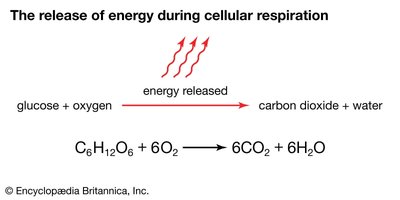
Equation for cellular respiration:
Additional info: This equation shows how glucose and oxygen are converted to carbon dioxide and water, releasing energy for cellular processes.
Exchange of Substances with the Environment
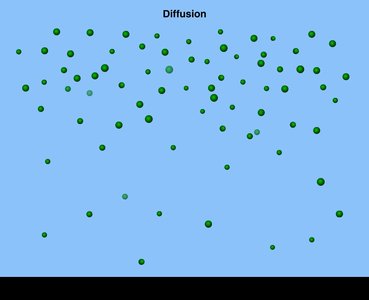
All cells must exchange substances with their environment. Small molecules move by diffusion, but larger or multicellular organisms require specialized systems for efficient exchange.
Diffusion: Movement of molecules from high to low concentration.
Limitations: Diffusion is effective only over short distances.
Gastrovascular Cavities in Simple Animals
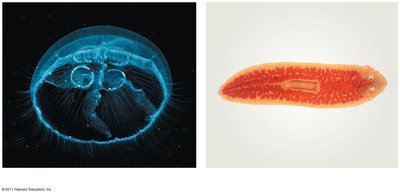
Some simple animals, such as cnidarians and flatworms, use gastrovascular cavities for both digestion and distribution of substances. These structures allow direct exchange with the environment.
Gastrovascular cavity: Central cavity for digestion and exchange.
Examples: Jellyfish (Aurelia), planarian (Dugesia).
Major Components of Circulatory Systems
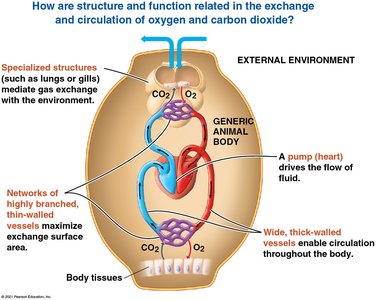
Complex animals have circulatory systems composed of three main components:
Muscular pump: The heart or similar structure.
Circulatory fluid: Blood or hemolymph.
Interconnecting vessels: Arteries, veins, capillaries.
Functions of the Circulatory System
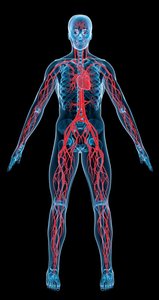
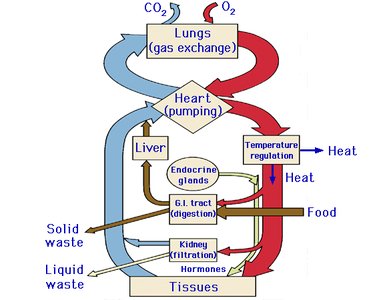
The circulatory system distributes gases, nutrients, wastes, hormones, antibodies, and heat throughout the body.
Transport: Moves substances to where they are needed.
Regulation: Maintains homeostasis, including temperature.
Protection: Circulates immune cells and antibodies.
Open vs. Closed Circulatory Systems
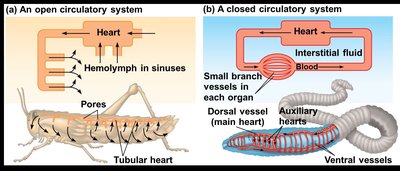
Animals have either open or closed circulatory systems, each with distinct structures and functions.
Open circulatory system: Hemolymph is not fully contained within vessels; found in arthropods and some mollusks.
Closed circulatory system: Blood is confined to vessels; found in annelids, cephalopods, and vertebrates.
Organization of Vertebrate Circulatory Systems
Vertebrates have a heart with two or more chambers, blood as the circulatory fluid, and three main types of blood vessels:
Arteries: Carry blood away from the heart.
Capillaries: Site of gas and nutrient exchange.
Veins: Return blood to the heart.
Single and Double Circulation
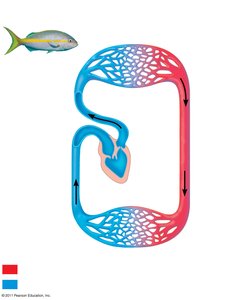
Circulatory systems in vertebrates can be classified as single or double circulation.
Single circulation: Blood passes through the heart once per cycle (e.g., fish).
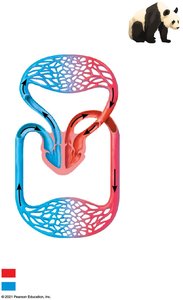
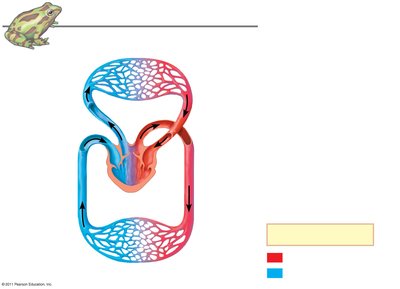
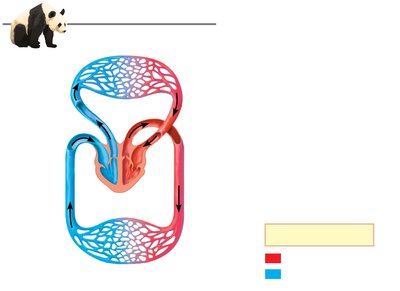
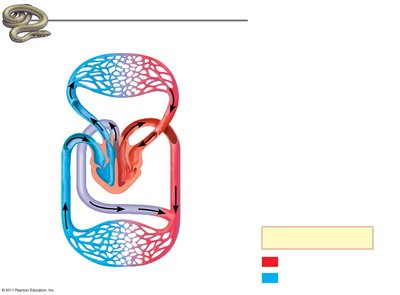
Double circulation: Blood passes through the heart twice per cycle (e.g., mammals, birds, amphibians).
Heart Structure and Blood Flow
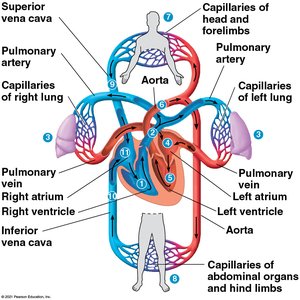
The heart is composed of atria and ventricles. The left side handles oxygen-rich blood, while the right side handles oxygen-poor blood. Mammals and birds have a four-chambered heart for efficient separation of oxygenated and deoxygenated blood.
Atria: Collection chambers with thin walls.
Ventricles: Pumping chambers with thick walls.
Valves: Ensure unidirectional blood flow.
Cardiac Cycle and Cardiac Output
The cardiac cycle consists of systole (contraction) and diastole (relaxation). Cardiac output is the volume of blood pumped per minute, calculated as:
Heart rate: Beats per minute.
Stroke volume: Blood pumped per contraction.
Blood Vessel Structure and Function
Blood vessels are specialized for their roles in circulation:
Arteries: Thick, muscular walls for high pressure.
Capillaries: Thin walls for exchange.
Veins: Thinner walls, valves to prevent backflow.
Blood Pressure and Flow
Blood pressure decreases from arteries to veins due to fluid loss and resistance. Flow velocity is slowest in capillaries, allowing time for exchange.
Hydrostatic pressure: Drives fluid out of capillaries.
Resistance: Increases in small-diameter vessels.
Cross-sectional area: Inversely related to flow velocity.
Lymphatic System
Fluid lost from capillaries is returned to the circulatory system via the lymphatic system. Lymph also plays roles in immunity and fat absorption.
Lymph: Recovered interstitial fluid.
Lymph nodes: Immune function.
Gas Exchange and Respiratory Surfaces
Gas exchange supplies oxygen for cellular respiration and removes carbon dioxide. Specialized respiratory surfaces include body surfaces, gills, tracheae, and lungs.
Body surface: Used by earthworms and some amphibians.
Gills: Used by aquatic animals.
Tracheal tubes: Used by insects.
Lungs: Used by mammals, birds, reptiles, and some amphibians.
Mechanisms of Breathing
Breathing ventilates the lungs by moving air in and out. Mammals use negative pressure breathing, where contraction of the diaphragm increases lung volume and draws air in.
Negative pressure breathing: Diaphragm contracts downward.
Tidal volume: Air inhaled per breath.
Residual volume: Air remaining after exhalation.
The Mammalian Respiratory System
Air travels through the pharynx, larynx, trachea, bronchi, and bronchioles to the alveoli, where gas exchange occurs. Cilia and mucus help trap and remove particles.
Alveoli: Site of gas exchange.
Cilia and mucus: Protect respiratory tract.
Coordination of Circulation and Gas Exchange
The pulmonary circuit brings oxygen-poor blood to the lungs for gas exchange, while the systemic circuit delivers oxygen-rich blood to tissues and returns deoxygenated blood to the heart.
Pulmonary circuit: Heart to lungs and back.
Systemic circuit: Heart to body tissues and back.
Red Blood Cells and Hemoglobin
Red blood cells (erythrocytes) transport oxygen and carbon dioxide. Hemoglobin binds oxygen for transport.
Biconcave shape: Increases surface area for gas exchange.
Hemoglobin: Protein that binds oxygen.
Effects of Cigarette Smoke
Cigarette smoke damages alveoli and reduces gas exchange, leading to respiratory diseases such as COPD and pneumonia.
Damage to alveoli: Reduces efficiency of gas exchange.
Respiratory diseases: Chronic and acute illnesses.
