 Indietro
Climate Patterns, Species Distribution, and Ecological Modeling
Guida di studio - Note intelligenti
 Appunti personalizzati basati sui tuoi materiali, ampliati con definizioni chiave, esempi e contesto.
Large-Scale Climate Patterns
Seasonality and Earth's Tilt
Seasonality refers to the predictable changes in climate and weather patterns throughout the year, primarily caused by the tilt of the Earth (23.5 degrees) relative to its orbit around the sun. The distance from the equator and the angle at which solar radiation strikes the Earth's surface determine temperature and seasonal variation.
Seasonality: Driven by Earth's axial tilt, resulting in varying sunlight intensity and duration.
Latitude: Regions closer to the equator receive more direct sunlight, leading to warmer temperatures.
Temperature: Influenced by latitude and solar angle.
Precipitation and Atmospheric Circulation
Global precipitation patterns are shaped by temperature-driven circulation loops, such as the Hadley cell. These loops create alternating wet and dry zones at different latitudes.
Hadley Cell: Atmospheric circulation pattern responsible for wet conditions at the equator (0°), dry at 30°, wet at 60°, and dry at the poles (90°).
Rain Shadow Effect: Occurs when mountains block moist air, causing dry conditions on the leeward side.
Ocean Currents and Climate
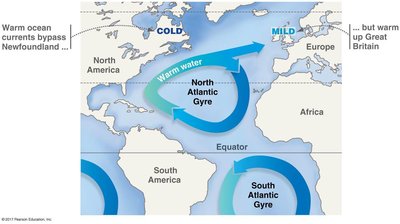
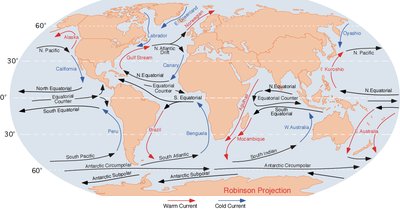
Ocean currents play a crucial role in regulating continental-scale temperature patterns. Warm equatorial water circulates toward the poles, cools, and returns to the equator, affecting coastal climates.
Ocean Currents: Warm currents (e.g., Gulf Stream) can make coastal climates warmer than expected, while cold currents can cool coastal regions.
Continental Position: The location of continents and geological features influences climate and the distribution of organisms.
Predicting Climate and Species Distribution
Factors Influencing Distribution and Abundance
Understanding climate patterns allows biologists to predict the distribution and abundance of organisms. Key factors include seasonality, latitude, geological structures, and ocean currents.
Abiotic Factors: Non-living environmental variables such as temperature, precipitation, and soil type.
Biotic Factors: Living components like competition, predation, and mutualism.
Case Study: Seattle, WA vs. Portland, ME
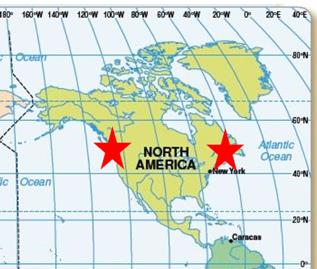
Although Seattle, WA and Portland, ME are at similar latitudes, their climates differ due to their positions on different coasts and the influence of ocean currents.
Seattle, WA: Milder, wetter climate due to proximity to the Pacific Ocean and prevailing westerly winds.
Portland, ME: Colder, drier climate influenced by the Atlantic Ocean and continental air masses.
Ecological Modeling and Spatial Analysis
Species Distribution Modeling (SDM) and Ecological Niche Modeling (ENM)
Modern biology uses GIS (Geographic Information Systems) and spatial analysis to model and predict species distributions based on environmental variables.
SDM: Uses statistical and computational methods to predict where species are likely to occur.
ENM: Identifies the ecological requirements of species and predicts their potential geographic range.
Limitations of Abiotic-Only Models
Models often focus on abiotic factors, but biotic interactions (e.g., seed dispersers, diseases, competition) can significantly affect species distributions.
Example: Will a seed disperser (e.g., toucan) be present in predicted areas? Will fungal diseases or competition alter the predicted range?
Application: Climate Change and Species Distribution
Hypothesis Testing in Ecology
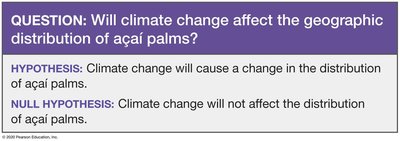
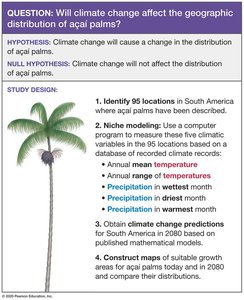
Ecologists use hypotheses and null hypotheses to test whether climate change will affect the geographic distribution of species, such as açaí palms.
Hypothesis: Climate change will cause a change in the distribution of açaí palms.
Null Hypothesis: Climate change will not affect the distribution of açaí palms.
Study Design for Distribution Modeling
Researchers identify locations, use niche modeling to analyze climate variables, obtain climate change predictions, and construct maps to compare present and future distributions.
Key Variables: Annual mean temperature, range of temperature, precipitation in wettest/driest/warmest months.
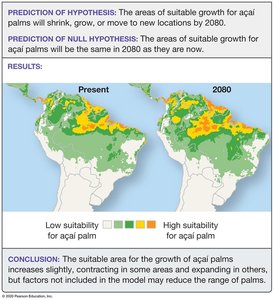
Mapping: Visual comparison of suitable growth areas for açaí palms in present and future scenarios.
Results and Conclusions
Model predictions show that suitable areas for açaí palm growth may expand, contract, or shift by 2080, depending on climate change. However, factors not included in the model (e.g., biotic interactions) may reduce the range.
Prediction of Hypothesis: Areas of suitable growth will change by 2080.
Prediction of Null Hypothesis: Areas of suitable growth will remain the same.
Conclusion: Suitable area increases slightly, but model limitations exist.
Summary Table: Abiotic vs. Biotic Factors in Species Distribution Modeling
Factor Type | Examples | Role in Modeling |
|---|---|---|
Abiotic | Temperature, precipitation, soil, sunlight | Often included in models; determines basic suitability |
Biotic | Competition, predation, mutualism, disease | Rarely included; can alter actual distribution |
Additional info:
Ecological modeling is a rapidly advancing field, with GIS and spatial analysis skills increasingly important for biologists.
Species distribution models are essential for conservation planning, predicting impacts of climate change, and understanding ecological dynamics.
