 Indietro
Community Ecology and Ecosystem Dynamics: Study Notes
Guida di studio - Note intelligenti
 Appunti personalizzati basati sui tuoi materiali, ampliati con definizioni chiave, esempi e contesto.
Community Ecology
Community Structure and Interactions
Community ecology examines how populations of different species interact within a shared environment, shaping the structure and dynamics of biological communities. - Community: An assemblage of populations of different species living close enough for potential interaction. - Interactions: Include competition, predation, herbivory, symbiosis, and facilitation. - Evolutionary Pressure: Interactions among species produce evolutionary pressure, leading to adaptations. 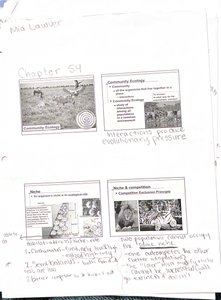
Competition and Niche Partitioning
Competition occurs when species vie for the same resources, influencing their distribution and abundance. - Competitive Exclusion Principle: Two species competing for identical resources cannot coexist indefinitely; one will outcompete the other. - Niche: The role and space an organism occupies in its environment, including its use of resources. - Resource Partitioning: The differentiation of ecological niches, enabling similar species to coexist. 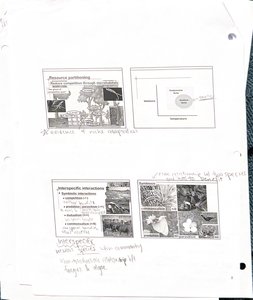
Interspecific Interactions
Interspecific interactions are relationships between species in a community. - Types: Competition, predation, herbivory, symbiosis (mutualism, commensalism, parasitism), and facilitation. - Mutualism: Both species benefit. - Commensalism: One benefits, the other is unaffected. - Parasitism: One benefits at the expense of the other.
Predation and Adaptations
Predator-Prey Relationships
Predation is a biological interaction where a predator feeds on its prey, driving evolutionary adaptations. - Predator Adaptations: Include claws, teeth, fangs, stingers, and camouflage. - Prey Adaptations: Include hiding, fleeing, alarm calls, and defensive mechanisms. 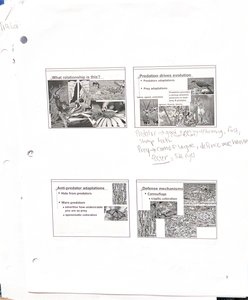
Anti-Predator Adaptations
Prey species evolve various strategies to avoid predation. - Camouflage: Blending with the environment to avoid detection. - Mimicry: Resembling another species for protection. - Warning Coloration: Bright colors signal toxicity or danger to predators. 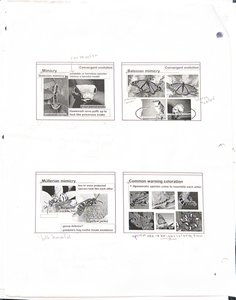
Mimicry and Warning Coloration
Batesian and Müllerian Mimicry
Mimicry is an adaptation where one species resembles another. - Batesian Mimicry: A harmless species mimics a harmful one. - Müllerian Mimicry: Two or more harmful species resemble each other, reinforcing avoidance by predators.
Common Warning Coloration
Warning coloration is a visual signal to predators that an organism is toxic or unpalatable. - Aposematism: The use of bright colors to warn predators. - Examples: Poison dart frogs, monarch butterflies.
Ecosystem Dynamics
Energy Flow in Ecosystems
Ecosystems are characterized by the flow of energy and cycling of nutrients. - Energy Input: Sunlight is the primary energy source for most ecosystems. - Energy Transfer: Energy flows from producers to consumers and decomposers. - Energy Loss: Energy is lost as heat at each trophic level. 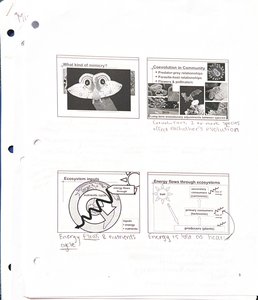
Food Chains and Food Webs
Food chains and food webs illustrate the transfer of energy and nutrients through trophic levels. - Food Chain: A linear sequence of organisms through which energy passes. - Food Web: A complex network of interconnected food chains. - Producers: Autotrophs (e.g., plants) that convert solar energy into chemical energy. - Consumers: Heterotrophs that feed on other organisms. - Decomposers: Break down dead organic matter, recycling nutrients. 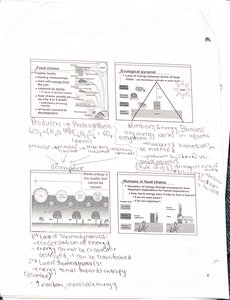
Ecological Pyramids
Ecological pyramids represent the distribution of energy, biomass, or numbers among trophic levels. - Energy Pyramid: Shows energy loss at each trophic level. - Biomass Pyramid: Illustrates the total mass of organisms at each level. - Numbers Pyramid: Displays the number of organisms at each level.
Community Structure and Biodiversity
Characterizing a Community
Communities are described by their species composition and diversity. - Species Diversity: The variety and abundance of species in a community. - Species Richness: The number of different species present. - Species Evenness: The relative abundance of each species. 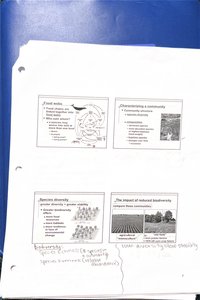
Impact of Reduced Biodiversity
Reduced biodiversity can affect ecosystem stability and function. - Consequences: Loss of ecosystem services, reduced resilience to disturbances, and increased vulnerability to invasive species.
Keystone Species and Ecosystem Stability
Keystone Species
Keystone species have a disproportionately large impact on community structure and ecosystem function. - Role: Their removal can cause dramatic changes in the ecosystem. - Examples: Sea otters, wolves, elephants. 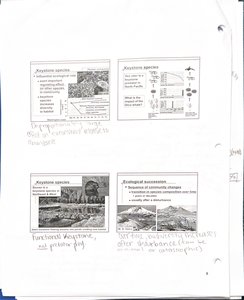
Ecological Succession
Ecological succession is the process of change in species composition over time following disturbance. - Primary Succession: Occurs in areas where no soil exists (e.g., after volcanic eruption). - Secondary Succession: Occurs in areas where soil remains after disturbance (e.g., after fire). 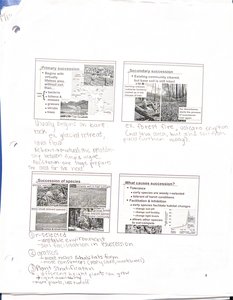
Climax Communities and Disturbance
Climax Community
A climax community is a stable, mature community that undergoes little change in species composition. - Characteristics: Dominated by long-lived species, high biodiversity, and resource stability. 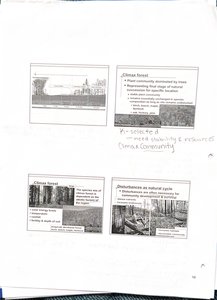
Disturbance as a Natural Cycle
Disturbances, such as fires, storms, or human activities, are natural parts of ecosystem dynamics. - Role: Disturbances can reset succession, promote diversity, and create new habitats.
Summary Table: Types of Species Interactions
Interaction Type | Effect on Species 1 | Effect on Species 2 | Example |
|---|---|---|---|
Competition | - | - | Two birds competing for nesting sites |
Predation | + | - | Wolf hunting deer |
Herbivory | + | - | Caterpillar eating leaves |
Mutualism | + | + | Bees pollinating flowers |
Commensalism | + | 0 | Barnacles on whales |
Parasitism | + | - | Ticks on mammals |
Key Equations
Photosynthesis Equation
Energy Transfer Efficiency
Species Diversity Index (Shannon Index)
where: = proportion of individuals in species , = total number of species
Additional info: Academic context was added to clarify definitions, examples, and equations for completeness.
