 Indietro
Community Ecology: Structure, Species Interactions, and Ecological Dynamics
Guida di studio - Note intelligenti
 Appunti personalizzati basati sui tuoi materiali, ampliati con definizioni chiave, esempi e contesto.
Community Structure
Attributes of Community Structure
Community structure refers to the organization and composition of species within a biological community. It is shaped by both biotic and abiotic factors and is fundamental to understanding ecological dynamics.
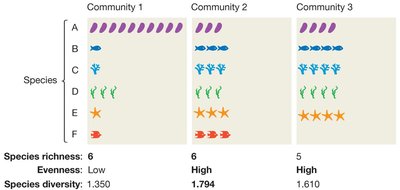
Total number of species: Known as species richness, this is the count of different species present in a community.
Sum of interactions among all species: Includes all possible relationships, such as predation, competition, and mutualism.
Relative abundance: The proportion of each species in the community, contributing to species evenness.
Physical attributes: Includes abiotic factors (e.g., size, altitude, sunlight) and biotic factors (e.g., vegetation type).
Species diversity is a weighted measure that incorporates both richness and evenness, providing a more comprehensive view of community complexity.
Species Interactions and Networks
Food Chains and Food Webs
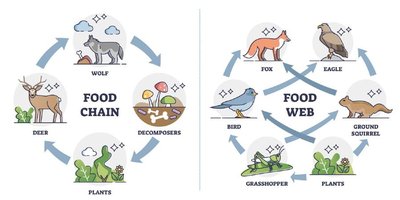
Species interactions form complex networks within communities. These can be visualized as food chains and food webs, which summarize consumption relationships.
Food chain: A linear sequence of consumption interactions.
Food web: A more complex network that combines multiple food chains, illustrating the interconnectedness of species.
Keystone Species and Community Dynamics
Keystone Species
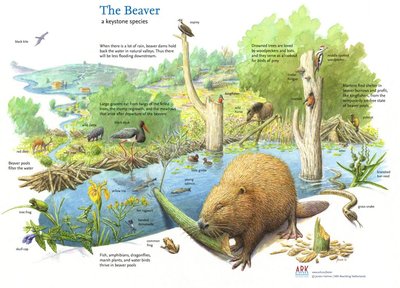
Some species exert a disproportionate influence on community structure, known as keystone species. Their presence or absence can dramatically alter the diversity and abundance of other species.
Direct and indirect effects: Keystone species impact other species through both direct interactions (e.g., predation) and indirect effects (e.g., altering habitat).
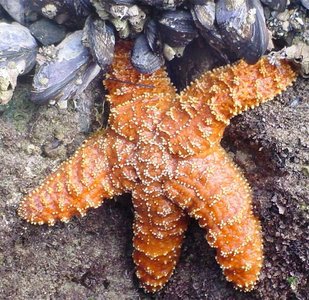
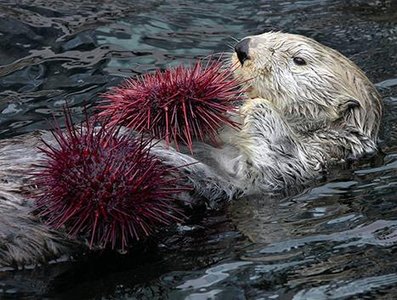
Examples: The ochre sea star (Pisaster ochraceus) and sea otters (Enhydra lutris) are classic keystone species.
Continuum of influence: Keystone species are not a discrete group but represent one end of a spectrum of ecological impact.
Bottom-Up and Top-Down Control
Community structure can be influenced by both bottom-up and top-down mechanisms:
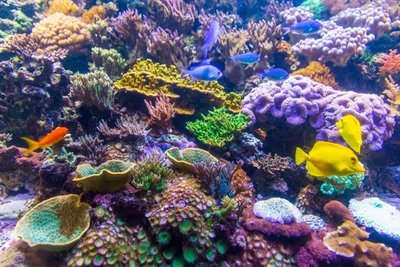
Bottom-up control: Abiotic factors (nutrients, sunlight, water) and ecosystem engineers (e.g., corals) determine the abundance of primary producers and shape habitat structure.
Top-down control: Consumers (predators) regulate the populations of prey species, often leading to cascading effects throughout the community.
Types of Species Interactions
Overview of Interaction Types
Species interactions are classified based on their effects on the fitness of the organisms involved:
Commensalism (+/0): One species benefits, the other is unaffected.
Competition (-/-): Both species are harmed by the interaction.
Consumption (+/-): One species benefits (consumer), the other is harmed (victim).
Mutualism (+/+): Both species benefit.
Commensalism
Commensalism is a +/0 interaction where one species gains a fitness benefit while the other is unaffected. It is often difficult to demonstrate due to the challenge of proving no effect on the host species.
Competition
Competition is a -/- interaction that reduces the fitness of both participants. It can be interspecific (between different species) or intraspecific (within the same species).
Niche: The range of resources a species can use or conditions it can tolerate.
Competitive exclusion principle: Formulated by G.F. Gause, states that two species with identical niches cannot coexist.
Fundamental niche: The full range of environmental conditions a species can theoretically occupy.
Realized niche: The actual range occupied, limited by competition.
Niche Differentiation and Character Displacement
Competition drives evolutionary changes that reduce niche overlap, known as niche differentiation or resource partitioning. Character displacement refers to changes in species traits that enable exploitation of different resources.
Example: Galápagos finches exhibit diverse beak shapes, allowing specialization on different food types.
Consumption
Consumption is a +/- interaction where one organism eats or absorbs nutrients from another. It includes predation, herbivory, and parasitism.
Predation: One organism kills and eats another.
Herbivory: One organism eats part of a plant or algae.
Parasitism: One organism lives on or in another, harming it.
Adaptations for Defense
Prey species evolve defenses against consumers, which can be constitutive (always present) or inducible (produced in response to threat).
Constitutive defenses: Cryptic coloration, escape behavior, toxins, schooling/flocking, armor/weapons.
Inducible defenses: Physical, chemical, or behavioral changes triggered by consumer presence.
Type of Defense | Example |
|---|---|
Cryptic coloration and object resemblance | Resemblance to a leaf enables grasshoppers to escape detection |
Escape behavior | Adaptations to detect predators and flee |
Toxins and defense chemicals | Brightly colored poison dart frogs advertise toxicity |
Schooling/flocking | Fish form dense schools to confuse predators |
Defense armor and weapons | Sharp thorns on plant stems |
Mutualism
Mutualism is a +/+ interaction where both species benefit. Examples include mycorrhizal fungi and plant roots, nitrogen-fixing bacteria, and pollinators with angiosperm plants.
Cheating: Some species exploit mutualistic relationships, turning them into +/– interactions.
Summary Table: Species Interactions
Type of Interaction | Fitness Effects | Short-Term Impact | Long-Term Impact |
|---|---|---|---|
Commensalism | +/0 | Population size and range of commensal may depend on host | Strong selection on commensal; none on host |
Competition | -/- | Reduces population size of both; weaker competitor may retreat or go extinct | Niche differentiation via selection |
Consumption | +/- | Impact depends on predator/prey density and defenses | Coevolutionary arms races |
Mutualism | +/+ | Population size and range depend on both species | Selection to maximize benefits and minimize costs |
Additional info:
Community ecology is directly relevant to General Biology, specifically Chapter 52: Community Ecology.
Topics covered include community structure, species interactions, keystone species, food webs, niche theory, and evolutionary consequences of interactions.
