 Indietro
Complement System: Structure, Function, and Activation Pathways
Guida di studio - Note intelligenti
 Appunti personalizzati basati sui tuoi materiali, ampliati con definizioni chiave, esempi e contesto.
Complement System
Overview of the Complement System
The complement system is a crucial component of the immune response, consisting of a network of plasma proteins and cell surface molecules that work together to defend the body against pathogens. It operates as a cascade of proteolytic enzymes, regulatory proteins, and inflammatory peptides, ultimately leading to pathogen elimination and maintenance of homeostasis.
Proteolytic enzymes: These enzymes cleave complement proteins to activate them.
Regulatory and inflammatory proteins: Control the activity and localization of complement activation.
Cell surface receptors: Mediate cellular responses to complement fragments.
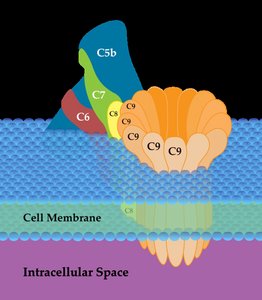
Membrane attack complex (MAC): Induces cell lysis by forming pores in microbial membranes.
Components of the Complement System
The complement system is composed of several types of molecules, each with a specific function in immune defense.
Recognition molecules: C1q, MBL (mannan-binding lectin), and ficolins detect danger signals and initiate complement activation.
Enzymes: C3/C5 convertase catalyze the cleavage of complement proteins, driving the cascade forward.
Membrane attack complex (MAC): C5b-9 forms the terminal structure that lyses cells.
Production: Most complement components are plasma proteins produced by the liver, while some are membrane-bound proteins.
Biological Functions of the Complement System
The complement system serves three main biological functions in immunity:
Opsonization: C3b coats pathogens, facilitating their recognition and phagocytosis by immune cells.
Inflammatory response: Fragments such as C3a and C5a act as chemoattractants and enhance phagocyte activity.
Cell lysis: The MAC disrupts microbial membranes, leading to cell death.
Activation Pathways of the Complement System
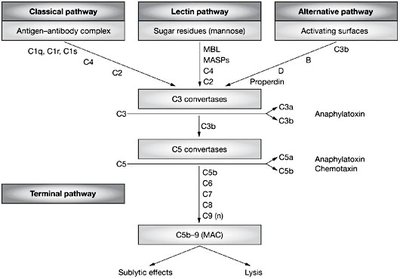
Complement activation occurs through three distinct pathways, all converging at the activation of C3:
Classical pathway: Initiated by antigen-antibody complexes (adaptive immunity).
Mannan-binding lectin pathway: Triggered by lectin binding to microbial carbohydrates.
Alternative pathway: Activated by foreign cell surface constituents such as lipopolysaccharides.
Classical Pathway
Activation of C1 Complex
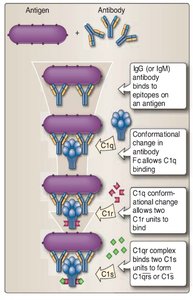
The classical pathway is initiated when antibodies (IgM or IgG) bind to antigens on the surface of a pathogen, causing a conformational change in the Fc region of the antibody. This enables the binding of C1q, which then activates the serine proteases C1r and C1s.
Antibody binding: IgG or IgM binds to antigen epitopes.
C1q binding: Conformational change allows C1q to bind.
Activation of C1r and C1s: C1qrs complex gains enzymatic activity for C4 and C2.
Production of C3 Convertase
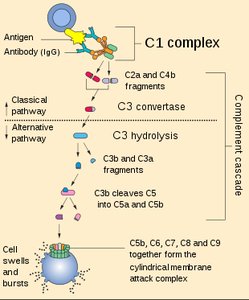
Activation of the C1 complex leads to cleavage of C4 and C2, forming the C4b2a complex, which acts as C3 convertase.
C4 → C4b
C2 → C2a
C4b2a: C3 convertase, a serine protease for C3
C3 cleavage: C3 convertase releases C3a and C3b
Production of C5 Convertase and Membrane Attack Complex (MAC)
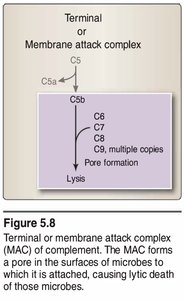
The C4b2a complex binds C3b to form C4b2a3b (C5 convertase), which initiates the formation of the MAC (C5b-9) on the microbial surface, leading to cell lysis.
C5 convertase: C4b2a3b complex
MAC formation: C5b recruits C6, C7, C8, and multiple C9 molecules to form a pore in the membrane
Cell lysis: The pore causes lytic death of the microbe
Mannan-Binding Lectin Pathway
Activation Mechanism
The lectin pathway is a non-antibody-dependent mechanism. Lectins, such as MBL, bind to specific carbohydrates (mannose residues) on microbial surfaces. The MBL-MASP complex then cleaves C4 and C2, forming the classical pathway C3 convertase.
Lectin binding: MBL binds to mannose-containing glycoproteins
MASP activation: MBL-associated serine protease (MASP) cleaves C4 and C2
C3 convertase formation: Same as classical pathway (C4b2a)
Alternative Pathway
Activation Mechanism
The alternative pathway is initiated by cell-surface constituents recognized as foreign, such as lipopolysaccharides. Enzymes like kallikrein, plasmin, and elastase cleave C3 into fragments, with C3b acting as a major opsonin.
C3b binding: C3b binds Factor B, which is cleaved by Factor D into Ba and Bb
C3bBb: Bb remains bound to C3b, forming C3 convertase
Properdin stabilization: C3bBb binds properdin (Factor P) to form C3bBbP
C5 convertase: Additional C3b fragments join to form C3bBbP3b
Amplification: Provides a source of C3b, amplifying classical pathway activity

Terminal Pathway and Membrane Attack Complex (MAC)
Formation and Function
The terminal pathway involves the assembly of the MAC, which forms a pore in the surface of microbes, causing lytic death.
C5b: Initiates MAC formation
C6, C7, C8, C9: Sequentially recruited to form the pore
Function: Causes lysis of microbes by disrupting membrane integrity
Summary Table: Complement Pathways
Comparison of Pathways
Pathway | Initiator | Key Components | C3 Convertase | C5 Convertase | Terminal Complex |
|---|---|---|---|---|---|
Classical | Antigen-antibody complex | C1q, C1r, C1s | C4b2a | C4b2a3b | C5b-9 (MAC) |
Lectin | Sugar residues (mannose) | MBL, MASPs, C4, C2 | C4b2a | C4b2a3b | C5b-9 (MAC) |
Alternative | Activating surfaces | C3b, Factor B, D, Properdin | C3bBb(P) | C3bBbP3b | C5b-9 (MAC) |
Self-Test Question
Classical Pathway Activation
Which of the following components is usually responsible for the activation of the classical pathway of the complement system?
A. Epitope
B. Immunoglobulin G (Correct answer: IgG or IgM antibodies initiate the classical pathway)
C. Glycoprotein on microbes
D. Lipopolysaccharide on the bacterial cell wall
E. None of the above
Key Equations
Complement Activation Equations
C3 convertase formation (Classical/Lectin):
C5 convertase formation (Classical/Lectin):
C3 convertase formation (Alternative):
C5 convertase formation (Alternative):
Additional info:
The complement system is a major part of innate immunity, but the classical pathway links it to adaptive immunity via antibody recognition.
Deficiencies in complement components can lead to increased susceptibility to infections and autoimmune diseases.
