 Indietro
Comprehensive Study Guide: Meiosis, Genetic Diversity, and Chromosomal Disorders
Guida di studio - Note intelligenti
 Appunti personalizzati basati sui tuoi materiali, ampliati con definizioni chiave, esempi e contesto.
Q1. Describe the stages of the sexual life cycle. What are the roles of meiosis, gamete formation, and fertilization in this process?
Background
Topic: Sexual Life Cycle and Genetic Continuity
This question explores how organisms alternate between haploid and diploid stages, and the importance of meiosis, gamete formation, and fertilization in maintaining chromosome number across generations.
Key Terms and Concepts:
Meiosis: Cell division that reduces chromosome number by half, producing haploid gametes.
Gamete: A haploid reproductive cell (sperm or egg).
Fertilization: Fusion of two gametes to form a diploid zygote.
Zygote: The first diploid cell of a new organism.
Diploid (2n): Cell with two sets of chromosomes.
Haploid (n): Cell with one set of chromosomes.
Step-by-Step Guidance
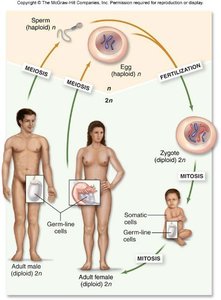
Begin by describing the alternation between diploid (2n) and haploid (n) stages in sexually reproducing organisms.
Explain how meiosis in germ cells produces haploid gametes (sperm and egg), reducing the chromosome number by half.
Describe how fertilization restores the diploid number by combining two haploid gametes to form a zygote.
Discuss how mitosis allows the zygote to grow and develop into a multicellular organism, maintaining the diploid state in somatic cells.
Set up a summary of the sequence: meiosis → gamete formation → fertilization → zygote → mitosis.
Try solving on your own before revealing the answer!
Final Answer:
The sexual life cycle alternates between diploid (2n) and haploid (n) stages. Meiosis in germ cells produces haploid gametes, which fuse during fertilization to form a diploid zygote. Mitosis then allows the zygote to grow into an adult organism, maintaining the chromosome number across generations.
Q2. What are germ cells and how are they involved in the sexual life cycle?
Background
Topic: Germ Cells and Their Role in Reproduction
This question focuses on the specialized cells that give rise to gametes and their importance in transmitting genetic information to the next generation.
Key Terms:
Germ cells: Cells in the reproductive organs that undergo meiosis to produce gametes.
Somatic cells: All other body cells that do not participate in gamete formation.
Step-by-Step Guidance
Define germ cells and distinguish them from somatic cells.
Explain where germ cells are located (testes in males, ovaries in females).
Describe how germ cells undergo meiosis to produce haploid gametes.
Discuss the role of germ cells in ensuring genetic continuity between generations.
Try solving on your own before revealing the answer!
Final Answer:
Germ cells are specialized cells found in the reproductive organs. They undergo meiosis to produce haploid gametes, ensuring that genetic information is passed from one generation to the next during sexual reproduction.
Q3. How are gametes produced in the sexual life cycle?
Background
Topic: Gametogenesis
This question examines the process by which gametes (sperm and eggs) are formed through meiosis in germ cells.
Key Terms and Concepts:
Gametogenesis: The process of forming gametes from germ cells.
Meiosis: The cell division process that produces haploid gametes.
Step-by-Step Guidance
Identify the starting cell type (germ cell) and its chromosome number (diploid, 2n).
Describe how germ cells undergo meiosis, which includes two consecutive divisions (Meiosis I and II).
Explain that the result is four haploid cells, each with half the original chromosome number.
Note that in animals, these haploid cells become sperm or eggs (gametes).
Try solving on your own before revealing the answer!
Final Answer:
Gametes are produced when diploid germ cells undergo meiosis, resulting in four haploid cells. These cells mature into sperm or eggs, ready for fertilization.
Q4. What is the role of mitosis in the sexual life cycle?
Background
Topic: Mitosis in Growth and Development
This question addresses how mitosis contributes to the growth and maintenance of multicellular organisms after fertilization.
Key Terms:
Mitosis: Cell division that produces genetically identical diploid cells.
Somatic cells: Non-reproductive body cells.
Step-by-Step Guidance
Explain that after fertilization, the zygote is diploid (2n).
Describe how mitosis allows the zygote to divide and develop into a multicellular organism.
Discuss how mitosis maintains the chromosome number in all somatic cells.
Try solving on your own before revealing the answer!
Final Answer:
Mitosis enables the zygote to grow and develop into an adult organism by producing genetically identical diploid cells, maintaining chromosome number in all somatic cells.
Q5. During fertilization, how is the chromosome number restored?
Background
Topic: Chromosome Number Restoration
This question focuses on how the fusion of gametes during fertilization restores the diploid chromosome number in the zygote.
Key Terms:
Haploid (n): Gametes with one set of chromosomes.
Diploid (2n): Zygote with two sets of chromosomes.
Fertilization: Fusion of two haploid gametes.
Step-by-Step Guidance
Recall that gametes are haploid, each carrying one set of chromosomes.
Describe how fertilization involves the fusion of a sperm and an egg.
Explain that the resulting zygote has two sets of chromosomes (one from each parent), restoring the diploid state.
Try solving on your own before revealing the answer!
Final Answer:
Fertilization restores the diploid chromosome number by combining two haploid gametes, resulting in a zygote with two sets of chromosomes (2n).
Q6. What is the difference between haploid and diploid?
Background
Topic: Chromosome Number in Cells
This question tests your understanding of the terms "haploid" and "diploid" as they relate to chromosome number in cells.
Key Terms:
Haploid (n): Cell with one set of chromosomes.
Diploid (2n): Cell with two sets of chromosomes.
Step-by-Step Guidance
Define haploid and diploid in terms of chromosome sets.
Give examples of haploid cells (gametes) and diploid cells (somatic cells, zygote).
Explain the significance of each in the sexual life cycle.
Try solving on your own before revealing the answer!
Final Answer:
Haploid cells (n) have one set of chromosomes and are found in gametes, while diploid cells (2n) have two sets and are found in somatic cells and the zygote.
Q7a. Describe how crossing over occurs, and during which phase does it occur?
Background
Topic: Genetic Recombination in Meiosis
This question examines the process of crossing over, which increases genetic diversity during meiosis.
Key Terms and Concepts:
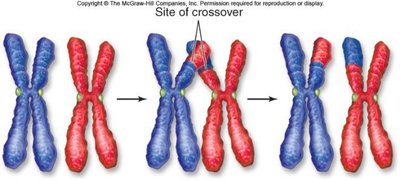
Crossing over: Exchange of genetic material between non-sister chromatids of homologous chromosomes.
Prophase I: The phase of meiosis where crossing over occurs.
Chiasma (plural: chiasmata): The site where crossing over occurs.
Step-by-Step Guidance
Describe how homologous chromosomes pair up during Prophase I of meiosis.
Explain how non-sister chromatids physically exchange segments at points called chiasmata.
Discuss the result: new combinations of alleles on each chromatid, increasing genetic diversity.
Try solving on your own before revealing the answer!
Final Answer:
Crossing over occurs during Prophase I of meiosis, when homologous chromosomes pair up and exchange genetic material between non-sister chromatids at chiasmata, resulting in new allele combinations.
Q7b. Which chromosomes and chromatids are involved in crossing over?
Background
Topic: Chromosomal Interactions in Meiosis
This question focuses on the specific structures involved in crossing over during meiosis.
Key Terms:
Homologous chromosomes: Chromosomes with the same genes but possibly different alleles.
Non-sister chromatids: Chromatids from homologous chromosomes, not from the same chromosome.
Step-by-Step Guidance
Identify homologous chromosomes as the pairs involved in crossing over.
Clarify that crossing over occurs specifically between non-sister chromatids of these homologous pairs.
Explain why this is important for genetic diversity.
Try solving on your own before revealing the answer!
Final Answer:
Crossing over involves non-sister chromatids of homologous chromosomes, allowing for the exchange of genetic material and increased genetic variation.
Q8c. Describe independent assortment and during which phase it occurs.
Background
Topic: Genetic Variation in Meiosis
This question explores how chromosomes are distributed independently into gametes, contributing to genetic diversity.
Key Terms and Concepts:
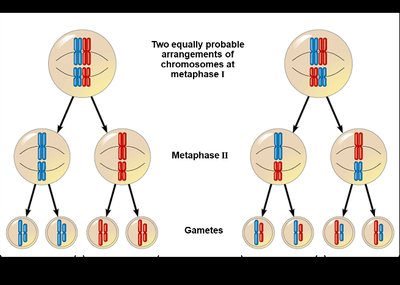
Independent assortment: The random distribution of homologous chromosomes to gametes during meiosis.
Metaphase I: The phase of meiosis where independent assortment occurs.
Step-by-Step Guidance
Describe how homologous chromosome pairs align randomly at the metaphase plate during Metaphase I.
Explain that each pair's orientation is independent of the others, leading to many possible combinations.
Discuss how this randomness increases genetic variation in gametes.
Try solving on your own before revealing the answer!
Final Answer:
Independent assortment occurs during Metaphase I of meiosis, when homologous chromosome pairs align randomly, resulting in a variety of possible genetic combinations in gametes.
Q8d. How does independent assortment increase genetic variation?
Background
Topic: Mechanisms of Genetic Diversity
This question examines the impact of independent assortment on the genetic makeup of offspring.
Key Terms:
Genetic variation: Differences in DNA sequences among individuals.
Gametes: Reproductive cells with unique combinations of chromosomes.
Step-by-Step Guidance
Explain that each gamete receives a random mix of maternal and paternal chromosomes due to independent assortment.
Discuss how this randomness leads to a large number of possible genetic combinations in offspring.
Relate this to the overall diversity seen in sexually reproducing populations.
Try solving on your own before revealing the answer!
Final Answer:
Independent assortment increases genetic variation by producing gametes with different combinations of maternal and paternal chromosomes, resulting in genetically unique offspring.
Q9e. Define random fertilization and explain its role in diversity.
Background
Topic: Sources of Genetic Diversity
This question focuses on how the random combination of gametes during fertilization contributes to genetic variation.
Key Terms:
Random fertilization: The unpredictable combination of any sperm with any egg.
Genetic diversity: The variety of genetic combinations in a population.
Step-by-Step Guidance
Define random fertilization as the process by which any sperm can fertilize any egg.
Explain how this randomness further increases the number of possible genetic combinations in offspring.
Discuss the cumulative effect of independent assortment, crossing over, and random fertilization on genetic diversity.
Try solving on your own before revealing the answer!
Final Answer:
Random fertilization means any sperm can fuse with any egg, multiplying the possible genetic combinations and greatly increasing genetic diversity in a population.
Q9f. Why are siblings not identical even with the same parents?
Background
Topic: Genetic Variation Among Siblings
This question explores why siblings (except identical twins) have unique genetic makeups despite sharing the same parents.
Key Terms:
Crossing over
Independent assortment
Random fertilization
Step-by-Step Guidance
Discuss how each gamete is genetically unique due to crossing over and independent assortment during meiosis.
Explain that random fertilization further increases the genetic differences between siblings.
Summarize that these mechanisms ensure siblings inherit different combinations of parental genes.
Try solving on your own before revealing the answer!
Final Answer:
Siblings are not identical because each inherits a unique combination of genes due to crossing over, independent assortment, and random fertilization, resulting in genetic variation even with the same parents.
