 Indietro
Control of Gene Expression in Bacteria
Guida di studio - Note intelligenti
 Appunti personalizzati basati sui tuoi materiali, ampliati con definizioni chiave, esempi e contesto.
Control of Gene Expression in Bacteria
Introduction to Gene Expression Regulation
Gene expression in bacteria is a highly regulated process, allowing cells to selectively express genes based on environmental conditions and cellular needs. This regulation ensures efficient use of resources and adaptation to changing environments.
Gene expression is the process by which a gene's product (RNA or protein) is synthesized and becomes active.
Bacterial cells are selective about which genes are expressed, when, and in what amounts.
Regulation occurs at multiple steps, including transcription, translation, and post-translation.
Overview of Gene Regulation and Information Flow
Efficient control of gene expression is crucial for bacterial survival, especially in competitive environments such as the human gut. Bacteria respond to environmental signals to regulate gene expression, conserving energy and resources.
Unnecessary protein synthesis reduces resources available for essential proteins.
Gene expression is triggered by specific environmental signals.
Mechanisms of Regulation
Levels of Gene Expression Control
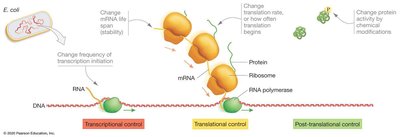
Bacterial gene expression can be regulated at three main levels: transcriptional, translational, and post-translational. Each level offers different speed and efficiency in response to cellular needs.
Transcriptional control: Determines whether mRNA is synthesized for a particular gene.
Translational control: Regulates whether synthesized mRNA is translated into protein.
Post-translational control: Modifies protein activity after translation, often through chemical modifications.
Transcriptional Control
Transcriptional control is the most resource-efficient but slowest form of regulation. It prevents unnecessary transcription of genes, saving energy and materials.
Regulatory proteins influence RNA polymerase's ability to bind to the promoter and initiate transcription.
Unneeded proteins are not transcribed, so ribosomes cannot make them.
Translational Control
Translational control allows rapid changes in protein levels because mRNA is already present. Regulation can occur by affecting mRNA stability or translation efficiency.
Regulatory molecules can increase mRNA degradation.
Translation rate or frequency can be altered.
Post-Translational Control
Post-translational control provides the fastest response by modifying protein activity after translation. Chemical modifications, such as phosphorylation, can activate or deactivate proteins.
Protein activity is regulated by chemical modifications.
Constitutive Gene Expression
Some genes are expressed continuously, known as constitutive expression. These genes often encode essential enzymes, such as those required for glycolysis.
Gene expression is not binary; levels can vary between fully "on" and "off."
Negative and Positive Control of Transcription
Regulation of Transcription
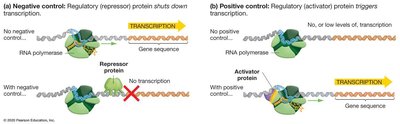
Transcription can be regulated by negative or positive control mechanisms, depending on the action of regulatory proteins.
Negative control: A repressor protein binds to DNA and shuts down transcription.
Positive control: An activator protein binds to DNA and triggers transcription.
Global Gene Regulation
Coordinated Regulation of Multiple Genes
Global gene regulation allows bacteria to coordinate the expression of many genes in response to specific signals. This is achieved through mechanisms such as sigma factors and operons.
Regulon: A set of separate genes or operons with the same regulatory sequences, controlled by a single regulatory protein.
Regulons can be under negative or positive control.
SOS Response Regulon
The SOS response regulon is an example of global gene regulation under negative control. It enables bacteria to repair DNA damage by expressing over 40 genes involved in repair, recombination, and specialized DNA polymerases.
LexA protein: Represses transcription of SOS genes when the cell is healthy.
DNA damage triggers LexA cleavage and inactivation, allowing expression of repair genes.
As DNA is repaired, LexA levels increase and the repair system is turned off.
Summary Table: Levels of Gene Expression Control
Level | Main Mechanism | Speed of Response | Example |
|---|---|---|---|
Transcriptional | Regulatory proteins affect RNA polymerase binding | Slow | Repressor blocks transcription initiation |
Translational | Regulatory molecules affect mRNA stability or translation | Moderate | mRNA degradation or translation inhibition |
Post-translational | Chemical modification of proteins | Fast | Phosphorylation activates protein |
