 Indietro
Descent with Modification: A Darwinian View of Life (Chapter 22 Study Notes)
Guida di studio - Note intelligenti
 Appunti personalizzati basati sui tuoi materiali, ampliati con definizioni chiave, esempi e contesto.
Descent with Modification: A Darwinian View of Life
Introduction to Evolutionary Biology
Evolutionary biology explores how species change over time, leading to the diversity and unity of life observed today. The concept of descent with modification is central to understanding how organisms adapt and evolve.
Key Observations About Life
Adaptation: Organisms are suited to their biotic (living) and abiotic (non-living) environments.
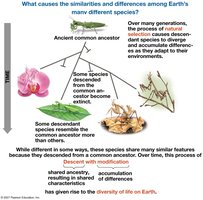
Unity: Shared characteristics among species reflect common ancestry.
Diversity: Differences among species arise as they adapt to different environments.
Evolution: The process by which species accumulate differences from their ancestors over time.
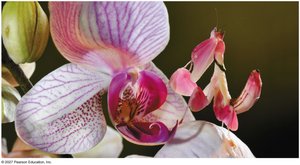
The Darwinian Revolution
The publication of The Origin of Species by Charles Darwin in 1859 marked the beginning of modern evolutionary biology. Darwin's ideas were influenced by his travels and the works of other scientists.
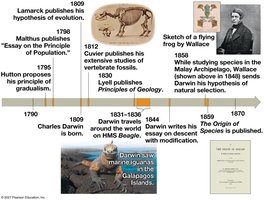
Historical Views on Species and Change
Aristotle: Proposed the scala naturae, a scale of increasing complexity, viewing species as fixed and unchanging.
Carolus Linnaeus: Developed a classification system and binomial nomenclature, grouping similar species into categories.
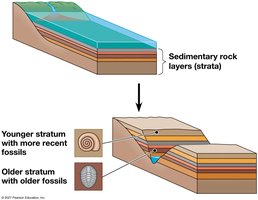
Fossils and Strata: Fossils found in sedimentary rock layers (strata) provide evidence for change over time.
Contributions of Early Scientists
Georges Cuvier: Developed paleontology, observed that older strata contain fossils less similar to current organisms.
James Hutton: Proposed gradual formation of Earth's geologic features.
Charles Lyell: Suggested that geologic processes operate at the same rate today as in the past.
Jean-Baptiste de Lamarck: Proposed the principles of use and disuse, and inheritance of acquired characteristics (not supported by evidence).
Darwin’s Research and the Voyage of the Beagle
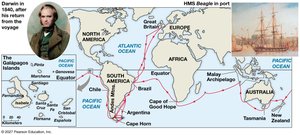
Darwin's five-year voyage on the HMS Beagle allowed him to collect specimens and observe species diversity, especially in the Galápagos Islands. He noted similarities between fossils and living species, and hypothesized that species colonized and diversified on islands.
Adaptation and Natural Selection
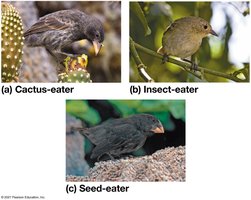
Adaptations: Inherited traits that enhance survival and reproduction.
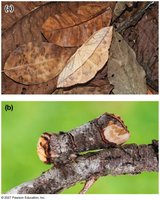
Natural Selection: Individuals with advantageous traits survive and reproduce at higher rates, leading to the accumulation of favorable traits.
Galápagos Finches: Example of adaptation through beak variation.
Descent with Modification
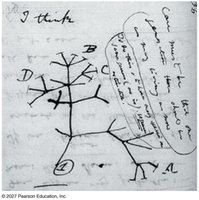
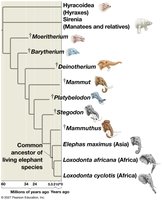
All organisms are related by descent from a common ancestor. Branching and extinction events explain morphological gaps between groups. Darwin envisioned the history of life as a tree with multiple branches.
Artificial Selection vs. Natural Selection
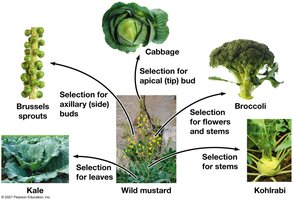
Artificial Selection: Humans breed individuals with desired traits, leading to significant changes in crops and animals.
Natural Selection: Occurs in nature, based on inherited variation and overproduction of offspring.
Key Features of Natural Selection
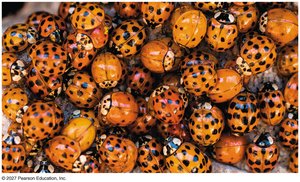
Individuals with certain heritable traits survive and reproduce at higher rates.
Natural selection increases the frequency of favorable adaptations.
Populations, not individuals, evolve over time.
Natural selection acts only on heritable traits that vary in a population.
Scientific Evidence for Evolution
Four main types of evidence support the pattern of evolution:
Direct Observations: Evolutionary change observed in real time, such as natural selection in response to introduced species and drug-resistant bacteria.
Homology: Similarity due to common ancestry, including anatomical, embryological, and molecular homologies.
Fossil Record: Provides evidence of extinction, origin of new groups, and changes within groups.
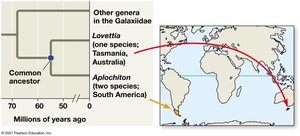
Biogeography: Study of geographic distribution of species, influenced by continental drift.
Direct Observations of Evolution
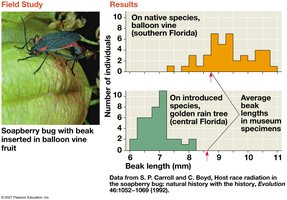
Soapberry Bugs: Evolution of beak length in response to fruit size in different environments.
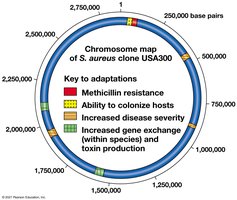
Drug-Resistant Bacteria: Evolution of resistance in Staphylococcus aureus (MRSA) due to antibiotic use.
Homology
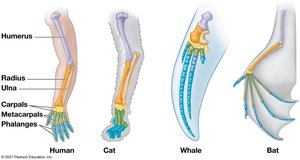
Anatomical Homologies: Forelimbs of mammals show similar bone arrangements but different functions.
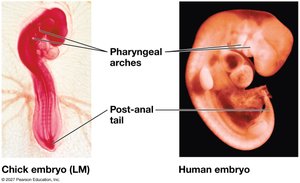
Embryological Homologies: Vertebrate embryos share features such as post-anal tail and pharyngeal arches.
Molecular Homologies: Genetic code and specific genes shared across diverse organisms.
Evolutionary Trees and Tree Thinking
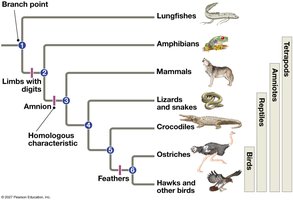
Evolutionary trees reflect hypotheses about relationships among groups, showing nested patterns of homologies and relative timing of evolutionary events.
Convergent Evolution
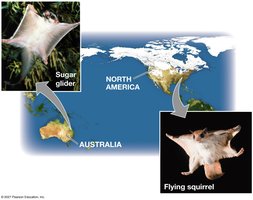
Convergent evolution occurs when distantly related groups independently evolve similar traits due to adaptation to similar environments. These traits are called analogous rather than homologous.
The Fossil Record
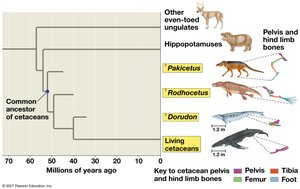
Documents extinction, origin of new groups, and changes within groups.
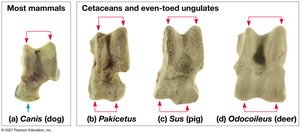
Supports hypotheses about evolutionary relationships, such as cetaceans and even-toed ungulates.
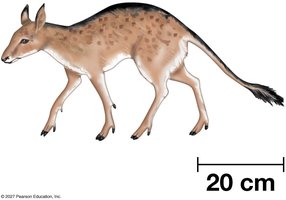
Biogeography
Geographic distribution of species is influenced by continental drift.
Species distributions help predict evolutionary history and relationships.
Scientific Theory of Evolution
Darwin's theory of evolution by natural selection integrates diverse areas of biological study and continues to stimulate new research. A scientific theory explains and integrates a wide variety of phenomena and observations.
----------------------------------------
