 Indietro
Descent with Modification: Evolution and the Diversity of Life
Guida di studio - Note intelligenti
 Appunti personalizzati basati sui tuoi materiali, ampliati con definizioni chiave, esempi e contesto.
Descent with Modification: Evolution and the Diversity of Life
Overview: Endless Forms Most Beautiful
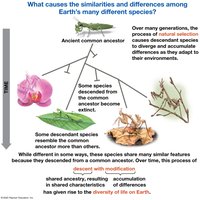
Evolution is the central theory that explains both the similarities and differences among Earth's many species. Over generations, natural selection causes descendant species to diverge and accumulate adaptations, resulting in the diversity of life observed today.
Natural selection drives the divergence of species from a common ancestor.
Shared ancestry explains similarities, while adaptation and accumulation of differences explain diversity.
The process of descent with modification gives rise to the tree-like pattern of life.
Development of Evolutionary Thought
The theory of evolution has developed through contributions from many scientists and philosophers. It is a unifying theory in biology, explaining the diversity and unity of life.
Major contributors: Aristotle, Linnaeus, Cuvier, Hutton, Lyell, Lamarck, Darwin, Wallace.
Darwin pieced together observations and theories to formulate natural selection.
Evolution is evident in the "tree of life" through common ancestry and descent with modification.
Concept 19.1: The Darwinian Revolution Challenged Traditional Views
Before Darwin, species were viewed as fixed and Earth as young. The Darwinian revolution challenged these views, introducing the concept of evolution by natural selection.
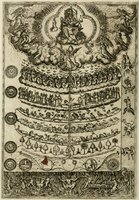
Scala Naturae: Aristotle's idea of a fixed hierarchy of life.
Taxonomy: Linnaeus developed the binomial naming system for species.
Ideas About Change Over Time
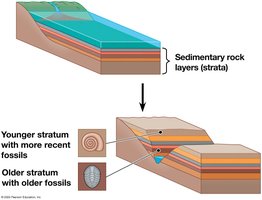
The study of fossils and geological strata provided evidence for change over time.
Fossils: Remains or traces of organisms found in layers (strata) of sedimentary rock.
Catastrophism: Cuvier's idea that boundaries between strata represent catastrophic events.
Gradualism & Uniformitarianism: Hutton and Lyell argued for slow, continuous geological processes.
Lamarck’s Hypothesis of Evolution
Lamarck was the first to propose a mechanism for evolution, suggesting that species evolve through use and disuse of body parts and inheritance of acquired characteristics. However, his mechanism is unsupported by evidence.
Concept 19.2: Descent with Modification by Natural Selection
Darwin and Wallace independently developed the theory of evolution by natural selection, explaining adaptation, unity, and diversity of life.
Adaptation: Traits that enhance survival and reproduction in a specific environment.
Natural selection: The process by which individuals with favorable traits are more likely to survive and reproduce.
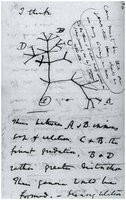
Descent with modification: The history of life is like a tree, with branches representing life's diversity.
Artificial Selection
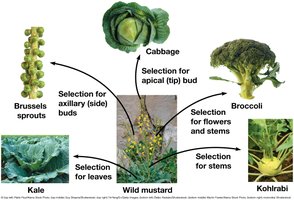
Humans have modified other species by selecting and breeding individuals with desired traits, a process called artificial selection.
Artificial selection: Intentional breeding for certain traits.
Example: Wild mustard bred into cabbage, broccoli, kale, etc.
Darwin’s Observations and Inferences
Darwin made two key observations leading to two inferences about natural selection:
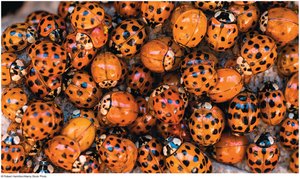
Observation 1: Members of a population vary in their inherited traits.
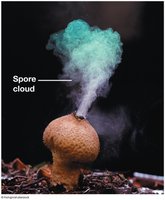
Observation 2: All species can produce more offspring than the environment can support; many fail to survive and reproduce.
Inference 1: Individuals well suited to their environment leave more offspring.
Inference 2: Favorable traits accumulate in the population over generations.
Concept 19.3: Scientific Evidence for Evolution
Evolution is supported by extensive scientific evidence from multiple sources:
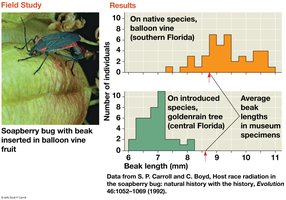
Direct observations: Evolution in real time, such as antimicrobial resistance and changes in beak size.
Homology: Similarity resulting from common ancestry, including anatomical and embryological similarities.
The fossil record: Provides evidence of extinction, origin of new groups, and changes within groups.
Biogeography: Geographic distribution of species supports evolutionary theory.
Direct Observations of Evolutionary Change
Field studies, such as changes in beak length in soapberry bugs, demonstrate evolution in real time.
Homology
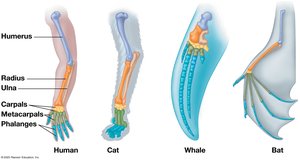
Homologous structures are anatomical features in different species that are similar due to shared ancestry, even if they serve different functions.
Example: Forelimbs of humans, cats, whales, and bats.
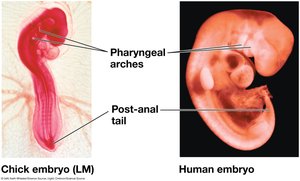
Anatomical Similarities in Vertebrate Embryos
Embryos of vertebrates show similarities, such as pharyngeal arches and post-anal tails, indicating common ancestry.
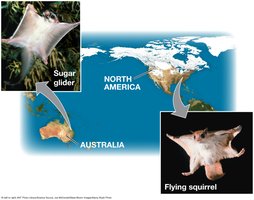
Convergent Evolution
Convergent evolution occurs when distantly related groups independently evolve similar features due to similar environmental pressures. These features are called analogous traits and do not indicate common ancestry.
The Fossil Record
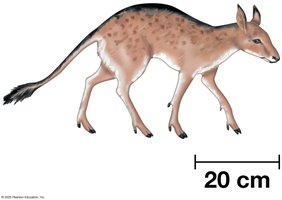
The fossil record documents the extinction of species, the origin of new groups, and changes within groups over time.
Example: Diacodexis, an early even-toed ungulate.
Ankle Bones: Clue to the Evolution of Whales
Comparisons of ankle bones among mammals provide evidence for the evolutionary transition of whales from land to sea.
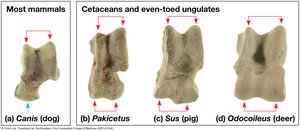
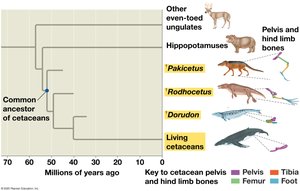
The Transition to Life in the Sea
Fossil and anatomical evidence show the evolutionary transition of cetaceans (whales) from terrestrial ancestors to aquatic life.
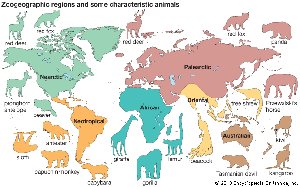
Biogeography
Biogeography is the study of the geographic distribution of species. Continental drift and the breakup of Pangea explain patterns of species distribution and support evolutionary theory.
What Is Theoretical About Darwin’s View of Life?
In science, a theory is a well-supported explanation that integrates many observations and predicts new phenomena. Darwin’s theory of evolution by natural selection continues to be tested and refined, integrating diverse areas of biological study.
Ongoing research adds to our understanding of evolution.
