 Indietro
Descent with Modification: Evolution and the Diversity of Life
Guida di studio - Note intelligenti
 Appunti personalizzati basati sui tuoi materiali, ampliati con definizioni chiave, esempi e contesto.
Descent with Modification: Evolution and the Diversity of Life
Overview: Endless Forms Most Beautiful
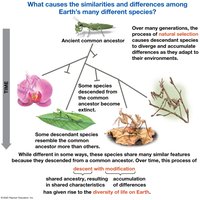
Evolution is the central theory in biology that explains both the similarities and differences among Earth's many species. Over generations, natural selection causes descendant species to diverge and accumulate adaptations, resulting in the diversity of life.
Natural selection is the process by which organisms better adapted to their environment tend to survive and reproduce.
Descent with modification refers to the passing of traits from parent to offspring, with changes accumulating over time.
Common ancestry explains why some species share similar features.
Diversity of life arises from the accumulation of differences as species adapt to their environments.
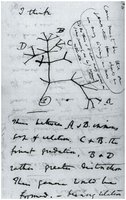
Tree-like pattern of evolution reflects branching from common ancestors.
Development of Evolutionary Thought
The theory of evolution has developed through contributions from many scientists. Darwin's theory of natural selection is a cornerstone, but earlier ideas and discoveries laid the foundation.
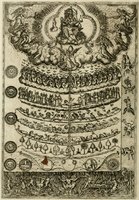
Aristotle viewed species as fixed and arranged them on a scala naturae (Great Chain of Being).
Carolus Linnaeus founded taxonomy and developed the binomial naming system (e.g., Homo sapiens).
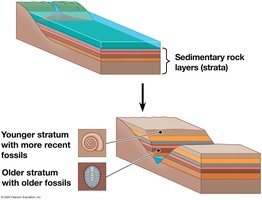
Fossils provided evidence for change over time, appearing in layers called strata.
Georges Cuvier proposed catastrophism, suggesting that boundaries between strata represent catastrophic events.
James Hutton and Charles Lyell argued for gradualism and uniformitarianism, where slow, continuous processes shape Earth's surface.
Jean-Baptiste Lamarck hypothesized evolution through use and disuse and inheritance of acquired characteristics, though his mechanism was unsupported.

The Darwinian Revolution
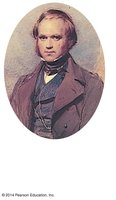
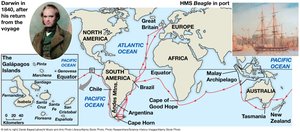
Charles Darwin's work challenged traditional views of a young, unchanging Earth. His voyage on the HMS Beagle and observations of species led to the formulation of natural selection.
On the Origin of Species (1859) introduced the theory of evolution by natural selection.
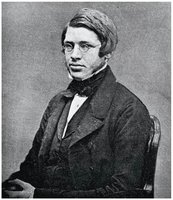
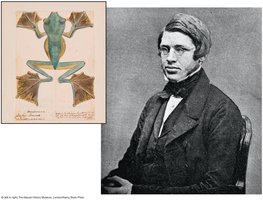
Alfred Russel Wallace independently conceived a similar theory.
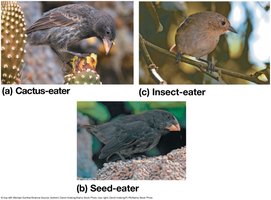
Darwin's observations in the Galápagos Islands were crucial to his understanding of adaptation and speciation.
Darwin’s Focus on Adaptation
Darwin recognized that adaptation to the environment and the origin of new species are closely related. He explained three broad observations: the unity of life, the diversity of life, and the match between organisms and their environment.
Adaptation is a trait that increases an organism's fitness in its environment.
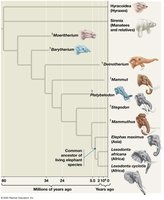
Species diverge from common ancestors, accumulating modifications.
The history of life is like a tree, with branches representing life's diversity.
Artificial Selection, Natural Selection, and Adaptation
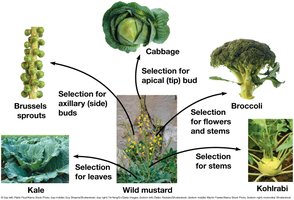
Darwin distinguished between artificial selection (human-driven) and natural selection (environment-driven). He drew two key inferences from two observations:
Observation 1: Members of a population vary in their inherited traits.
Observation 2: All species can produce more offspring than the environment can support; many fail to survive and reproduce.
Inference 1: Individuals well-suited to their environment leave more offspring.
Inference 2: Favorable traits accumulate in the population over generations.
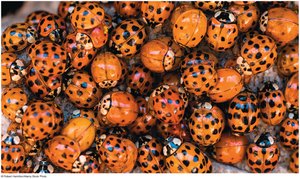
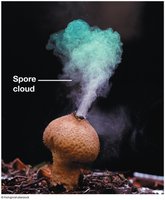
Scientific Evidence for Evolution
Evolution is supported by extensive scientific evidence from multiple sources. Four main types of data document the pattern of evolution:
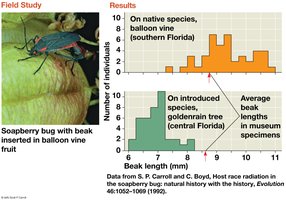
Direct observations of evolutionary change (e.g., antimicrobial resistance, changes in beak size).
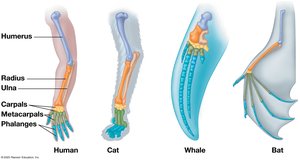
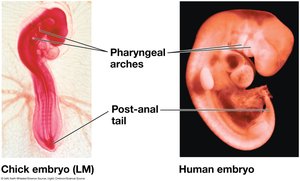
Homology: Similarity due to common ancestry, including anatomical and embryological similarities.
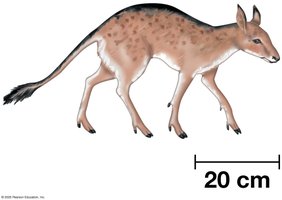
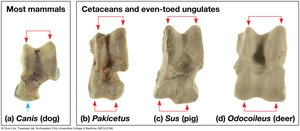
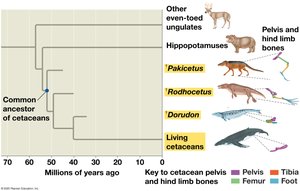
The fossil record: Provides evidence of extinction, origin of new groups, and changes within groups.
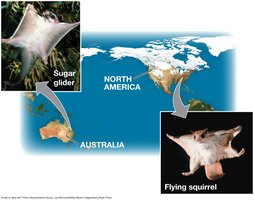
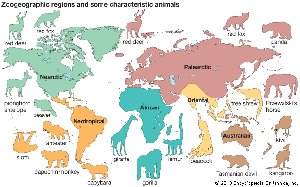
Biogeography: Geographic distribution of species supports evolutionary theory.
Key Terms and Concepts
Evolution: Change in the genetic composition of a population over generations.
Natural selection: Differential survival and reproduction of individuals due to differences in phenotype.
Adaptation: A heritable trait that increases an organism's fitness.
Homology: Similarity in traits due to shared ancestry.
Convergent evolution: Independent evolution of similar traits in distantly related groups.
Fossil record: Chronological collection of life's remains in sedimentary rock layers.
Biogeography: Study of the distribution of species and ecosystems in geographic space and through geological time.
Summary Table: Types of Evidence for Evolution
Type of Evidence | Description | Example |
|---|---|---|
Direct Observation | Evolutionary changes observed in real time | Antimicrobial resistance, beak size in finches |
Homology | Similar structures due to common ancestry | Forelimbs of humans, cats, whales, bats |
Fossil Record | Evidence of extinct and transitional species | Diacodexis, whale ankle bones |
Biogeography | Distribution of species across continents | Unique species in Australia, continental drift |
Equations and Models
Evolutionary biology often uses mathematical models to describe changes in populations. One fundamental equation is the Hardy-Weinberg equilibrium:
Hardy-Weinberg Equation:
$ p^2 + 2pq + q^2 = 1 $
Where p and q are the frequencies of two alleles in a population.
Conclusion
Darwin's theory of evolution by natural selection integrates diverse areas of biological study and continues to stimulate new research. Ongoing discoveries further support and refine our understanding of the unity and diversity of life.
