 Indietro
Deuterostome Animals: Echinoderms, Chordates, and Vertebrate Evolution
Guida di studio - Note intelligenti
 Appunti personalizzati basati sui tuoi materiali, ampliati con definizioni chiave, esempi e contesto.
Deuterostome Animals
Overview of Deuterostomes
Deuterostomes are a major lineage of animals characterized by unique embryonic development and include some of the largest and most complex animal groups.
Key embryonic features: Radial cleavage, formation of the anus from the blastopore, enterocoelous coelom formation, and indeterminate fate of early blastomeres.
Major phyla: Echinodermata, Hemichordata, Xenoturbellida, and Chordata.
Deuterostome Phyla
Echinodermata: Sea stars, sea urchins, and relatives.
Hemichordata: Acorn worms, deposit/suspension feeders.
Xenoturbellida: Recently discovered wormlike species.
Chordata: Vertebrates and their relatives.
Echinodermata
Defining Characteristics
Echinoderms are exclusively marine animals with unique body plans and systems.
Larval symmetry: Bilateral
Adult symmetry: Pentaradial (five-sided)
Endoskeleton: Made of calcium carbonate
Water vascular system: Branching, fluid-filled tubes forming a hydrostatic skeleton
Tube feet: Fluid-filled, externally projecting podia
Echinoderm Life Styles
Echinoderms display diverse feeding strategies, often using their podia.
Predatory species: Use tube feet to open prey
Suspension feeders: Trap particles with podia
Deposit feeders: Consume organic material from substrate
Herbivores: Feed on algae
Echinoderm Diversity
Five major living lineages:
Crinoidea: Feather stars, sea lilies (suspension feeders)
Asteroidea: Sea stars (predators, scavengers)
Ophiuroidea: Brittle stars, basket stars (suspension/deposit feeders)
Echinoidea: Sea urchins, sand dollars (herbivores/suspension feeders)
Holothuroidea: Sea cucumbers (suspension/deposit feeders)
Chordata
Defining Characteristics
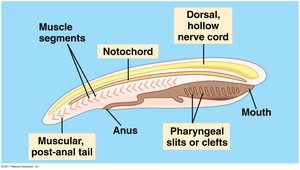
Chordates are defined by four key features present at some stage of development.
Pharyngeal slits: Used for feeding, gas exchange, or as parts of the ear/head/neck
Dorsal hollow nerve cord: Central nervous system precursor
Notochord: Supportive, flexible rod
Muscular post-anal tail: Locomotion
Chordate Phylogeny
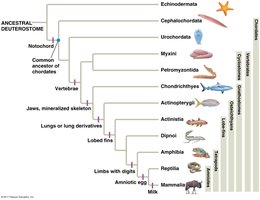
Three major lineages:
Cephalochordates: Lancelets (marine, mobile suspension feeders)
Urochordates: Tunicates (marine, retain only pharyngeal slits as adults)
Craniates (Vertebrates): Animals with skulls and often backbones
Cephalochordates
Small, marine, mobile suspension feeders
Dioecious with external fertilization
Urochordates
Marine, retain only pharyngeal slits as adults
Exoskeletal tunic, U-shaped gut, two siphons
Sexual (internal/external fertilization), some asexual
Craniates/Vertebrates
Head with skull (cranium), brain, eyes, sensory organs
Higher metabolism, complex musculature, heart with 2+ chambers
Erythrocytes with hemoglobin, kidneys
Vertebrate Synapomorphies
Spinal column (cartilage or bone)
Cranium (elaborate skull)
Fin rays (in aquatic forms)
Large brains divided into forebrain, midbrain, hindbrain
Neural Crest Cells
Neural crest is a unique feature of craniates, producing diverse cell types.
Craniofacial bones and cartilage
Melanocytes, smooth muscles, adrenal medulla
Parts of nervous system
Myxini (Hagfish)
Most basal craniates, marine, bottom-dwelling scavengers
Cartilaginous skull, axial rod of cartilage from notochord
Lack jaws and vertebrae, small brain/eyes/ears, tooth-like formations
Petromyzontida (Lampreys)
Oldest living vertebrate lineage
Lack true vertebrae, jawless, ectoparasites of fish
Vertebrate Key Innovations
Fossil evidence documents major evolutionary innovations:
Bony exoskeleton (~480 mya)
Jaws (~440 mya)
Bony endoskeleton (~410 mya)
Limbs capable of moving on land (~365 mya)
Amniotic egg (~345 mya)
Jaw Evolution
Jaws evolved from anterior-most gill arch cartilage, a neural crest derivative.
Gnathostome characters: Enlarged forebrain, lateral lines in aquatic forms
Most diverse vertebrate group today
Major Vertebrate Groups
Jawed Lineages
Chondrichthyes: Cartilaginous fishes
Osteichthyes: Bony fishes (includes Actinopterygii and Sarcopterygii)
Actinopterygia: Ray-finned fishes
Sarcopterygia: Lobe-finned fishes (includes tetrapods)
Chondrichthyes
Cartilaginous skeleton, mostly marine
Cloaca, acute senses, paired fins, placoid scales
Elasmobranchii: Most diverse group (sharks, rays)
Holocephalians: Ancient, deep sea, single gill opening
Osteichthyes
Bony endoskeleton, high species and habitat diversity
Includes Actinopterygii (ray-fins), Sarcopterygii (lobe-fins), and tetrapods
Actinopterygii: Ray-finned Fishes
Fin rays in paired fins, most have swim bladder
Greatest diversity among Osteichthyes
Bony scales, protrusible jaws, elaborate fin specialization
Sarcopterygii: Lobe-finned Fishes
Muscular pectoral and pelvic fins supported by bones
Scales of cosmine, diverse fossil record
Living species: Lungfish (Dipnoi), Coelacanth (Actinistia)
Fin-Limb Transition
The transition from fins to limbs was a major event in vertebrate evolution, linking fish to tetrapods.
Tetrapod adaptations: Four limbs with digits, neck, pelvic girdle fused to backbone, absence of gills, ears for airborne sounds
Supported by fossil and molecular evidence
Tiktaalik: The "Fishapod"
Tiktaalik is a transitional fossil showing both fish and tetrapod features.
Fins, gills, lungs, scales
Ribs for breathing air, neck, flattened skull, eyes on top
Fin bones showing limb pattern
Amphibians
Major Clades and Characteristics
Amphibians are the first tetrapods to colonize land, showing diverse adaptations.
Three clades: Frogs & toads (Anura), Salamanders (Uredela), Caecilians (Apoda)
Lungs and/or skin for respiration, moist skin, metamorphosis, cloaca
Amniota
Major Clades and Characteristics
Amniotes are distinguished by the amniotic egg and adaptations for terrestrial life.
Major clades: Anapsida, Synapsida, Diapsida (distinguished by skull openings)
Lay cleidoic egg, rib cage ventilated lungs, less permeable skin
Amniotic Egg and Extraembryonic Membranes
The amniotic egg allows reproduction independent of water and contains specialized membranes.
Amnion: Protective membrane
Yolk sac: Nutrients
Allantois: Waste storage
Chorion: Gas exchange
Albumen: Water and protein supply
Reptilia
Major Lineages and Characteristics
Reptiles include four major lineages and show adaptations for terrestrial and aquatic life.
Lizards & snakes (squamates), turtles (chelonians), crocodiles & alligators (crocodilians), birds (Aves)
Ectothermy (except birds), scales, well-developed lungs, oviparous (most)
Birds: From Dinosaurs to Modern Forms
Evolution and Characteristics
Birds are descended from feathered theropod dinosaurs and are the only living endothermic reptiles.
Early forms had teeth, clawed forelimbs, long tails
All egg layers, feathers, scaly hind feet, hollow bones, clavicle, keeled sternum
Lack urinary bladder, most have one ovary, efficient respiratory system, enlarged brains
Feathers and Flight
Feathers are made from β-keratin and evolved from reptilian scales, serving multiple functions.
Insulation, camouflage, gliding, courtship display, flight
Flight evolution hypotheses: Ground up or trees down
Mammalia
Major Clades and Characteristics
Mammals are the only living synapsids, with unique features and three major clades.
Insulating hair or fur, three ear bones, mammary glands, enucleated red blood cells, seven cervical vertebrae, diaphragm
Clades: Monotremata (egg-layers), Metatheria (marsupials), Eutheria (placentals)
Amniote to Mammal Jaw Evolution
Reduction of jaw bones, increase of middle ear bones, modified jaw joint
Mammals have single lower jaw bone (dentary), articular = malleus, quadrate = incus
Monotremes
Most ancient group, lay shelled eggs, retain cloaca, low metabolic rates
Platypus and echidnas (Australia/New Guinea)
Marsupials
Young born early, nurtured in marsupium, diverse in Cretaceous
Australia, New Guinea, Americas
Placentals
Global distribution, most diverse modern mammals
Young born later and more developed, diet correlates with tooth and digestive tract structure
Metatherian - Eutherian Convergences
Australian marsupials converged in habit with many placentals
