 Indietro
Diffusion & Osmosis Worksheet Study Guide
Guida di studio - Note intelligenti
 Appunti personalizzati basati sui tuoi materiali, ampliati con definizioni chiave, esempi e contesto.
Q1. For each scenario, state the direction water will flow (into the bag, out of the bag, or at an equal rate in and out), and justify your reasoning:
Beaker contains 40% sucrose solution; bag contains 40% sucrose solution
Beaker contains 25% sucrose solution; bag contains 35% sucrose solution
Beaker contains 40% sucrose solution; bag contains water
Beaker contains 21% sucrose solution; bag contains 20% sucrose solution
Background
Topic: Osmosis and Tonicity
This question tests your understanding of osmosis, which is the movement of water across a selectively permeable membrane from an area of lower solute concentration to an area of higher solute concentration. The direction of water flow depends on the relative concentrations of solute (sucrose) inside and outside the bag.
Key Terms and Concepts:
Osmosis: The diffusion of water across a selectively permeable membrane.
Isotonic: Equal solute concentration on both sides of the membrane; no net water movement.
Hypertonic: Higher solute concentration compared to the other side; water moves toward this side.
Hypotonic: Lower solute concentration compared to the other side; water moves away from this side.
Step-by-Step Guidance
For each scenario, compare the sucrose concentration in the beaker and the bag.
Determine which side is hypertonic (higher solute concentration) and which is hypotonic (lower solute concentration).
Recall that water moves from the hypotonic side to the hypertonic side by osmosis.
For the isotonic scenario (equal concentrations), predict the net movement of water.
For the other scenarios, set up your reasoning for the direction of water flow based on the concentration gradient.
Try solving on your own before revealing the answer!
Final Answer:
Beaker 40%, Bag 40%: Water will flow at an equal rate in and out (isotonic). No net movement.
Beaker 25%, Bag 35%: Water will flow into the bag (beaker is hypotonic, bag is hypertonic).
Beaker 40%, Bag water: Water will flow out of the bag (beaker is hypertonic, bag is hypotonic).
Beaker 21%, Bag 20%: Water will flow out of the bag (beaker is slightly hypertonic compared to the bag).
Water always moves toward the side with higher solute concentration (hypertonic side) to balance the concentrations.
Q2. List the physical/chemical factors that affected the rate at which Janus Green and Potassium Permanganate moved through the agar plate. Using these factors, give a scenario where a molecule would move through the agar at the fastest rate possible.
Background
Topic: Diffusion in Gels
This question is about the factors that influence the rate of diffusion of molecules through a semi-solid medium (like agar). Understanding these factors helps explain how substances move in biological systems.
Key Terms and Concepts:
Diffusion: The movement of molecules from an area of higher concentration to an area of lower concentration.
Factors affecting diffusion rate: Molecular size, temperature, concentration gradient, and properties of the medium.
Step-by-Step Guidance
List the main physical and chemical factors that can affect diffusion rate (e.g., size of molecule, temperature, concentration gradient, and agar density).
Explain how each factor influences the rate (e.g., smaller molecules move faster, higher temperature increases rate).
Think about how you could maximize each factor to achieve the fastest diffusion rate.
Set up a scenario where all these factors are optimized for maximum diffusion speed.
Try solving on your own before revealing the answer!
Final Answer:
Factors: Molecular size (smaller moves faster), temperature (higher increases rate), concentration gradient (steeper increases rate), agar density (less dense increases rate).
Fastest scenario: A small molecule, at high temperature, with a steep concentration gradient, moving through a low-density agar.
All these factors together would allow the molecule to diffuse through the agar most rapidly.
Q3. Draw examples of and discuss what is occurring in the following scenarios:
The solution in the beaker is hypotonic
The solution in the beaker is hypertonic
The solution in the beaker is isotonic
Background
Topic: Tonicity and Cell Behavior
This question asks you to visualize and explain what happens to cells when placed in solutions of different tonicities. This is important for understanding cell volume regulation and osmoregulation.
Key Terms and Concepts:
Hypotonic solution: Lower solute concentration outside the cell; water enters the cell.
Hypertonic solution: Higher solute concentration outside the cell; water leaves the cell.
Isotonic solution: Equal solute concentration; no net water movement.
Step-by-Step Guidance
For each scenario, identify the relative solute concentration inside and outside the cell.
Predict the direction of water movement (into, out of, or no net movement).
Describe the effect on the cell (swelling, shrinking, or staying the same size).
Sketch or imagine what the cell would look like in each scenario.
Try solving on your own before revealing the answer!
Final Answer:
Hypotonic: Water enters the cell; cell swells and may burst (lysis in animal cells, turgid in plant cells).
Hypertonic: Water leaves the cell; cell shrinks (crenation in animal cells, plasmolysis in plant cells).
Isotonic: No net water movement; cell remains the same size.
These scenarios illustrate how cells respond to different external solute concentrations.
Q4. The cells below were placed in a particular type of solution. Please describe this solution based upon the cells’ appearance.
Background
Topic: Osmosis and Cell Morphology
This question asks you to infer the tonicity of the solution based on how the cells look. Observing cell shape and structure can reveal whether water has entered or left the cell.
Key Terms and Concepts:
Plasmolysis: Shrinking of the cell membrane away from the cell wall in plant cells due to water loss.
Turgid: Swollen and firm plant cell due to water intake.
Flaccid: Plant cell that is not swollen or shrunken; normal state in isotonic solution.
Step-by-Step Guidance
Examine the appearance of the cells (are they swollen, shrunken, or normal?).
Recall what happens to plant cells in hypotonic, hypertonic, and isotonic solutions.
Match the observed cell appearance to the expected result of each type of solution.
Set up your reasoning for which type of solution the cells were placed in.
Try solving on your own before revealing the answer!
Final Answer:
If the cells appear swollen and the membrane is pressed tightly against the cell wall, the solution is hypotonic (causing the cells to become turgid). If the cells are shrunken and the membrane has pulled away from the wall, the solution is hypertonic (causing plasmolysis). If the cells look normal, the solution is isotonic.
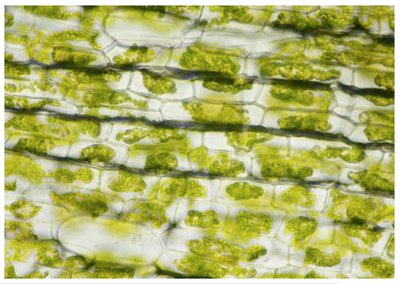
Q5. The cells on the next page were placed in a particular type of solution. Please describe this solution based upon the cells’ appearance.
Background
Topic: Plant Cell Response to Osmosis
This question requires you to analyze the provided image of plant cells and determine the type of solution they were placed in, based on their appearance.
Key Terms and Concepts:
Plasmolysis: Occurs when plant cells lose water in a hypertonic solution, causing the cell membrane to pull away from the cell wall.
Turgid: Plant cells in a hypotonic solution take up water and become swollen and firm.
Flaccid: Plant cells in an isotonic solution are neither swollen nor shrunken.
Step-by-Step Guidance
Carefully observe the image of the plant cells. Look for signs of swelling (turgidity), shrinking (plasmolysis), or normal appearance (flaccid).
Recall the effects of different solutions on plant cells: hypotonic (turgid), hypertonic (plasmolysis), isotonic (flaccid).
Compare the observed cell structure to the expected outcomes for each solution type.
Set up your reasoning for which type of solution the cells were likely placed in, based on their appearance.
Try solving on your own before revealing the answer!
Final Answer:
The cells in the image appear turgid, with the cell membrane pressed tightly against the cell wall and chloroplasts distributed throughout the cytoplasm. This indicates the cells were placed in a hypotonic solution, causing water to enter the cells and making them firm and swollen.
