 Indietro
Diversification of Eukaryotes: Protists and Their Role in Biology
Guida di studio - Note intelligenti
 Appunti personalizzati basati sui tuoi materiali, ampliati con definizioni chiave, esempi e contesto.
Chapter 27: Diversification of Eukaryotes
Introduction to Eukaryotes
Eukaryotes represent the third domain of life, encompassing a vast range of organisms from single-celled protists to multicellular giants like sequoia trees and blue whales. They are distinguished from bacteria and archaea by their size, complexity, and cellular features.
Key Features: Large size, numerous organelles, extensive cytoskeleton, nuclear envelope, multicellularity, and both asexual and sexual reproduction.
Protists: All eukaryotes except land plants, fungi, and animals. They lack defining features and are not a unified group, typically inhabiting aquatic environments.
Why Do Biologists Study Protists?
Protists are studied for their medical, ecological, and evolutionary significance. They are crucial for understanding the evolution of plants, fungi, and animals.
Medical Importance: Some protists cause diseases such as malaria, toxoplasmosis, and sleeping sickness.
Ecological Importance: Protists are abundant in aquatic environments and play key roles in food webs and the global carbon cycle.
Evolutionary Importance: Studying protists helps elucidate the origins and diversification of major eukaryotic lineages.
Impacts on Human Health
Several protists are pathogenic to humans and crops. Malaria, caused by Plasmodium species, is a major global health concern.
Malaria: Transmitted by mosquitoes, involves complex life cycles specialized for infecting host cells.
Other Diseases: Brain-eating amoeba (Naegleria fowleri), toxoplasmosis (Toxoplasma gondii), harmful algal blooms (dinoflagellates), sleeping sickness (Trypanosoma), Chagas disease, and amoebic dysentery (Entamoeba histolytica).
Species | Disease |
|---|---|
Plasmodium spp. | Malaria |
Naegleria fowleri | Meningoencephalitis |
Toxoplasma gondii | Toxoplasmosis |
Dinoflagellates | Algal bloom toxins |
Trypanosoma gambiense/rhodesiense | Sleeping sickness |
Trypanosoma cruzi | Chagas disease |
Entamoeba histolytica | Amoebic dysentery |
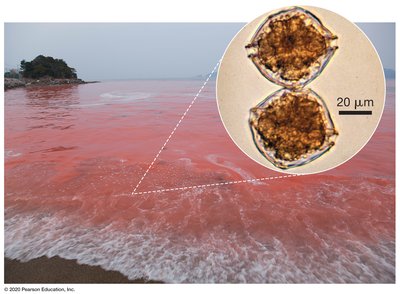
Harmful Algal Blooms
Rapid population growth of toxin-producing protists (dinoflagellates) in aquatic environments can lead to harmful algal blooms, which are dangerous to humans due to toxin accumulation in shellfish.
Protists in Aquatic Food Webs
Photosynthetic protists are primary producers, fixing carbon dioxide into sugars and forming the base of aquatic food webs. Their production accounts for nearly half of Earth's total carbon fixation.
Plankton: Diatoms and other small organisms drifting in oceans and lakes.
Food Webs: Protists are foundational species in aquatic environments.
Protists and the Global Carbon Cycle
Protists play a significant role in the global carbon cycle by acting as carbon sinks. Their shells contribute to sedimentary rocks, and their dead cells accumulate at the ocean bottom, aiding in carbon storage.
Carbon Sinks: Long-lived repositories such as sedimentary rocks and petroleum.
Climate Change: Ocean fertilization with iron can increase protist populations, enhancing carbon sequestration and reducing atmospheric CO2.
Studying Protist Evolution
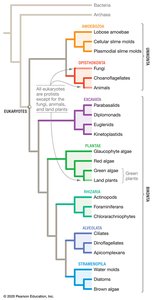
Protists are a paraphyletic group, meaning they do not share a single common ancestor exclusive to them. Eukaryotic lineages diverged over a billion years ago, resulting in significant diversity.
Phylogenetic Analysis: Seven major eukaryotic lineages identified; Opisthokonta and Amoebozoa form Unikonta, while five others form Bikonta.
Paraphyly: Protists lack synapomorphies (shared derived traits).
Morphological Innovations in Protists
Protists exhibit a wide range of morphological diversity. Key innovations include mitochondria, nucleus, cytoskeleton, and multicellularity.
Earliest Eukaryotes: Single-celled, with mitochondria, nucleus, endomembrane system, cytoskeleton, and no cell wall.
Flagella: Novel locomotion structure.
Endosymbiosis and the Origin of Mitochondria
The endosymbiosis theory posits that mitochondria originated when a bacterial cell was engulfed by another cell, forming a symbiotic relationship.
Evidence: Mitochondria are similar in size to α-proteobacteria, replicate by fission, have their own ribosomes and proteins, possess double membranes, and contain circular genomes.
Phylogenetic Data: Mitochondrial genes are closely related to α-proteobacteria.
Endosymbiosis and the Origin of Chloroplasts
Chloroplasts in photosynthetic protists likely originated from the engulfment of cyanobacteria. This process provided the host with oxygen and glucose, while the host offered protection and access to light.
Evidence: Chloroplasts have bacteria-like characteristics, circular DNA, peptidoglycan in cell walls, and extant endosymbiotic cyanobacteria.
Secondary Endosymbiosis: Some protists acquired chloroplasts by engulfing photosynthetic protists, resulting in organelles with more than two membranes.
The Nuclear Envelope
The nuclear envelope likely originated from infoldings of the plasma membrane, which also gave rise to the endoplasmic reticulum. This structure is continuous in eukaryotes.
Evidence: Infoldings are observed in some bacteria; nuclear envelope and ER are continuous.
Multicellularity
Multicellularity evolved independently in various eukaryotic lineages. Mutations caused cells to stick together after division, leading to specialization and diversification.
Specialization: Not all cells express the same genes; cells perform different functions.
How Do Protists Obtain Food?
Protists employ diverse feeding strategies, including ingestive, absorptive, and photosynthetic methods.
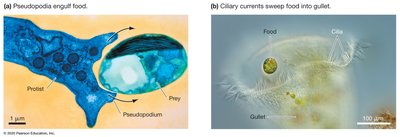
Ingestive Feeding: Involves phagocytosis, where protists without cell walls use pseudopodia to engulf prey. Some use cilia to sweep food into their mouth.
Absorptive Feeding: Nutrients are absorbed directly from the environment. Decomposers feed on detritus, while parasites damage their hosts.
Photosynthesis: Autotrophic protists produce organic compounds using CO2 as a carbon source.
How Do Protists Move?
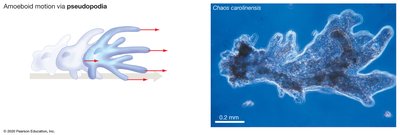
Protists move actively to find food or light, using amoeboid motion, flagella, or cilia.
Amoeboid Motion: Sliding movement via streaming of pseudopodia, requiring ATP.
Flagella and Cilia: Flagella are long and few; cilia are short and numerous. Both structures are used for swimming.
How Do Protists Reproduce?
Protists reproduce both asexually and sexually. Asexual reproduction involves mitosis, producing genetically identical offspring. Sexual reproduction involves meiosis and gamete fusion, resulting in genetic diversity.
Meiosis: Generates variable offspring, which may thrive in changing environments.
Adaptation: Sexual reproduction is viewed as an adaptation to combat rapidly evolving parasites and pathogens.
Summary Table: Human Health Problems Caused by Protists
Species | Disease |
|---|---|
Plasmodium spp. | Malaria |
Naegleria fowleri | Meningoencephalitis |
Toxoplasma gondii | Toxoplasmosis |
Dinoflagellates | Algal bloom toxins |
Trypanosoma gambiense/rhodesiense | Sleeping sickness |
Trypanosoma cruzi | Chagas disease |
Entamoeba histolytica | Amoebic dysentery |
Additional info: Protists are a paraphyletic group, meaning they do not form a single, unified evolutionary lineage. Their study is essential for understanding the origins and diversification of eukaryotes, as well as their ecological and medical impacts.
