 Indietro
DNA and the Gene: Synthesis and Repair – Study Notes
Guida di studio - Note intelligenti
 Appunti personalizzati basati sui tuoi materiali, ampliati con definizioni chiave, esempi e contesto.
Chapter 15: DNA and the Gene – Synthesis and Repair
15.1 What Are Genes Made Of?
Genes are fundamental units of heredity, and their molecular composition was historically debated. Chromosomes are complexes of DNA and proteins, but most biologists initially believed genes were made of proteins due to their complexity and variability. DNA, however, is composed of only four nucleotides, which led to questions about its capacity to encode genetic information.
Structure of DNA
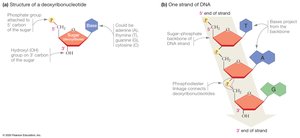
DNA is double-stranded: Each strand consists of deoxyribonucleotides, which are made up of a deoxyribose sugar, a phosphate group, and a nitrogenous base.
Phosphodiester linkage: Covalent bond between the 3’ hydroxyl group of one deoxyribose and the 5’ phosphate group of another.
Backbone: Formed by sugar and phosphate groups, with bases projecting from each sugar.
Directionality: Each strand has a 3’ end (hydroxyl group) and a 5’ end (phosphate group).
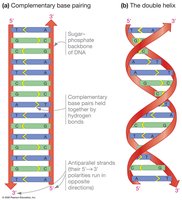
Antiparallel arrangement: Two DNA strands run in opposite directions and twist to form a double helix.
Complementary base pairing: Guanine (G) pairs with cytosine (C), adenine (A) pairs with thymine (T), stabilized by hydrogen bonds and base stacking interactions.
15.2 Testing Early Hypotheses about DNA Synthesis
Watson and Crick proposed that existing DNA strands serve as templates for new strands, with deoxyribonucleotides added according to complementary base pairing. Three hypotheses for DNA replication were considered:
Semiconservative replication: Parental strands separate, each serving as a template for a new strand. Each daughter DNA has one old and one new strand.
Conservative replication: Parental molecule remains intact; one daughter molecule has both old strands, the other has both new strands.
Dispersive replication: Parent molecule is cut into pieces; each daughter molecule contains interspersed old and new DNA.
15.3 A Model for DNA Synthesis
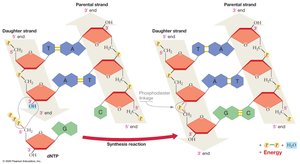
DNA polymerase is the enzyme responsible for catalyzing DNA synthesis. It works only in one direction, adding deoxyribonucleotides to the 3’ end of a growing DNA chain, so synthesis always proceeds in the 5’ → 3’ direction.
DNA polymerization is endergonic: Requires energy input, provided by deoxyribonucleoside triphosphates (dNTPs), which have high potential energy due to their three phosphate groups.
Formation of phosphodiester bonds: The energy released from dNTP hydrolysis makes the reaction exergonic.
Where Does Replication Start?
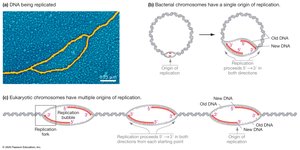
Replication bubble: Forms at the origin of replication, a specific DNA sequence.
Bacteria: One origin, one replication bubble.
Eukaryotes: Multiple origins and replication bubbles per chromosome.
Replication forks: Each bubble has two forks, and synthesis is bidirectional.
How is the Helix Opened and Stabilized?
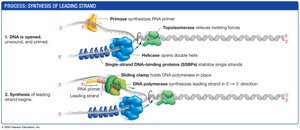
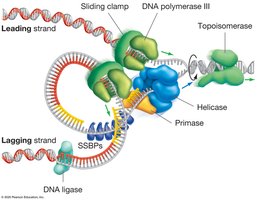
DNA helicase: Breaks hydrogen bonds to separate DNA strands.
Single-strand DNA-binding proteins (SSBPs): Prevent separated strands from rejoining.
Topoisomerase: Relieves tension by cutting and rejoining DNA ahead of the replication fork.
How is the Leading Strand Synthesized?
The antiparallel nature of DNA means that synthesis differs for each strand. DNA polymerase can only extend from the 3’ end of an existing strand, so a primer is required.
Primer: Short RNA strand made by primase (an RNA polymerase), base-paired to the DNA template.
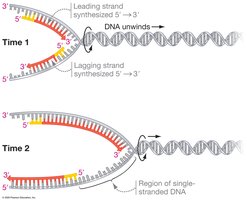
Leading strand: Synthesized continuously toward the replication fork in the 5’ → 3’ direction.
How is the Lagging Strand Synthesized?
The lagging strand is synthesized away from the replication fork in short fragments due to the 5’ → 3’ directionality requirement.
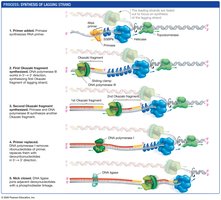
Discontinuous replication hypothesis: Primase synthesizes new RNA primers as the fork opens; DNA polymerase synthesizes short DNA fragments (Okazaki fragments).
Okazaki fragments: Short DNA segments synthesized on the lagging strand, later joined by DNA ligase.
Okazaki Fragments and Lagging-Strand Synthesis
DNA polymerase: Removes RNA primers and replaces them with DNA.
DNA ligase: Catalyzes formation of phosphodiester bonds between adjacent Okazaki fragments, closing the backbone.
Proteins Required for DNA Synthesis in Bacteria
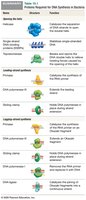
Several proteins are essential for DNA synthesis, each with a specific function.
Protein | Function |
|---|---|
Helicase | Catalyzes separation of DNA strands |
SSBPs | Stabilize single strands |
Topoisomerase | Relieves tension ahead of fork |
Primase | Synthesizes RNA primer |
DNA polymerase III | Extends leading strand |
Sliding clamp | Holds DNA polymerase in place |
DNA polymerase I | Removes RNA primer and replaces with DNA |
DNA ligase | Joins Okazaki fragments |
The Replisome
The replisome is a large macromolecular machine containing all enzymes responsible for DNA synthesis around the replication fork. It is dynamic, and rates of DNA synthesis may vary.
15.4 Replicating the Ends of Linear Chromosomes
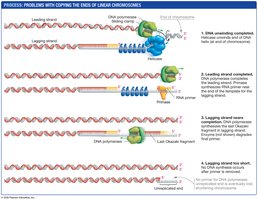
Telomeres are regions at the ends of eukaryotic chromosomes. Replication of telomeres is problematic, especially for the lagging strand, because DNA polymerase cannot add to the end without a primer, leaving single-stranded DNA that is eventually degraded.
Telomeres: Consist of short, repeating stretches of bases; do not contain genes.
End replication problem: Chromosomes would shorten with each replication cycle.
Telomerase Solves the End Replication Problem
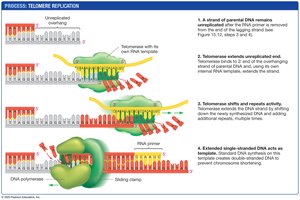
Telomerase: Enzyme that replicates telomeres using an RNA template it carries.
Extends the 3’ overhang, allowing normal DNA synthesis to complete the chromosome end.
Effect of Telomere Length on Cell Division
Telomerase is primarily found in gametes and stem cells; somatic cells lack telomerase and their chromosomes shorten with age.
Telomere length limits the number of cell divisions; most cancer cells have active telomerase, allowing unlimited division.
15.5 Repairing Mistakes and DNA Damage
DNA polymerase works quickly but must be accurate. The error rate during replication is very low, but mistakes can contribute to cancer development. Accurate DNA replication is essential for life.
Correcting Mistakes in DNA Synthesis
DNA polymerase matches bases with high accuracy due to energetically favorable pairing and distinct shapes.
Repair enzymes remove defective bases and replace them with correct ones.
DNA Polymerase Proofreading
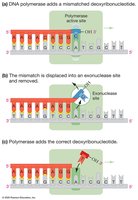
DNA polymerase can proofread its work; mismatched bases are removed by the exonuclease active site.
Mismatch Repair
Mismatch repair enzymes recognize and remove mismatched pairs after DNA synthesis is complete, then fill in correct bases.
Repairing Damaged DNA
DNA can be damaged by sunlight, X-rays, and chemicals.
UV light and chemicals can cause thymine dimers, which block replication.
Nucleotide excision repair system recognizes damage, removes the damaged strand, and uses the intact strand as a template for repair.
DNA ligase links the repaired strand to the original DNA.
Additional info: The chapter covers the molecular basis of genetic information, mechanisms of DNA replication, the role of enzymes and proteins in DNA synthesis, the challenges of replicating linear chromosomes, and the importance of DNA repair systems in maintaining genetic integrity.
