 Indietro
BIO 102 Week 5 Part 2
Guida di studio - Note intelligenti
 Appunti personalizzati basati sui tuoi materiali, ampliati con definizioni chiave, esempi e contesto.
POT1 and Telomere Protection
Telomeres are specialized structures at the ends of linear chromosomes that protect genetic material from degradation and inappropriate repair. The protein POT1 (Protection of Telomeres 1) is a critical component of the shelterin complex, which safeguards telomere integrity and regulates telomerase activity.
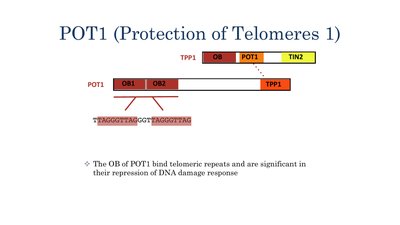
POT1 Structure: POT1 contains two oligosaccharide/oligonucleotide binding (OB) domains (OB1 and OB2) that specifically bind to the single-stranded telomeric DNA overhang.
Protein Interactions: POT1 interacts with TPP1 via a dedicated binding domain, and TPP1 in turn connects to TIN2, integrating POT1 into the shelterin complex.
Function: The OB folds of POT1 bind telomeric repeats and are significant in repressing the DNA damage response at chromosome ends.
Example: Loss of POT1 binding leads to telomere dysfunction and activation of DNA damage pathways.
POT1 and Telomere Length Regulation
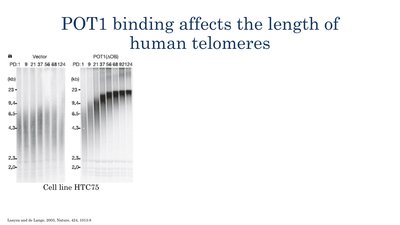
POT1 not only protects telomeres but also regulates their length by modulating telomerase activity. Experimental evidence demonstrates that the absence of POT1's OB folds results in abnormal telomere elongation.
Experimental Design: In telomerase-positive HTC75 cells, removal of POT1 OB folds (POT1ΔOB) prevents POT1 from binding the telomeric overhang.
Results: Control cells maintain stable telomere length across population doublings, while POT1ΔOB cells show progressive telomere elongation.
Conclusion: POT1 acts as a negative regulator of telomerase, maintaining telomere length homeostasis.
POT1 and Telomere Protection from DNA Damage Response
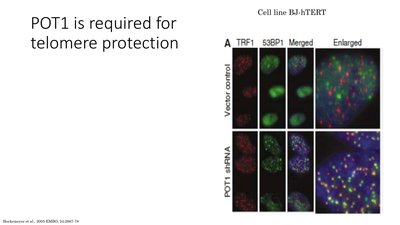
POT1 is essential for distinguishing telomeres from sites of DNA damage, preventing inappropriate activation of DNA repair pathways at chromosome ends.
Experimental Evidence: In BJ/HTERT cells, depletion of POT1 using shRNA leads to co-localization of DNA damage marker 53BP1 with telomeric protein TRF1, indicating activation of DNA damage response at telomeres.
Normal Cells: 53BP1 foci do not overlap with telomeres, showing that DNA damage response is not normally triggered at chromosome ends.
POT1-Depleted Cells: Increased overlap of 53BP1 and TRF1 signals demonstrates that loss of POT1 results in telomeres being recognized as DNA breaks.
Telomere Shortening, Senescence, and Cancer
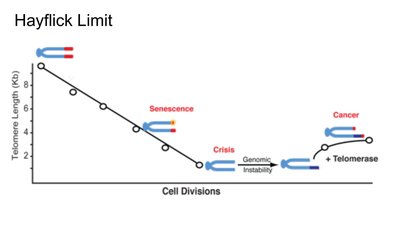
Telomere length decreases with each cell division, eventually triggering cellular senescence or crisis. If telomerase is reactivated in cells with unstable genomes, this can lead to uncontrolled proliferation and cancer.
Senescence: A programmed halt in cell division when telomeres reach a critical short length, serving as a tumor suppressor mechanism.
Crisis: Further telomere shortening leads to genomic instability and potential cell death.
Cancer Progression: If telomerase is reactivated in cells with unstable genomes, cells can bypass crisis and become immortalized, contributing to tumorigenesis.
DNA Repair Mechanisms
Importance of DNA Repair
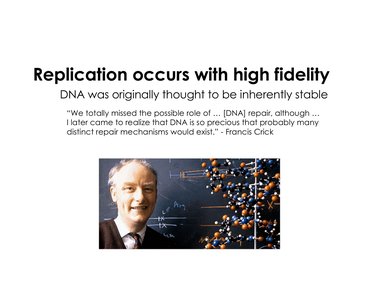
DNA repair is essential for maintaining genome integrity and preventing the accumulation of mutations that can lead to disease. Despite the high fidelity of DNA replication, repair mechanisms are necessary to correct errors and damage that occur spontaneously or due to environmental factors.
High Fidelity Replication: DNA polymerases have proofreading activity, but some errors escape correction.
Role of Repair: Multiple distinct repair pathways exist to address different types of DNA damage.
Sources of Mutations
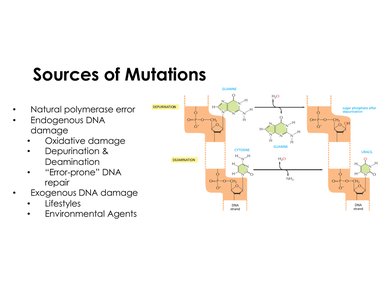
Mutations can arise from endogenous (internal) or exogenous (external) sources, necessitating robust DNA repair systems.
Spontaneous Mutations: Errors by DNA polymerase, oxidative damage from metabolic byproducts, depurination (loss of purine bases), and deamination (conversion of cytosine to uracil).
Inducible Mutations: Caused by environmental agents such as UV light, chemicals, and carcinogens.
Example: Depurination and deamination are common spontaneous mutations that can lead to incorrect base pairing.
Impact of Faulty DNA Repair: Germline vs. Somatic Mutations
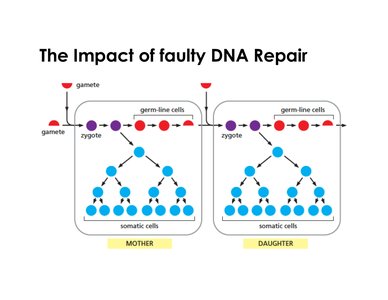
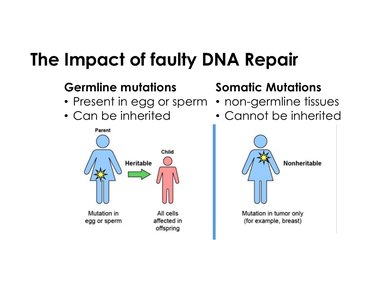
The consequences of mutations depend on whether they occur in germline or somatic cells. Germline mutations can be inherited, while somatic mutations affect only the individual.
Germline Mutations: Occur in egg or sperm cells (or their precursors) and can be passed to offspring, affecting all cells in the next generation.
Somatic Mutations: Occur in non-germline cells and are not inherited, but can lead to diseases such as cancer within the individual.
Example: Hereditary breast cancer can result from germline mutations, while sporadic tumors often arise from somatic mutations.
Overview of DNA Repair Pathways
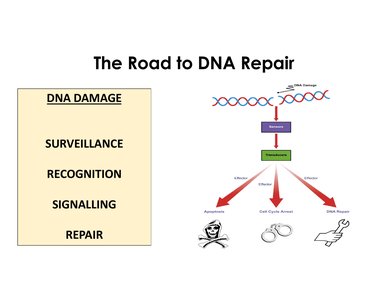
DNA repair involves surveillance, recognition, signaling, and repair. If repair is not possible, cells may undergo apoptosis or cell cycle arrest to prevent propagation of damaged DNA.
Surveillance: Monitoring DNA integrity.
Recognition: Identifying DNA lesions.
Signaling: Activating repair pathways.
Repair: Restoring DNA structure and sequence.
Alternative Outcomes: Apoptosis or cell cycle arrest if repair is not feasible.
Base Excision Repair (BER)
Base excision repair corrects single damaged bases, such as those resulting from deamination or depurination. The process involves several enzymes that remove the damaged base and restore the correct sequence.
Steps:
Recognition and removal of the damaged base by a DNA glycosylase.
Removal of the sugar-phosphate backbone by an AP endonuclease and phosphodiesterase.
Filling the gap with the correct nucleotide by DNA polymerase.
Sealing the nick with DNA ligase.
Example: Removal of uracil from DNA after cytosine deamination.
Nucleotide Excision Repair (NER)
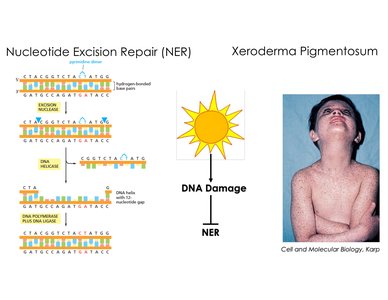
Nucleotide excision repair removes bulky DNA lesions, such as pyrimidine dimers caused by UV light. This pathway excises a short single-stranded DNA segment containing the lesion and fills the gap using the undamaged strand as a template.
Steps:
Recognition of the bulky lesion.
Dual incision on both sides of the lesion by excision nucleases.
Removal of the oligonucleotide fragment by DNA helicase.
Gap filling by DNA polymerase and ligation by DNA ligase.
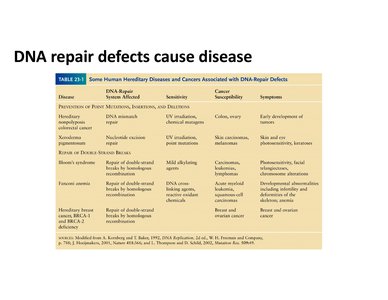
Disease Connection: Defects in NER cause xeroderma pigmentosum (XP), a disorder characterized by extreme sensitivity to UV light and increased skin cancer risk.
Double-Strand Break Repair: NHEJ and HR
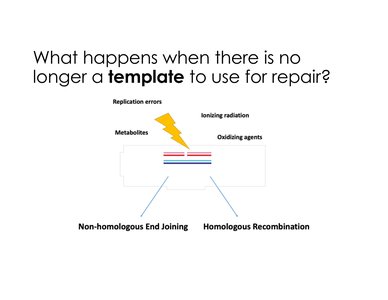
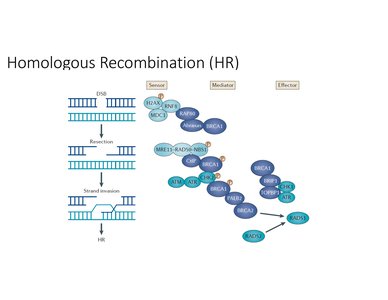
Double-strand breaks (DSBs) are severe forms of DNA damage. Two major pathways repair DSBs: non-homologous end joining (NHEJ) and homologous recombination (HR).
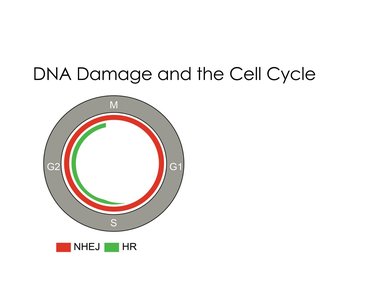
NHEJ: Joins broken DNA ends directly, often resulting in loss of nucleotides (error-prone). Available throughout the cell cycle.
HR: Uses a homologous chromosome as a template for accurate repair. Requires extensive processing and is available during S and G2 phases when a sister chromatid is present.
Mechanisms of NHEJ and HR
Non-Homologous End Joining (NHEJ): Involves binding of KU70/80 protein complex to DNA ends, minimal processing, and ligation. This pathway is error-prone and can introduce mutations (scars) at the repair site.
Advantage: Rapid repair of DSBs when no template is available.
Disadvantage: Can lead to small insertions or deletions at the repair site.
Homologous Recombination (HR): Involves extensive resection of DNA ends, strand invasion into a homologous chromosome, DNA synthesis using the homologous template, and resolution of joint molecules. This pathway is highly accurate.
Advantage: Error-free repair using homologous sequence as a template.
Disadvantage: Limited to S and G2 phases when a homologous template is available.
DNA Repair Defects and Disease
Deficiencies in DNA repair pathways can lead to increased sensitivity to DNA-damaging agents and a higher risk of cancer and other diseases. For example, mutations in BRCA1/2 increase susceptibility to breast and ovarian cancers, while defects in NER cause xeroderma pigmentosum.
Take-Home Message: Effective DNA repair is essential for genome integrity and cancer prevention. Defects in repair pathways increase mutation rates and disease susceptibility.
Additional info: Understanding the molecular mechanisms of DNA repair is fundamental for appreciating how cells maintain genetic stability and how failures in these systems contribute to human disease, including cancer.
