 Indietro
DNA Replication and Structure: Study Notes for General Biology
Guida di studio - Note intelligenti
 Appunti personalizzati basati sui tuoi materiali, ampliati con definizioni chiave, esempi e contesto.
DNA Replication and the Central Dogma
The Central Dogma of Molecular Biology
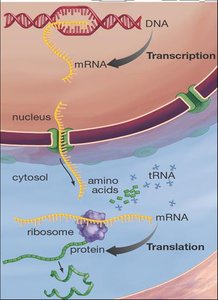
The central dogma describes the flow of genetic information within a biological system. It explains how DNA is transcribed into RNA and then translated into protein, forming the basis of cellular function and inheritance.
Transcription: The process by which DNA is used as a template to synthesize messenger RNA (mRNA).
Translation: The process by which mRNA is decoded by ribosomes to produce a specific protein.
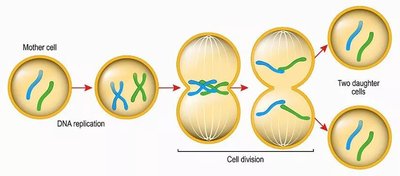
Replication: The process by which DNA makes an identical copy of itself before cell division.
Language Change: Information is rewritten from nucleic acid (DNA/RNA) to amino acids (proteins).
Properties of Life Related to DNA
Self-replication: DNA can replicate itself, ensuring genetic continuity.
Instruction Storage and Execution: DNA stores instructions for cellular processes, which are executed via transcription and translation.
Evolution: DNA undergoes mutations, providing variation and enabling evolution.
DNA Replication and Cell Division
Overview of DNA Replication
DNA replication is essential for cell division, ensuring that each daughter cell receives an identical copy of genetic material. Replication occurs before cell division and involves the separation of DNA strands and synthesis of new complementary strands.
Identical Copies: Replicated DNA strands are held together and then separated during cell division.
Result: Two identical cells, each with a complete set of chromosomes.
DNA Structure
Double Helix and Nucleotide Composition
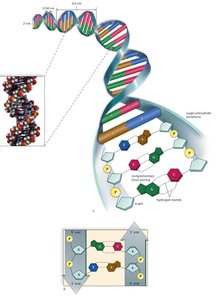
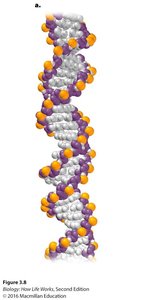
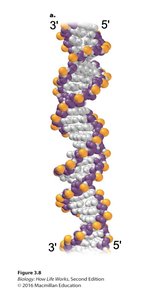
DNA is composed of two antiparallel strands forming a double helix. Each strand is a polymer of nucleotides, which consist of a sugar, phosphate group, and nitrogenous base.
Backbone: The sugar-phosphate backbone provides structural stability.
Base Pairs: Nitrogenous bases form the rungs of the ladder, held together by hydrogen bonds.
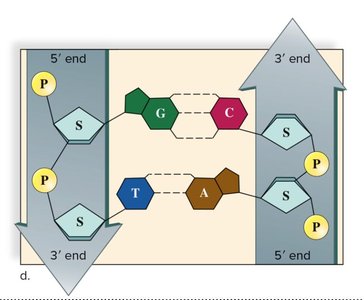
Antiparallel Strands: The two strands run in opposite directions (5' to 3' and 3' to 5').
Nucleotide Structure
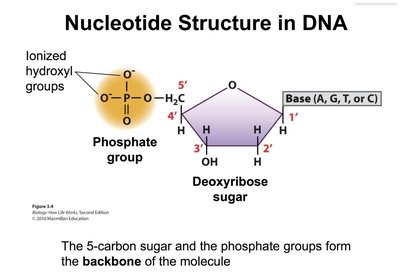
Nucleotides are the building blocks of DNA. Each nucleotide contains a deoxyribose sugar, a phosphate group, and a nitrogenous base (A, T, G, or C).
Phosphate Group: Attached to the 5' carbon of the sugar.
Deoxyribose Sugar: A five-carbon sugar with a hydrogen at the 2' position (distinguishing DNA from RNA).
Nitrogenous Base: Attached to the 1' carbon; can be adenine (A), thymine (T), guanine (G), or cytosine (C).
Types of Nitrogenous Bases
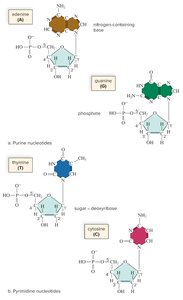
Nitrogenous bases are classified as purines (adenine and guanine) or pyrimidines (thymine and cytosine).
Purines: Double-ring structures (A, G).
Pyrimidines: Single-ring structures (T, C).
Antiparallel and Complementary Strands
DNA strands are antiparallel and complementary, meaning each base pairs with its specific partner (A with T, G with C) via hydrogen bonds.
Antiparallel: One strand runs 5' to 3', the other 3' to 5'.
Complementary Base Pairing: Ensures accurate replication and transcription.
DNA Polymerization and Replication Mechanism
Dehydration Synthesis and Phosphodiester Bonds
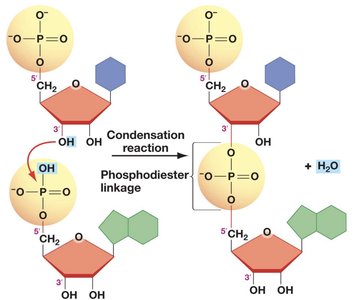
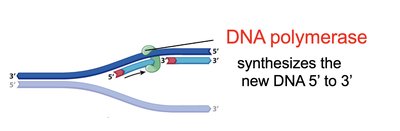
DNA polymerization occurs via dehydration synthesis, forming phosphodiester bonds between nucleotides. The enzyme DNA polymerase catalyzes this reaction, adding nucleotides to the 3' end of the growing strand.
Directionality: DNA is synthesized in the 5' to 3' direction.
Phosphodiester Bond: Links the 3' hydroxyl group of one nucleotide to the 5' phosphate of the next.
DNA Polymerase and Replication Fork
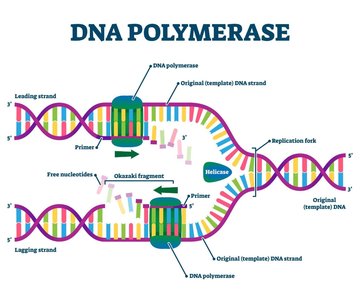
DNA polymerase uses the original parent strand as a template. Replication begins at origins, where initiator proteins and helicase unwind the DNA, forming replication forks and bubbles.
Replication Fork: The site where DNA is actively unwound and replicated.
Replication Bubble: Region where two replication forks move in opposite directions.
Helicase: Unwinds DNA by breaking hydrogen bonds.
RNA Primase and DNA Synthesis
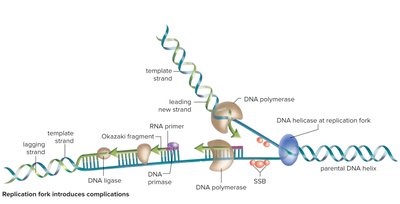
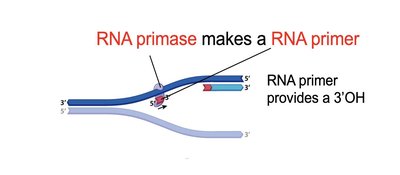
RNA primase synthesizes short RNA primers, providing a 3' OH group for DNA polymerase to begin synthesis. DNA polymerase then extends the new DNA strand.
RNA Primer: Essential for initiation of DNA synthesis.
DNA Polymerase: Adds nucleotides to the 3' end, synthesizing DNA in the 5' to 3' direction.
Proofreading and DNA Repair
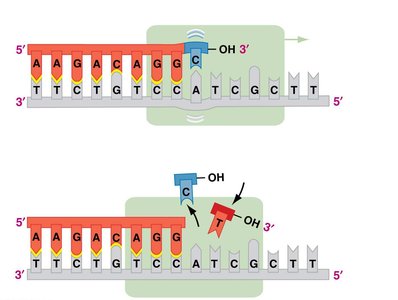
DNA polymerase has proofreading ability, detecting and correcting mismatched nucleotides. If errors are not corrected, they result in mutations.
Proofreading: Ensures high fidelity of DNA replication.
Mutation: Permanent change in nucleotide sequence if errors persist.
DNA Ligase and Completion of Replication
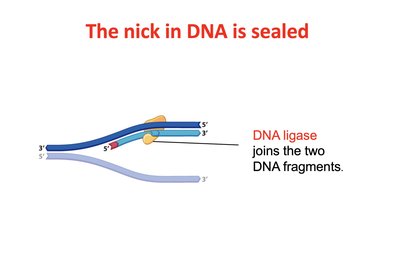
DNA ligase seals nicks in the DNA backbone, joining Okazaki fragments on the lagging strand and completing the replication process.
DNA Ligase: Forms the final phosphodiester bond, ensuring continuity of the DNA strand.
Semiconservative Replication
Mechanism and Significance
DNA replication is semiconservative, meaning each new DNA molecule consists of one parental strand and one newly synthesized strand. This ensures genetic continuity and accurate transmission of information.
Parent Strands: Serve as templates for new synthesis.
Result: Each daughter cell receives one old and one new strand.
Replication in Prokaryotes and Eukaryotes
Replication Bubble and Multiple Origins
Replication in prokaryotes typically occurs from a single origin, while eukaryotes have multiple origins per chromosome, allowing rapid replication of large genomes.
Replication Bubble: Two forks moving in opposite directions.
Multiple Origins: Enable efficient replication in eukaryotes.
Summary Table: Key Enzymes in DNA Replication
Enzyme | Function |
|---|---|
Helicase | Unwinds DNA strands |
RNA Primase | Synthesizes RNA primers |
DNA Polymerase | Adds nucleotides, proofreads |
DNA Ligase | Seals nicks, joins fragments |
Additional info:
Replication is highly regulated and involves multiple checkpoints to ensure accuracy.
Mutations can be beneficial, neutral, or harmful, contributing to genetic diversity and evolution.
