 Indietro
DNA Replication: Mechanisms, Enzymes, and Biological Significance
Guida di studio - Note intelligenti
 Appunti personalizzati basati sui tuoi materiali, ampliati con definizioni chiave, esempi e contesto.
DNA Replication: Mechanisms and Enzymes
Overview of DNA Replication
DNA replication is a fundamental process in all living organisms, ensuring the accurate transmission of genetic information from one generation to the next. The process is semi-conservative, meaning each new DNA molecule consists of one parental (old) strand and one newly synthesized strand.
Semi-conservative replication: Each parent strand serves as a template for a new strand, resulting in two DNA molecules, each with one old and one new strand.
Importance: Understanding DNA replication is crucial for biotechnology, medicine, and basic science, with applications in antibiotics, antivirals, cancer therapeutics, and more.
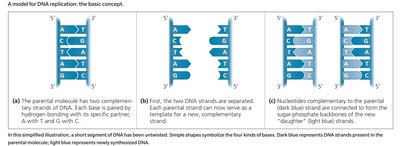
Steps of DNA Replication
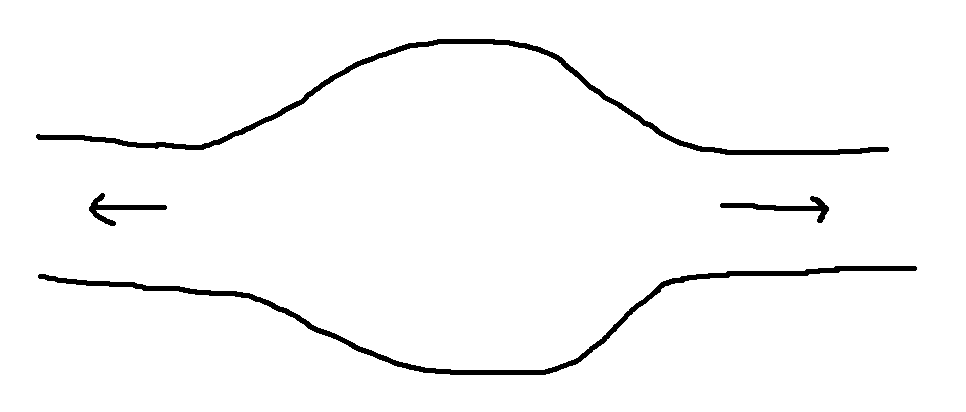
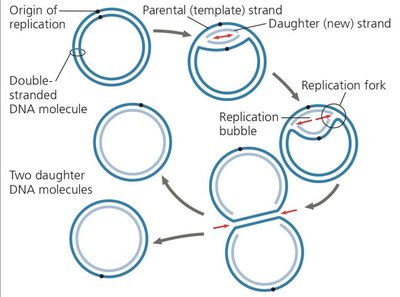
Initiation: The double helix is unwound at specific origins of replication, forming a replication bubble with two replication forks.
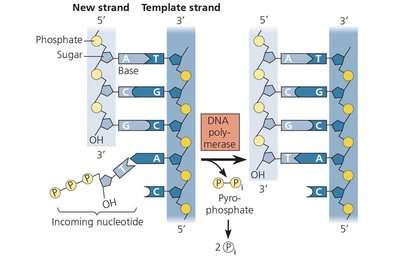
Elongation: New nucleotides are added to the growing DNA strand by DNA polymerase, always in the 5' to 3' direction.
Termination: Replication ends when the entire DNA molecule has been copied.
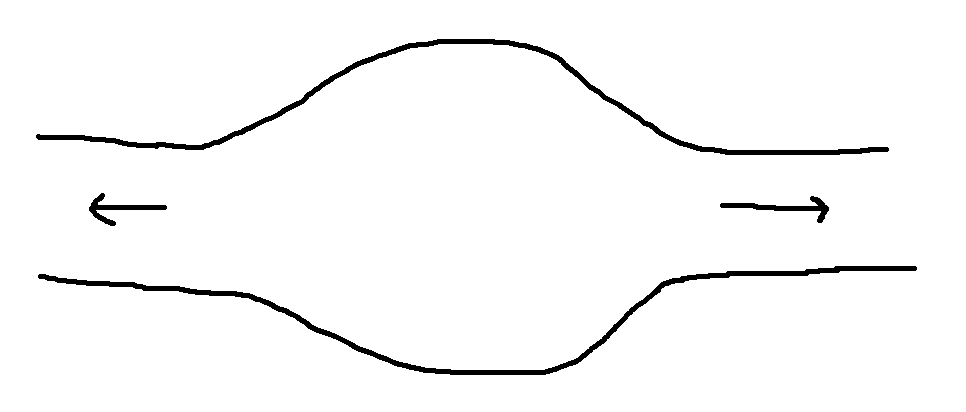
Directionality and Polymerase Activity
DNA polymerase can only add nucleotides to the 3' OH end of a growing DNA strand, not the 5' end. This directionality is essential for the synthesis of both leading and lagging strands.
Leading and Lagging Strands
Due to the antiparallel nature of DNA, replication occurs differently on each template strand:
Leading strand: Synthesized continuously in the direction of the replication fork.
Lagging strand: Synthesized discontinuously, forming short segments called Okazaki fragments, which are later joined by DNA ligase.
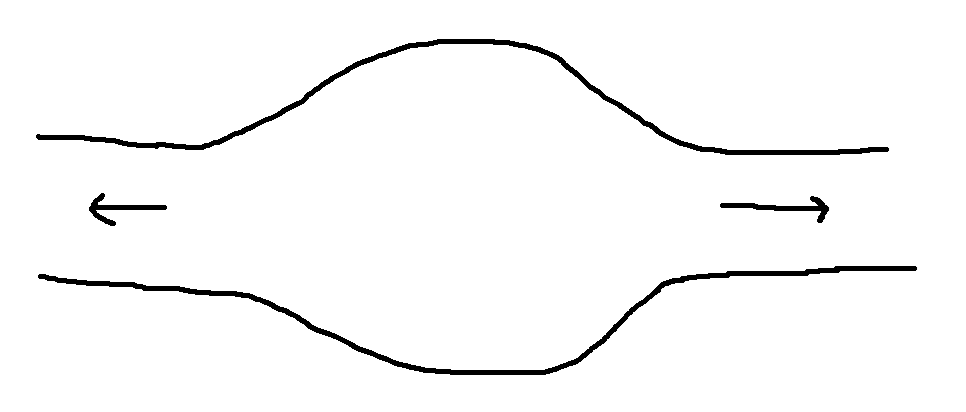
Key Enzymes and Proteins in DNA Replication
Helicase: Unwinds the DNA double helix by breaking hydrogen bonds between bases.
Single-stranded binding proteins (SSBPs): Stabilize unwound DNA strands and prevent them from re-annealing.
Topoisomerase: Relieves tension ahead of the replication fork by breaking and rejoining DNA strands.
Primase: Synthesizes short RNA primers to provide a starting point for DNA polymerase.
DNA polymerase: Adds nucleotides to the 3' end of the new DNA strand.
DNA ligase: Joins Okazaki fragments on the lagging strand.
Okazaki Fragments and Lagging Strand Synthesis
On the lagging strand, DNA is synthesized in short fragments (Okazaki fragments) due to the 5' to 3' activity of DNA polymerase. RNA primers are required for each fragment, and DNA ligase later joins these fragments into a continuous strand.
DNA polymerase I: Removes RNA primers and fills in the gaps with DNA.
DNA ligase: Seals the nicks between Okazaki fragments.
Comparing DNA Replication in Bacteria and Eukaryotes
Bacterial DNA Replication
Chromosome structure: Circular DNA molecule.
Origin of replication: Single origin, often rich in A-T base pairs (easier to separate due to fewer hydrogen bonds).
Replication: Proceeds bidirectionally from the origin, forming a single replication bubble.
Eukaryotic DNA Replication
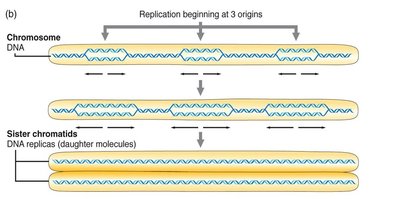
Chromosome structure: Linear chromosomes.
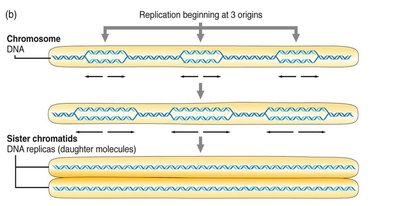
Origins of replication: Multiple origins per chromosome, allowing for faster replication of large genomes.
Replication: Multiple replication bubbles form and eventually merge.
Replisome Structure and Evolution
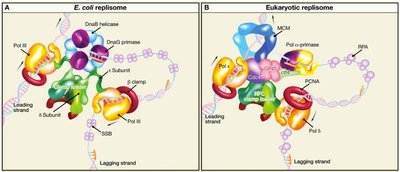
The replisome is a complex of proteins responsible for DNA replication. Fundamental components are conserved across bacteria and eukaryotes, reflecting common ancestry.
Telomeres and the End Replication Problem
Structure and Function of Telomeres
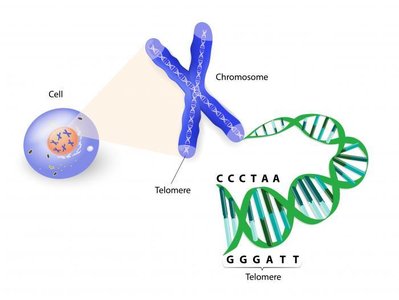
Telomeres are repetitive DNA sequences at the ends of linear chromosomes that protect genetic material from degradation during replication. In humans, the repeat sequence is TTAGGG.
The End Replication Problem
During replication of linear chromosomes, the lagging strand cannot be fully replicated at the ends, leading to progressive shortening of chromosomes with each cell division. This is known as the "end replication problem." Both leading and lagging strands are affected, but the lagging strand is more susceptible due to the removal of the final RNA primer.
Consequence: Chromosome shortening limits the number of times a cell can divide (the Hayflick limit).
Senescence: Cells eventually stop dividing but do not die, a process called senescence.
Role of Telomerase
Telomerase is an enzyme that extends telomeres by adding repetitive sequences, using an RNA template within the enzyme. This activity is crucial in stem cells, germ cells, and cancer cells, allowing them to divide indefinitely.
Mechanism: Telomerase binds to the 3' end of the telomere and extends it, allowing DNA polymerase to complete replication of the lagging strand.
Clinical significance: Abnormal telomerase activity is linked to aging and cancer.
Visualizing Telomeres
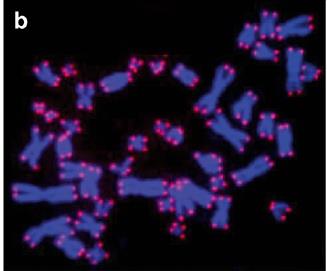
Fluorescent in situ hybridization (FISH) is a technique used to visualize telomeres in cells. Fluorescent probes complementary to the telomere sequence bind to chromosome ends, allowing visualization under a microscope.
Summary Table: Key Differences in DNA Replication
Feature | Bacteria | Eukaryotes |
|---|---|---|
Chromosome Structure | Circular | Linear |
Origins of Replication | Single | Multiple |
Replication Bubbles | One | Many |
End Replication Problem | No | Yes (solved by telomerase) |
Key Terms and Concepts
Okazaki fragments: Short DNA fragments synthesized on the lagging strand.
Primase: Enzyme that synthesizes RNA primers.
DNA ligase: Enzyme that joins DNA fragments together.
Telomere: Repetitive DNA sequence at the end of linear chromosomes.
Telomerase: Enzyme that extends telomeres.
Senescence: State in which cells stop dividing.
Equations and Formulas
DNA Synthesis Direction:
Telomere Repeat Sequence (Human):
Example Application
Antibiotic Targeting: Ciprofloxacin inhibits bacterial topoisomerase, preventing DNA replication in bacteria but not in humans due to structural differences in the enzyme.
Clinical Relevance: Telomere shortening is associated with aging and telomere biology disorders, while cancer cells evade senescence by activating telomerase.
